

April 13, 2026 – In the space of a single week, Donald Trump has ordered a naval blockade of Iran, threatened to wipe out the country’s power plants and bridges, deployed a secret CIA heartbeat-detecting technology to rescue a downed pilot, launched an unprecedented public attack on the Pope, asked Congress for $152 million to reopen Alcatraz prison, and joked about running for president of Venezuela. If there is a through-line to the 47th president’s third year in office, it is this: the volume has never been louder, and the news cycle has never stopped spinning.
Here is the state of Donald Trump today.
Part 1: The Iranian Blockade – Squeezing the Strait
On Monday, April 13, the United States military officially began a naval blockade of all maritime traffic entering and exiting Iranian ports . The operation, announced by Trump on Sunday and enforced by US Central Command (CENTCOM), blocks vessels of all nations from Iranian ports in the Gulf and the Gulf of Oman .
Trump’s stated goals are twofold: to force Iran back to the negotiating table by denying it commercial revenue, and to reduce energy prices for American consumers . “We can’t let a country blackmail or extort the world, because that’s what they’re doing,” Trump told reporters outside the Oval Office .
The blockade is the latest escalation in a conflict that has seen US B-2 bombers strike Iranian nuclear facilities and the Strait of Hormuz—through which one-fifth of the world’s oil passes—effectively closed for weeks. CENTCOM has promised not to impede vessels transiting to non-Iranian ports, but the message to Tehran is unambiguous: no ships in, no ships out .
Part 2: “Nuclear Dust” – Trump’s Enigmatic Demand
Alongside the blockade, Trump has introduced a new and puzzling term into the diplomatic lexicon: “nuclear dust.” On Monday, he told reporters that the US will secure Iran’s nuclear “dust,” either by force or via negotiation .
“Iran will not have a nuclear weapon, and we’re going to get the dust back. We’ll get it back, either we’ll get it back from them, or we’ll take it,” he said . What exactly “dust” means remains unclear—possibly all of Iran’s enriched uranium stockpile, possibly something else entirely.
On his Truth Social platform last week, Trump wrote: “The United States will, working with Iran, dig up and remove all of the deeply buried (B-2 Bombers) Nuclear ‘Dust’” . The phrase is vintage Trump: vague, menacing, and impossible for adversaries to fully parse.
Part 3: The Tuesday Deadline – “Power Plant Day”
The blockade is not the only hammer Trump is wielding. On April 6, he set a Tuesday deadline for Iran to make a deal, warning that failure would trigger strikes on the country’s power plants and bridges .
“Tuesday will be Power Plant Day, and Bridge Day, all wrapped up in one, in Iran. There will be nothing like it!!! Open the Fuckin’ Strait, you crazy bastards, or you’ll be living in Hell — JUST WATCH! Praise be to Allah,” Trump wrote on Truth Social .
Speaking to reporters later, he doubled down: “They’ll have no bridges, they’ll have no power plants, they’ll have no anything. I won’t go further because there are other things that are worse than those two” . The deadline came and went with no strikes—at least none reported—suggesting either a last-minute diplomatic reprieve or a strategic bluff.
Part 4: Ghost Murmur – The CIA’s Secret Heartbeat Technology
One of the week’s most remarkable stories was not about bombs or blockades, but about a secret technology that the CIA reportedly used for the first time to locate a downed US pilot in Iran.
The pilot, codenamed “44 Bravo,” was the weapons systems officer of an F-15E shot down over mountainous Iranian terrain. For two days, he hid while Iranian forces searched for him . According to reports, the CIA deployed a classified system called Ghost Murmur—developed by Lockheed Martin’s Skunk Works division—that uses long-range quantum magnetometry to detect the electromagnetic signal of a human heartbeat. Artificial intelligence algorithms then isolate the biological signal from ambient noise .
Trump told reporters that the technology detected the airman from approximately 64 kilometers away. “It was like finding a needle in a haystack,” he said . CIA Director John Ratcliffe called it “exquisite technology that no other intelligence service in the world possesses” .
However, the story has drawn sharp skepticism from physicists and engineers. Quantum magnetometers can detect cardiac signals, but typically only at very close range in shielded laboratory conditions . Scientific American concluded that the current public description of Ghost Murmur is “almost certainly not true,” arguing that detecting a single heartbeat at long range appears physically implausible with known technology . Skeptics suggest the story may be a mix of genuine but limited research, political theater, and deliberate disinformation aimed at confusing adversaries .
Part 5: The Pope Fight – Trump vs. Leo XIV
In a highly unusual break with diplomatic and religious norms, Trump launched a public attack on Pope Leo XIV over the weekend. The pontiff had warned that a “delusion of omnipotence” was fueling the Iran conflict and suggested that God “does not listen to the prayers of those who wage war” .
Trump responded on Truth Social, calling the Pope “a very liberal person,” “WEAK on Crime,” and “terrible for Foreign Policy” . He added: “I don’t want a Pope who thinks it’s OK for Iran to have a Nuclear Weapon” .
Speaking to reporters, Trump escalated further: “I don’t think he’s doing a very good job. He likes crime I guess” . The exchange underscores growing tensions between the Vatican and the Trump administration over the conduct of the Iran war—and Trump’s willingness to break nearly any taboo in pursuit of his message.
Part 6: The Alcatraz Plan – $152 Million for “The Rock”
On the domestic front, Trump’s proposed budget for fiscal year 2027 includes a line item that has stunned historians, tourism officials, and California politicians: $152 million to reopen Alcatraz prison .
The infamous island prison, closed since 1963, currently operates as a tourist attraction run by the National Park Service, generating approximately $60 million in annual revenue . Trump’s plan would “rebuild Alcatraz as a state-of-the-art secure prison facility” to house “America’s most ruthless and violent offenders” .
Former House Speaker Nancy Pelosi called the proposal “absurd on its face and should be rejected outright,” adding that it is “a stupid notion that would be nothing more than a waste of taxpayer dollars and an insult to the intelligence of the American people” .
Critics point out that Alcatraz has no running water or sewage system, that all supplies must be brought in by boat, and that when it closed, it was three times more expensive to operate than any other federal prison . For Trump, however, “The Rock” represents a powerful symbol of law and order—even if the economics make little sense.
Part 7: Venezuela – Statues, Presidency, and Liberation
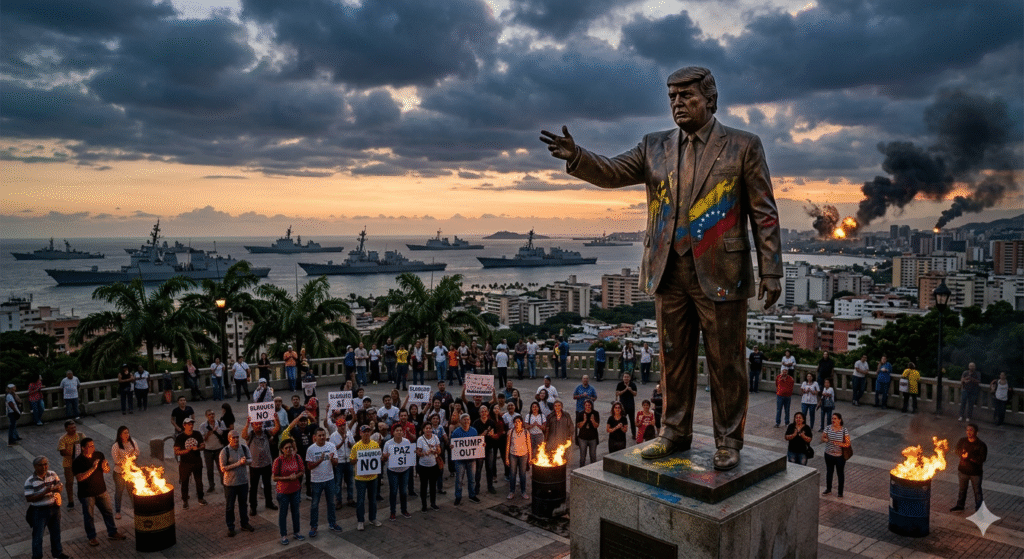
Perhaps the most surreal moments of the week came when Trump turned his attention to Venezuela. During a Cabinet meeting, Interior Secretary Doug Burgum suggested that Venezuelans might erect a statue of Trump for “liberating” the country after the US operation that ousted Nicolás Maduro .
“Forget that, when are they gonna do the statue?” Trump interrupted, drawing laughter from the room. “To hell with ya” .
The president also revived his joke about running for president of Venezuela. “After the presidency, I may go to Venezuela and run against Delcy. It’s an option. They like me in Venezuela” . He had made a similar comment the previous week, adding: “I will quickly learn Spanish. It won’t take too long” .
Internet users were unimpressed, with one calling Trump a narcissist and another accusing him of wanting to be like Kim Jong-un .
Part 8: The Polling Problem – 62% Disapproval
Amid the blockades and the banter, a potentially more consequential number emerged: Trump’s approval rating has taken a significant hit. A national NBC News poll found that 62% of voters disapprove of Trump’s handling of inflation and the cost of living, compared to just 36% who approve .
The same poll ranked inflation/cost of living and threats to democracy as the top issues facing the country, with 26% of voters ranking them as their top concerns . Democratic pollster Jeff Horwitt noted that the data points to “an American electorate that is once again fed up with those in power and looking for change wherever they can find it” .
Whether the Iran conflict and the associated spike in gas prices will further erode Trump’s support remains an open question. But the polling suggests that even as Trump dominates the news cycle, voters are watching their wallets.
Part 9: The Negotiation Stance – “Only Alive to Negotiate”
On the eve of formal talks in Islamabad, Trump issued a characteristically blunt warning to Iran. “The Iranians don’t seem to realize they have no cards, other than a short term extortion of the World by using International Waterways. The only reason they are alive today is to negotiate!” he wrote on Truth Social .
Vice President JD Vance, who has long been skeptical of foreign military interventions, was dispatched to lead the negotiations. Before departing, Vance warned Iran not to “try and play us,” adding that if they did, “they’re gonna find that the negotiating team is not that receptive” .
Part 10: The Vance Dynamic – A Reluctant Negotiator
Trump’s decision to send Vance—a vocal opponent of the Iraq War and a skeptic of open-ended military commitments—to lead the Islamabad talks is notable. Vance has seemed, according to reports, “the most reluctant defender of the 6-week-old conflict” .
His presence signals that Trump may be genuinely seeking an off-ramp, even as he maintains maximum pressure. But it also raises questions: if Trump’s own vice president has doubts about the war, how unified is the administration’s approach?
Part 11: The “Discombobulator” – Another Mystery Weapon
Ghost Murmur is not the only secret technology Trump has boasted about. He has also spoken of a mysterious “discombobulator” weapon, telling the New York Post he was “not allowed to talk about it” while claiming it made enemy radar and other equipment “not work” during the US raid that captured Maduro .
Officials speculate he may be referring to some form of directed-energy or electronic-warfare system, but there is no public confirmation and little technical detail . Like Ghost Murmur, the “discombobulator” may be real, exaggerated, or entirely invented—but in Trump’s telling, it is another example of American technological supremacy.
Part 12: The Week Ahead – What Comes Next?
As this article goes to press, the naval blockade of Iran is in effect, negotiations in Islamabad are underway, and Trump’s Tuesday deadline for a deal has passed without public resolution. The president has warned that if a deal “isn’t good, we’ll go right back” to military action “very easily” .
On the domestic front, his budget proposal—including the Alcatraz funding—faces an uncertain path through Congress. His approval ratings are underwater. And his public feud with the Pope has drawn criticism from Catholic leaders worldwide.
Yet for Trump, these are not contradictions; they are features. The blockades, the threats, the jokes, the feuds—all of it is part of a single, relentless performance. In April 2026, Donald Trump remains the center of gravity in American politics and global affairs. Whether that is a source of strength or instability depends entirely on where you stand.
