

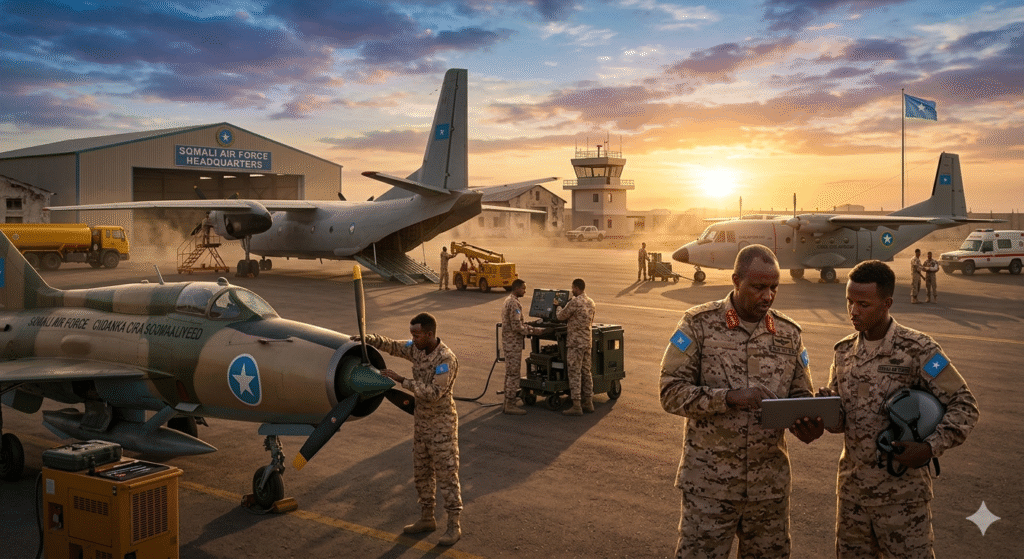
More than three decades after the collapse of the Somali central government in 1991, the nation’s military aviation capabilities are undergoing a historic transformation. In 2026, Somalia finds itself at a pivotal crossroads: actively negotiating for modern fighter jets, hosting foreign combat aircraft for the first time, and establishing the legal framework for a national aviation authority—all while navigating intense political rivalries and the persistent threat of Al-Shabaab. This is the state of Somalia’s military aviation today.
Part 1: The Legacy of Collapse – An Air Force That Vanished
To understand Somalia’s military aviation today, one must first acknowledge the void. At its peak during the Cold War, the Somali Air Force was the seventh largest in Africa, operating Soviet-supplied MiG fighters and transport aircraft. That capability evaporated almost overnight in 1991 when the central government disintegrated.
According to open-source military tracking, Somalia currently has no recorded active military aircraft inventory. The nation operates zero combat aircraft, zero dedicated military helicopters, and zero trainers as of 2026. The Somali Air Force exists in name only, surviving as a skeletal institution awaiting resurrection.
What Somalia does operate are light utility aircraft—Cessna 172s and 182s—and a handful of helicopters, including Mil Mi-8s and Agusta-Bell 412s, primarily used by the United Nations and African Union missions. For more than 30 years, Somali airspace has been patrolled, secured, and defended entirely by foreign partners: first Ethiopia, then AMISOM/ATMIS, and now Turkey and the United States.
Part 2: The JF-17 Gambit – Negotiations with Pakistan
That era of dependency may be ending. In February 2026, Somali Air Force Commander Mohamud Sheikh Ali (widely known as Dable Baylood) traveled to Islamabad for high-level talks with Pakistani defense officials. The objective: negotiating the purchase of up to 24 JF-17 Thunder Block III multirole fighter jets in a package valued at approximately $900 million.
The JF-17 Thunder, jointly developed by Pakistan and China, is a fourth-generation single-engine lightweight multirole combat aircraft. The Block III variant, which entered service with the Pakistan Air Force in 2023, incorporates an active electronically scanned array (AESA) radar, an upgraded electronic warfare suite, a helmet-mounted display and sight system, and compatibility with advanced beyond-visual-range air-to-air missiles.
For Somalia, this would represent a technological leap from zero to 4.5-generation capability overnight. The aircraft can carry up to 1,500 kg of external ordnance across seven hardpoints, including air-to-air, air-to-surface, and anti-ship weapons. It retains a maximum speed of Mach 1.6 and supports in-flight refueling for extended range.
Part 3: Can Somalia Afford $900 Million?
The JF-17 package represents the largest defense investment Somalia has considered since the Cold War. For one of the world’s poorest nations—where roughly 70 percent of the population lives below the poverty line—this raises obvious questions.
The unit price of a JF-17 Block III is estimated between $30 million and $40 million. Western alternatives cost more than three times that amount, making the Pakistani-Chinese fighter an attractive option for a cash-strapped nation rebuilding from scratch.
Somalia has made progress on the economic front. Completion of the Heavily Indebted Poor Countries (HIPC) initiative in 2023 significantly reduced external debt. The country also joined the East African Community in 2024, opening new avenues for regional trade. Potential external financing from Saudi Arabia and Turkey has been mentioned as a mechanism to facilitate payment arrangements.
However, analysts note that acquisition cost is only the beginning. Operating advanced fighters requires trained pilots, maintenance crews, spare parts supply chains, secure air bases, and long-term logistics budgets. Building that ecosystem from scratch could take years.
Part 4: Strategic Rationale – Why Somalia Needs Air Power
Why would a nation still fighting a grinding ground war against Al-Shabaab invest in advanced fighter jets? The answer lies in Somalia’s geography and sovereignty ambitions.
Somalia occupies one of the most sensitive geographic positions in the world, sitting along the maritime crossroads linking the Red Sea, the Gulf of Aden, and the Indian Ocean. Some of the world’s busiest shipping routes pass along its coastline. Control of airspace above these waters carries profound economic and security implications.
The Somali government is particularly concerned with monitoring areas stretching from Berbera and Hargeisa in the north to Kismayo, Ras Caseyr, and Ras Kamboni in the south—where maritime activity, smuggling networks, and militant movements intersect. A modern fighter fleet would theoretically allow Mogadishu to conduct air patrols, maritime surveillance, and rapid strike operations against insurgent targets.
There is also a political dimension: full sovereign control of Somali airspace, including over the breakaway region of Somaliland (which Israel formally recognized in late 2025), forms part of the strategic rationale.
Part 5: Turkey’s F-16 Deployment – Foreign Air Power on Somali Soil
While Somalia negotiates for its own fighters, foreign combat aircraft are already operating from Mogadishu. On January 28, 2026, three Turkish Air Force F-16 fighter jets landed at Aden Adde International Airport, accompanied by two T129 ATAK helicopters.
This deployment marked the first time Turkey has stationed manned combat aircraft on Somali territory. Turkish cargo aircraft had reportedly prepared hangars and facilities in advance. Videos circulating online showed the jets flying low over the capital—their presence unmistakable.
The official justification is support for Somalia’s fight against Al-Shabaab. However, analysts see a deeper strategic calculus. Turkey has been building its presence in Somalia since 2011, when then-Prime Minister Recep Tayyip Erdogan became the first non-African leader to visit in nearly two decades. Today, Turkey operates its largest overseas military base—Camp TURKSOM—in Mogadishu, has trained thousands of Somali troops, manages the airport and port, and has signed oil and gas exploration agreements.
“This looks less like a change of model and more like an escalation in the means Turkey is willing to use to defend what it has already built in Somalia,” said Riccardo Gasco, a PhD researcher at the University of Bologna.
Part 6: Turkish Ground Troops Enter Combat
The F-16 deployment occurred in parallel with another significant shift: the first confirmed direct participation of Turkish ground troops in combat against Al-Shabaab.
In late January 2026, Somali forces launched an artillery bombardment against Al-Shabaab positions in the Middle Shabelle region, followed by a coordinated ground assault. The operation was led by Somali Gorgor special forces, with direct support from Turkish soldiers and officers—dozens of Turkish personnel, equipped with armored vehicles and advanced weaponry, took part in ground engagements lasting approximately three hours.
Until this operation, Turkey had maintained a clear operational line, limiting its presence to training, equipment provision, intelligence sharing, and indirect support (including armed drones). The Middle Shabelle operation marked the end of that distinction and positioned Turkey as a direct combat actor.
Part 7: The Geopolitical Chessboard – Israel, UAE, and Somaliland
Turkey’s increased military commitment cannot be separated from regional geopolitics. In December 2025, Israel became the first country to recognize Somaliland as an independent state. The move was seen as a direct challenge to Somalia’s territorial integrity and a blow to the federal government in Mogadishu.
The UAE has long-standing investments in Somaliland’s Berbera Port, a project that has strengthened Dubai’s position as a regional commercial hub. Turkey, by contrast, has consistently backed Somalia’s central government and territorial unity.
The F-16 deployment is interpreted by analysts as a signal: Ankara is “all in” on Somalia, using hard power to counter fragmentation and narrow the room for rivals to operate through sub-state channels. This places Turkey in alignment with Saudi Arabia, which signed a military agreement with Somalia in early February 2026, and at odds with the UAE’s position.
Part 8: The Drone Revolution – A More Immediate Capability
While fighter jets may take years to materialize, drone technology is already reshaping Somalia’s counter-terrorism operations. At the African Land Forces Summit 2026 in Rome, Somali National Army Ground Forces Commander Brigadier General Sahal Abdullahi Omar articulated Somalia’s evolving defense posture, specifically highlighting how the integration of advanced drone technology is fundamentally reshaping operations against Al-Shabaab.
Drones offer Somalia an immediate, cost-effective path to air power. Unlike fighters, they require less infrastructure, fewer personnel, and carry lower political and financial risks. Turkey has used drones extensively in Somalia for years, and the Somali National Army is actively working to integrate these capabilities into its own force structure.
The General also emphasized the necessity of fortifying regional intelligence-sharing architectures, arguing that seamless information distribution is required to guarantee the efficiency of modern security apparatuses.
Part 9: The Legal Framework – Somali Airports Authority Bill
Rebuilding military aviation requires more than aircraft—it requires institutions. On April 1, 2026, Somalia’s Council of Ministers officially passed the Somali Airports Authority Bill, modernizing national aviation oversight.
The bill is part of a broader legislative mobilization designed to optimize federal governance and secure the republic’s aviation and maritime domains. The cabinet also approved the Anti-Smuggling and Human Trafficking Bill and ratified the International Convention for the Suppression of Unlawful Acts against the Safety of Maritime Navigation (SUA 2005).
These legal moves signal that Somalia is thinking beyond immediate counter-terrorism toward long-term state-building. An effective national aviation authority is a prerequisite for controlling airspace, managing civilian and military traffic, and attracting international investment.
Part 10: The Civil-Military Interface – Airlines Banned for Carrying Armed Troops
Not all aviation news in Somalia is about fighter jets. In late January 2026, the Somali Federal Government announced a ban on two commercial airlines after they attempted to transport heavily armed regional forces into Mogadishu from Puntland and Jubaland states.
The aircraft were carrying soldiers equipped with AK-47 rifles and rocket-propelled grenades (RPGs)—nearly 200 heavily armed troops identified as elite special forces attached to the presidential palaces of the Jubaland and Puntland presidents. The incident occurred one day before the two regional leaders were expected to attend a high-level meeting in Mogadishu.
The Federal Government’s statement was unambiguous: “No individual or regional authority is permitted to bring armed forces or heavy weapons into Mogadishu. The Federal Government is responsible for ensuring the safety of everyone in the capital”.
This incident highlights a persistent challenge for Somali military aviation: the tension between the federal center and regional states. While Mogadishu seeks to centralize security control, regional administrations have their own armed forces and, apparently, their own access to air transport.
Part 11: The Regional Air Power Balance
If Somalia successfully acquires and deploys 24 JF-17 Block III aircraft, it could significantly alter the balance of air power within the East African region.
Current regional capabilities: Uganda operates Su-30MK2 Flanker fighters, a heavy multirole platform. Kenya maintains modernized F-5 fighters. Tanzania fields Chengdu J-7 aircraft, an older design derived from Soviet technology. Other East African Community members, including Rwanda, Burundi, and South Sudan, maintain limited or no modern fighter capability.
In technological terms, the JF-17 Block III’s AESA radar and modern weapons suite would place Somalia ahead of Tanzania’s aging J-7 fleet and potentially narrow the gap with Kenya’s upgraded F-5s. However, operational capability—trained pilots, maintenance infrastructure, command and control—will take years to develop, regardless of when contracts are signed.
Part 12: The Road Ahead – From Ashes to Air Power
Somalia’s military aviation today is a study in contrasts. On one hand, the nation has no active combat aircraft and remains dependent on foreign air power for its security. On the other hand, it is actively negotiating for a modern fighter fleet, has foreign allies (Turkey) deploying combat aircraft on its soil, is building the legal framework for aviation governance, and is integrating drone technology into its counter-terrorism operations.
The challenges are formidable. Financing remains uncertain. Infrastructure is lacking. Regional political tensions threaten to fragment the nation just as it seeks to unify its airspace. And the persistent threat of Al-Shabaab means that any air capability must be secured against attack from the ground.
Yet the direction is clear. After three decades without an air force, Somalia is determined to reclaim its skies. As one Somali defense ministry official put it: “Our airspace must be protected by Somali hands”. Whether that vision becomes reality depends on funding, political will, and the patience to build, from the ashes of collapse, a modern air arm worthy of the nation’s strategic position at the crossroads of Africa and the Arabian Sea.