

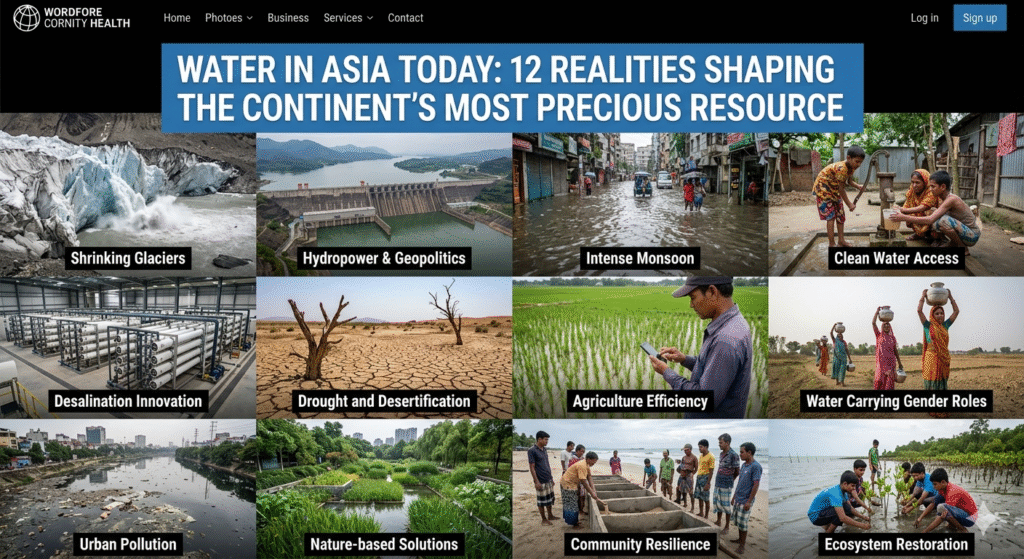
From the melting glaciers of the Himalayas to the sinking megacities of the Mekong Delta, water is the silent crisis reshaping Asia in 2026. The continent that lifted 2.7 billion people out of extreme water insecurity over the past decade now faces a paradox: unprecedented progress alongside accelerating environmental collapse . As climate change intensifies and infrastructure ages, Asia’s water story has become a tale of two realities—one of achievement, the other of impending crisis. This article breaks down the state of water across Asia into 12 critical parts.
Part 1: The Great Leap Forward – 2.7 Billion People Gained Water Security
The headline from the Asian Development Bank’s 2025 Asian Water Development Outlook is genuinely historic. Over the past 12 years, more than 60 percent of Asia and the Pacific’s population—approximately 2.7 billion people—has been lifted out of extreme water insecurity . This represents one of the fastest improvements in basic human welfare ever recorded.
The drivers have been political commitment, targeted investments, and governance reforms since 2013 . Rural India alone accounts for 840 million people gaining better water, sanitation, and hygiene (WASH) services, chiefly through government programs . Cambodia and the Lao People’s Democratic Republic have significantly reduced exposure to unsafe drinking water. Even in Tajikistan, UN-supported early warning systems have strengthened flood and storm management .
Yet this progress is fragile. The same report warns that accelerating environmental decline and a massive financing gap now threaten to reverse a decade of gains .
Part 2: The Environmental Blind Spot – Ecosystems in Free Fall
If there is a single metric that captures Asia’s water vulnerability, it is this: environmental water security is deteriorating or stagnating in 30 of 50 Asian economies studied . The ecosystems that filter, store, and regulate water—wetlands, rivers, aquifers, and forests—are being destroyed faster than ever.
Since 1970, global freshwater species populations have declined by more than 80 percent . In Asia, rapid urbanization, industrialization, groundwater over-extraction, river pollution, deforestation, and the loss of mangroves and coral reefs are pushing natural systems to their breaking point . As ADB Vice President Fatima Yasmin put it: “Nature has become the weakest link in the region’s water chain” .
The cost of ignoring nature is rising. Between 2013 and 2023, Asia experienced 244 major floods (41 percent of the global total), 104 droughts, and more than 100 severe storms . Each disaster erodes development gains and forces governments into costly, reactive repairs.
Part 3: The Asian Water Tower Is Leaking – 24 Billion Tonnes Lost Annually
High Mountain Asia—known as the “Asian Water Tower”—supplies water to more than a dozen downstream countries, supporting agricultural irrigation, urban supplies, and ecological security for hundreds of millions of people . A recent satellite study led by the Chinese Academy of Sciences has delivered alarming news: groundwater in the region is depleting at a staggering rate of approximately 24.2 billion tonnes per year .
Between 2003 and 2020, roughly two-thirds of High Mountain Asia experienced groundwater storage declines. The worst losses occurred in densely populated, irrigation-intensive basins—the Ganges–Brahmaputra, Indus, and Amu Darya . While some high-elevation inland regions saw localized recoveries, the overall trend is unmistakable.
Climatic factors account for nearly half of the observed variability, with the cryosphere (glaciers and snowpack) playing a prominent role. But human water withdrawals—particularly for downstream irrigation—have become an increasingly major contributor, a trend that accelerated after 2010 . Even more concerning, projections indicate that under current water-use practices, this downward trend will persist. While glacier melt may temporarily slow groundwater losses around the 2060s, this “buffer effect” is unsustainable and will be followed by more rapid decline .
Part 4: The Financing Gap – $4 Trillion Needed by 2040
Asia has an infrastructure problem, but the real crisis is a financing one. The ADB estimates that the region will need $4 trillion through 2040—approximately $250 billion annually—just to meet its water, sanitation, and hygiene (WASH) needs .
Current public spending covers less than 40 percent of this requirement, leaving an annual shortfall exceeding $150 billion . Closing this gap requires smarter deployment of finances, including blended finance that pools public and private resources to reduce project risk and mobilize private capital .
The stakes extend beyond water. The Asia Investor Group on Climate Change and MSCI Institute found that climate change is already costing Asia’s power utilities $6.3 billion annually—a figure projected to exceed $8.4 billion by 2050 if adaptation measures remain inadequate . Asia accounts for 60 percent of the world’s power generation capacity, and water disruptions—from declining river flows to flooding—directly threaten energy security.
Part 5: Climate Shocks Are Here – La Niña and the Drying of West Asia
The climate crisis is no longer a forecast; it is a daily reality. La Niña conditions declared in late 2025 are expected to persist, bringing reduced precipitation across West Asia during autumn, winter, and spring . This significantly heightens drought risks in already vulnerable areas, including Iraq, Jordan, Lebanon, Palestine, and Syria.
Between October and November 2025, these countries experienced below-average precipitation, affecting the start of the rainy season. While some rainfall in late December and January 2026 brought partial relief, it will likely be insufficient to fully replenish water reserves depleted by the exceptionally dry conditions of 2024–2025 . Seasonal forecasts predict near-normal precipitation through June 2026 but with a high probability of above-average temperatures, increasing evapotranspiration and challenging vegetation recovery.
The consequences are already visible: drought is fueling community-level tensions and disputes over water and land access, particularly in Iraq, Lebanon, and Syria. Southern Iraq saw an upward trend of water-related protests, demonstrations, and riots in 2025 .
Part 6: The Super El Niño Threat – Thailand’s Eastern Corridor at Risk
While West Asia dries, Southeast Asia braces for a different extreme. A “Super El Niño”—defined by Pacific sea surface temperature rises exceeding 1.5 to 2 degrees Celsius—is forecast to bring severe drought and extreme heat to Thailand and the ASEAN region, with effects expected as early as May 2026 .
The Eastern Economic Corridor (EEC), Thailand’s premier investment zone covering Chonburi, Chachoengsao, and Rayong, is particularly vulnerable. Three major EEC reservoirs are holding at less than 70 percent capacity, raising fresh concern over water security . This matters because the EEC’s population is projected to double from 3 million to 6 million by 2037, driving total water demand from 2.4 billion cubic meters in 2017 to nearly 3 billion cubic meters by 2037 .
In response, a multi-stakeholder platform involving the Thai government and the World Bank has been established to implement urgent water management solutions across three workstreams: securing bulk water supply, managing demand and efficiency, and promoting wastewater treatment and reuse .
Part 7: The Inequality Divide – Water as a Driver of Injustice
For all the talk of regional progress, water insecurity in Asia is not evenly distributed. It falls hardest on women and girls, children, persons with disabilities, and rural and marginalized communities . As World Vision’s Alexander Pandian wrote for World Water Day 2026: “When water systems fail, they fail unequally. What may be an inconvenience for some becomes a crisis for those living in informal settlements, remote villages, or with limited mobility” .
The hidden “time tax” on women and girls is particularly devastating. In seven out of ten households without water on their premises, women and girls are responsible for collection. When wells dry up or sources are contaminated, they walk farther and wait longer. Each additional hour spent securing water is an hour stolen from education, income-generating work, or rest .
Across East Asia, an estimated 24 million vulnerable children still lack access to safely managed drinking water . Unsafe water continues to drive diarrheal disease, a leading cause of child illness and mortality. Flooded or damaged sanitation facilities disrupt schooling. During droughts, children miss class to help secure household water supplies.
Part 8: Urban Vulnerability – Sinking Cities and Overwhelmed Drains
Asia’s rapid urbanization has created a water paradox: cities built for yesterday’s climate are being pushed beyond their limits. In central Vietnam’s Quy Nhon, Typhoon Kalmaegi snapped power lines and left streets submerged under chest-high water. “I can’t go back because my home is underwater,” one resident told the Associated Press .
Coastal megacities face mounting threats from storm surges, rising sea levels, and saltwater intrusion. The region already accounts for 41 percent of global flooding . Informal communities, often located in flood-prone or marginal lands, bear the brunt of these shocks.
The problem is not just too much water—it is also too little. In rapidly urbanizing areas, prolonged dry spells cause water pressure to drop or disappear entirely. Infrastructure built for a stable climate lacks the redundancy and storage capacity to manage the new volatility .
Part 9: Nature-Based Solutions – The Green Infrastructure Answer
There is growing consensus that concrete alone cannot solve Asia’s water crisis. Healthy ecosystems are the first line of defense against water stress and climate shocks . Wetlands filter pollutants, forests regulate flow, mangroves buffer storms, and floodplains absorb excess rainfall.
The ADB is actively promoting the integration of green and gray infrastructure. In Vietnam, combining traditional drainage systems with green roofs, parks, and retention ponds has helped multiple cities enhance flood resilience . In Mongolia, expanding terrestrial protected areas has helped maintain watershed functions and offset ecological declines observed elsewhere in the region .
The message is clear: investing in natural infrastructure is not an environmental luxury—it is a water security necessity.
Part 10: Technology and Data – AI Meets the Water Crisis
One of the most promising developments in Asian water management is the application of artificial intelligence and satellite technology to address critical data gaps. Currently, only about 3 percent of global water quality measurements come from the world’s poorest regions . Even where data exist, they are often scattered across agencies.
New initiatives are changing this. In Indonesia’s Cimanuk–Cisanggarung River Basin, an AI-powered tool developed by the National Research and Innovation Agency combines satellite Earth observation data—digital elevation maps, land cover, rainfall data—with drainage networks and soil information to identify optimal locations for retention ponds . This shifts infrastructure planning from subjective judgment to transparent, evidence-based prioritization.
In Thailand’s Songkhla Lake, researchers are combining satellite remote sensing with machine learning to estimate water quality parameters like turbidity and biochemical oxygen demand, enabling near-monthly monitoring rather than quarterly point measurements . These innovations, supported by the UN Economic and Social Commission for Asia and the Pacific (ESCAP), demonstrate how digital technology can turn fragmented data into actionable intelligence.
Part 11: The Geopolitics of Water – Shared Rivers, Rising Tensions
Water does not respect borders, and Asia’s 50-plus transboundary river basins are potential flashpoints for conflict. The Indus, Ganges–Brahmaputra, Mekong, and Amu Darya basins all span multiple countries, each with competing demands for irrigation, hydropower, and domestic supply.
The satellite study of High Mountain Asia highlights the stakes: the most significant groundwater losses are occurring in downstream basins shared by multiple nations . As aquifers deplete and glaciers recede, upstream infrastructure projects—dams, diversions, reservoirs—become sources of tension.
In West Asia, drought is already fueling community-level disputes and protests over water access . While full-scale “water wars” remain unlikely, water scarcity is increasingly a driver of instability, displacement, and humanitarian need across the continent.
Part 12: The Road Ahead – ASIAWATER 2026 and the Innovation Imperative
In April 2026, more than 20,000 water professionals from 52 countries gathered in Kuala Lumpur for ASIAWATER 2026, the region’s premier water and wastewater platform . The theme—”Building Nations: Leveraging Technology-Driven Water Services for Inclusive Growth”—reflected a fundamental shift in how water is viewed: not just as infrastructure, but as a strategic national priority.
Malaysia’s Deputy Prime Minister Fadillah Yusof opened the event by highlighting the urgency: the country faces a Non-Revenue Water rate of 37.1 percent, representing massive daily losses . Across the exhibition floor, more than 1,000 brands showcased solutions in water treatment, wastewater management, smart water technologies, and sustainable infrastructure .
The message from ASIAWATER 2026 was unambiguous: the technologies to address Asia’s water crisis already exist. The challenges now are political will, financing, and the capacity to scale proven innovations from pilots to regional transformation.
Conclusion: Two Realities, One Future
Asia today presents two faces of water. One shows historic achievement: 2.7 billion people lifted from extreme water insecurity, rural access transformed, and public health improved. The other shows accelerating environmental decline, a $150 billion annual financing gap, and climate shocks that are already reshaping landscapes and livelihoods.
As ADB’s Vivek Raman observed: “It’s a tale of two realities” . Which reality defines Asia’s water future depends on decisions made today. The continent must protect the ecosystems that underpin all water security, close the investment gap through innovative financing, deploy technology to fill critical data gaps, and center the most vulnerable—women, children, and marginalized communities—in every water policy.
Because where water flows, equality can grow. But where water fails, inequality deepens. And in Asia today, the clock is ticking