

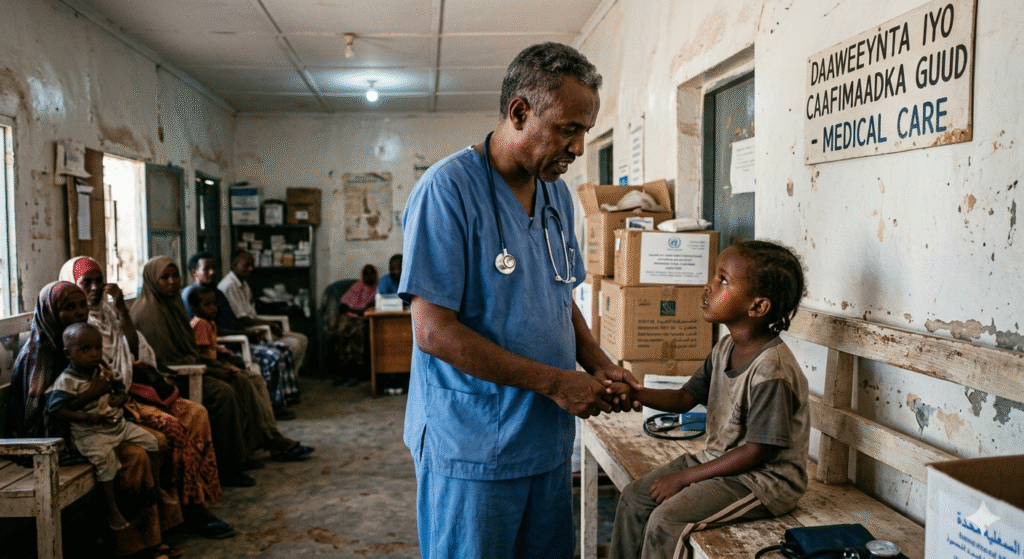
In the Horn of Africa, the health of Somalia’s 17 million people hangs in a precarious balance. As of April 2026, the nation faces what humanitarian organizations describe as a predictable yet largely preventable catastrophe. A toxic combination of climate shocks, ongoing conflict, severe funding cuts, and now global fuel price surges has pushed Somalia’s fragile healthcare system to the verge of collapse. This article examines the multiple dimensions of the health crisis gripping the country.
The Scale of Need: Millions Without Care
The numbers are staggering. According to the 2026 Humanitarian Needs and Response Plan, an estimated 5 million people require urgent health assistance across Somalia . More broadly, 7.5 million people—representing 39 percent of the population—have been affected by the intensifying crisis, driven by prolonged drought, conflict, and recurrent disease outbreaks .
The health system itself is crumbling. Since early 2025, more than 200 health and nutrition facilities have closed across the country due to sharp cuts in humanitarian funding . This represents a dramatic reduction in the already limited healthcare infrastructure available to Somali families. Where facilities remain open, they are often understaffed, undersupplied, and overwhelmed by patient numbers.
The Nutrition Catastrophe: Children Dying Slowly
Perhaps the most urgent dimension of the crisis is child malnutrition. Between February and March 2026, an estimated 1.84 million children aged 6-59 months were projected to suffer from acute malnutrition . Of these, 483,000 children are expected to face severe acute malnutrition—the most dangerous form, which carries a high risk of death without immediate treatment .
MSF teams on the ground have witnessed the horrifying trajectory of this crisis. In Baidoa, admissions for severe acute malnutrition surged by 42 percent in 2025 compared to the previous year. In Mudug, the increase was even steeper at nearly 60 percent . These are not abstract statistics; they represent infants and toddlers whose bodies are slowly shutting down from lack of adequate nutrition.
The drought has devastated livelihoods, forcing families to abandon their homes and seek refuge in overcrowded displacement camps. As one mother living in a camp in Baidoa described: “We cannot afford water. We are extremely short of food and water, and we fear diseases like cholera. Hunger and lack of clean water are making everything worse” .
In a particularly heartbreaking account, Awo, a widow and mother of two, explained how she has coped with the hunger of her children: “We pretended to cook water so the children could sleep… I put a pot on the fire with only water. When they saw the steam, they believed food was cooking. They fell asleep waiting” .
Disease Outbreaks: Three Concurrent Emergencies
Somalia is currently battling three concurrent disease outbreaks that present significant public health risks: AWD/Cholera, Diphtheria, and Measles . The combination of drought-induced displacement, lack of clean water, and collapsed vaccination coverage has created a perfect storm for infectious diseases.
Between January and November 2025, the country recorded alarming case numbers: 3,375 diphtheria cases with 139 associated deaths, 11,599 measles cases, and 8,846 cases of AWD/cholera . In Baidoa alone, 189 children were treated for suspected measles in October 2025, and 95 percent of them had never been vaccinated .
The lack of vaccination coverage is a critical vulnerability. Somalia has one of the lowest vaccination rates in the world, leaving millions of “zero-dose” children—those who have never received any vaccines—susceptible to preventable killers. In response, the Prime Minister launched the Somalia Immunization and Polio Eradication Task Force in mid-2025, which he personally chairs, signaling government commitment to reversing this trend .
The Fuel Crisis: A New Barrier to Healthcare
Since late February 2026, a new and unexpected obstacle has emerged: skyrocketing fuel prices. Following the escalation of conflict in the Middle East, fuel prices across Somalia have surged sharply, driving up transport and food costs and making it more expensive—or impossible—for people to reach lifesaving healthcare .
In Baidoa, MSF noted a 25 percent rise in local fuel prices, from $1.20 to $1.50 per liter. Water trucking costs rose 40 percent within the city, from $50 to $70 per trip. In Mudug, fuel increased by 33 percent, and local transport costs rose by 50 percent .
For families already struggling to afford food, these transport costs are prohibitive. Patients are often traveling hundreds of kilometers to reach the few functioning health facilities. As one mother who traveled 12 hours with her 45-day-old son Muscab explained: “We delayed coming because we could not afford the transport. It has become much more expensive than before, and many people are now forced to walk long distances just to reach healthcare” .
Hospitals themselves are feeling the squeeze. MSF has spent 20 percent more on fuel in March 2026 compared to February—fuel needed to keep hospital services, including generators and ambulances, functioning .
Funding Collapse: The Donor Retreat
Behind many of these crises lies a stark reality: humanitarian funding for Somalia has reached its lowest level in a decade . The consequences have been devastating. Food assistance has dropped from targeting 1.1 million people per month to just 350,000 . By mid-2025, humanitarian partners were forced to revise their response targets from 4.6 million people to a mere 1.3 million, leaving millions without assistance .
The Health Cluster is appealing for $80 million to provide life-saving health services in 2026, aiming to reach 2.4 million people with the highest needs . Whether donors will meet this request remains uncertain. The Somali government has urged international donors to better align their support with national priorities and channel funding through a government-led framework to ensure accountability and efficiency .
The Drought: A Climate-Driven Health Emergency
Somalia is ranked among the world’s most climate-vulnerable countries . The country has experienced four consecutive failed rainy seasons, with northern regions enduring a fourth failed season and rainfall levels 60 percent below average—the driest conditions recorded since 1981 .
The impact on water availability has been catastrophic. Eighty percent of berkads (traditional water storage structures) in Puntland have dried up. In Hirshabelle, 50 boreholes require urgent rehabilitation. Water prices in Puntland have reached $12-15 per 200-liter barrel—far beyond the reach of most families .
Crop failure affects up to 85 percent of farmland, reducing sorghum and maize yields by 20-30 percent. Livestock deaths and widespread pastoral movements underscore the collapse of traditional livelihoods that have sustained Somali communities for generations .
Displacement: Over 3 Million Uprooted
More than 3.3 million people have already been forced from their homes, many arriving in overcrowded camps around cities like Baidoa and Mudug . These displacement camps are themselves health hazards: overcrowding, lack of sanitation, limited clean water, and minimal healthcare access create conditions where disease spreads rapidly.
The drought “separated families,” as one widow explained. “It starves us. Everyone here has been affected the same way” . The displacement is not a single event but a repeated trauma, as families move multiple times in search of water, food, and safety.
Health Worker Training: A Glimmer of Hope
Amid the crisis, there are efforts to build capacity. The World Health Organization, in collaboration with the Federal Ministry of Health, is rolling out Somalia’s 2025 updated national guideline for the prevention and management of acute malnutrition . More than 40 Somali health professionals recently completed a two-week master training-of-trainers course supported by ECHO and WHO.
The revised guideline represents an important advance: it goes beyond treatment to emphasize prevention, expands care for infants under 6 months, and includes protocols for moderate wasting. As Dr. Aweis Olow Hassan, Nutrition Officer at WHO Somalia, explained: “This guideline reflects the realities health workers face every day. It helps them identify risks earlier and act before children become severely malnourished” .
Security Constraints: The Access Nightmare
Delivering healthcare in Somalia has always been dangerous, but access constraints have worsened. Between January and September 2025, 139 security incidents affecting aid delivery were reported, including interference in aid delivery and violence against personnel .
Severe restrictions persist along key corridors, and unpredictable movement due to checkpoints, ambushes, IEDs, and hostilities has increased costs and delayed aid. Some of the most recent polio cases, for example, have occurred in areas considered “off limits” to vaccination teams . Security incidents, reduced funding, and operational transitions have heightened risk aversion among humanitarian organizations, further limiting the reach of health services.
Supply Chain Vulnerability
Somalia imports almost all of its critical medical and humanitarian supplies, and many organizations’ regional warehouses are located in the Middle East . Sustained disruption to shipping and air corridors—exacerbated by the current regional conflict—could delay the supply of life-saving medicines, food to treat malnutrition, and equipment by months.
This vulnerability extends to nutrition supplies as well. Pipeline disruptions in Ready-to-Use Therapeutic Food (RUTF) and Ready-to-Use Supplementary Food (RUSF) are anticipated to further exacerbate the food security crisis as the drought intensifies .
A Call for Action
The message from humanitarian organizations on the ground is urgent and unambiguous. “Somalia’s communities cannot afford for the humanitarian response to slow down at this moment,” said Dr. Mohammed of MSF. “Every organization working here must step up, and the international community must ensure that the resources are in place to keep that response running. Without collective action now, people will lose access to the healthcare they desperately need and have nowhere else to turn to” .
World Vision’s National Director for Somalia, Kevin Mackey, echoed this urgency: “The recently released report has confirmed our deepest fears… This number is staggering and should spur humanitarian organizations and donors into immediate action to protect the lives of children” .
Conclusion: A Predictable Tragedy
What makes Somalia’s health crisis so devastating is that it is largely predictable and preventable. The warning signs have been clear for months. The drivers—drought, conflict, funding shortfalls, and now fuel prices—are well understood. Yet the response remains critically underfunded, and millions are left without access to basic healthcare, food, or clean water.
The human cost is measured in child deaths, in families drinking salty water because they cannot afford clean supplies, in mothers watching their children fall ill with preventable diseases. As MSF’s Country Representative in Somalia, Elshafie Mohamed, stated: “This situation is unacceptable because it is predictable and largely preventable” .
Without an urgent, multisectoral response that scales up nutrition programs, vaccination campaigns, and water services—alongside sustained commitment from the international community—a massive loss of life in the coming months may be unavoidable. The health of Somalia’s people hangs in the balance, and the time to act is now.
