

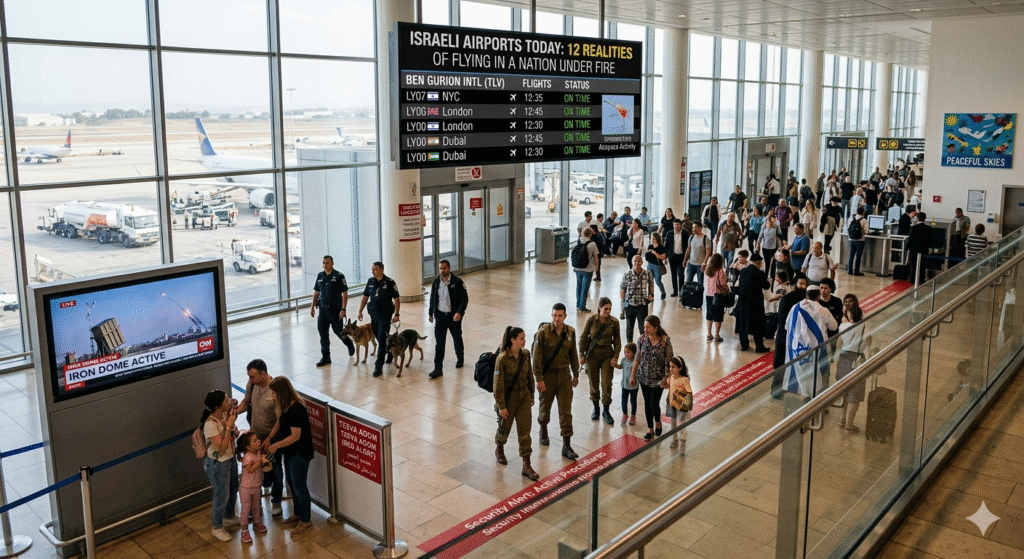
In the spring of 2026, Israel’s airports are not merely transportation hubs. They are fortified lifelines, national security assets, and the stage for a high-stakes drama of survival, innovation, and profound frustration. Since the outbreak of the US-Israeli air war with Iran on February 28, the country’s skies have been transformed . This article breaks down the current state of Israeli aviation into 12 critical parts, revealing how the nation moves—or fails to move—through the air.
Part 1: Ben Gurion Today – The 50-Passenger Prison
Israel’s main international gateway, Ben Gurion Airport (TLV), is operating under wartime protocols that would have been unthinkable just months ago. As of late March 2026, the airport is limited to just one takeoff and one landing per hour . Departing flights are capped at 50 passengers—down from a normal capacity of 120 to 150 . There is no restriction on incoming passengers, but the bottleneck is severe.
What does this mean in practice? An airport that once handled over 20 departures per hour now moves a single flight every 60 minutes. El Al, the national carrier, has seen its seat availability shrink to just 5% of normal operations . The Transportation Ministry has proposed easing the cap to 90 passengers starting in April, but this remains tentative and subject to daily security assessments . For now, flying out of Tel Aviv is a privilege reserved for the lucky, the connected, or the desperate.
Part 2: The Missile Threat – Why the Skies Are Closed
The restrictions are not bureaucratic red tape; they are matters of life and death. The trigger for the current shutdown was a series of Iranian ballistic missile attacks targeting central and southern Israel. While Israel’s air defense systems intercept over 90% of incoming projectiles, failures have occurred. On one Saturday night in late March, debris from an intercepted missile damaged three private jets parked at Ben Gurion . Scores of civilians were injured in two southern towns .
Transportation Minister Miri Regev made the decision to scale back traffic “in order to prevent potential risk to human life” . The logic is brutal but sound: fewer planes on the ground and in the air means fewer targets and less debris risk. The airport is no longer a civilian facility in the traditional sense; it is a protected asset in a war zone.
Part 3: The Airlines’ Struggle – El Al, Arkia, and Israir Grounded
Only Israeli airlines are currently operating—El Al, Arkia, Israir, and the small carrier Air Haifa . All foreign carriers have suspended service, some until June . Even these four national carriers are gutted.
El Al, the flag carrier, now flies to just seven destinations: New York, Los Angeles, Miami, London, Paris, Rome, and Athens . Israir has seen up to 73% of its scheduled flights canceled on some days, operating only to nearby hubs like Athens, Larnaca, Rome, Tbilisi, and Addis Ababa . Arkia has effectively abandoned Ben Gurion for most long-haul routes, shifting operations to Egypt and Jordan . The airlines are not running a business; they are running a humanitarian air bridge.
Part 4: The Exodus to Eilat – Ramon Airport as the Last Resort
With Ben Gurion crippled, attention has turned south. Ramon Airport (ETM), near the Red Sea resort city of Eilat, is Israel’s second-largest international airport . El Al has urgently called on authorities to open Ramon as a “complementary alternative” to Ben Gurion .
Ramon is more than four hours’ drive from Tel Aviv, but it is outside the range of many of the threats plaguing the center of the country. Wizz Air announced plans in January to establish a new base at Ramon, launching routes to Budapest and other European cities . The airport now serves as a critical diversion field and an evacuation hub. For Israelis desperate to leave, the long drive south may be the only way to catch a flight.
Part 5: Overland Escape – Taba and Aqaba Become Airports
Perhaps the most surreal development of the war is that Israeli travelers are now departing from foreign soil. Arkia has shifted most of its long-haul operations to Taba, Egypt and Aqaba, Jordan—cities just across Israel’s land borders . From these makeshift hubs, Arkia operates flights to New York, Bangkok, Hanoi, Sofia, Athens, Paris, and Rome using leased foreign aircraft .
Passengers must cross the border by land—through the Taba crossing (open 24/7) or the Jordan River crossing—pay exit fees (110 NIS) and visa costs ($30-$60), and then board their flights . Between February 28 and March 18, over 52,000 people left Israel via land border crossings, and more than 38,000 entered the same way . The airport has, in a sense, moved to the border.
Part 6: The Repatriation Success – Operation Lion’s Wings
Amid the chaos, there is a success story. When the war broke out, tens of thousands of Israelis were stranded abroad. The Israel Airports Authority launched “Operation Lion’s Wings” to bring them home . Between March 5 and 9 alone, 177 flights landed at Ben Gurion carrying approximately 32,000 passengers .
By mid-March, the operation had repatriated roughly 60% of all Israelis who were abroad when the conflict began . Simultaneously, a related land operation—”Operation Lion’s Roar”—moved 25,000 people across border crossings . The mission was declared complete in late March, with Regev stating that no Israeli citizen remained stranded abroad . The air bridge worked—at least in one direction.
Part 7: Passenger Priorities – Who Gets a Seat?
With only 50 seats per departing flight, allocation has become a brutal triage process. El Al states that “passenger allocation will be carried out according to flight assignment prioritization based on the original flight date, with priority given to exceptional humanitarian and medical cases” .
This means that the average tourist or family going on vacation has effectively been shut out. Travel agents report that approximately a quarter of a million tickets for the Passover holiday period have been canceled . Shirley Cohen Orkaby, VP at Eshet Tours, told The Times of Israel: “In practice, the new restrictions on flights from Ben Gurion Airport mean that there is currently no real way to travel abroad from Israel” . Many Israelis are replacing overseas vacations with domestic stays in Eilat or the Dead Sea.
Part 8: The Security Nightmare – Fighter Jets and WiFi Hoaxes
Security at Israeli airports has always been intense. Today, it is hyper-vigilant to the point of paralysis. A single incident in early February demonstrated how fragile the system has become.
A passenger on a Wizz Air flight from London to Tel Aviv noticed a WiFi hotspot named “Terrorist” in Arabic on their personal device . Panic spread. Some passengers claimed to have received threatening text messages. The captain followed international security protocols, and as the plane entered Israeli airspace, fighter jets were scrambled to escort it. The aircraft circled over the Mediterranean before landing safely .
The aftermath? Police boarded the plane and detained several passengers. The investigation eventually revealed that the culprit was a teenager from Jerusalem who had deliberately changed his phone’s WiFi name as a “prank” . The point is not the motive but the response: Israeli authorities cannot afford to take any risk lightly. Every flight is treated as a potential target.
Part 9: Terminal 3’s Ghost Town – Then a Glimmer of Life
For weeks, Ben Gurion’s Terminal 3—normally a bustling hub of duty-free shopping and crowded gates—was a ghost town. Flightradar24 data showed cancellation rates of 32% or higher on many days . However, as repatriation flights continued and some outgoing traffic resumed, the Israel Airports Authority began to reopen facilities.
Catering services in Terminal 3 resumed full 24/7 operations in mid-March. Three cafes opened in the Duty-Free hall and Concourse C, alongside a Richardson stand at the end of Concourse C . It is a small sign of normalization, but the terminal remains eerily quiet compared to its pre-war bustle.
Part 10: The Premium Push – New Lounges Amid the Crisis
In a surprising twist, even as flights were being slashed, Ben Gurion Airport moved forward with a major upgrade to its premium passenger experience. In January 2026, before the war intensified, the Israel Airports Authority launched a modernization of its terminal lounges .
Two new lounges—Aspire (operated by Swissport in Terminal 3’s Pier E) and Jetex (managed by LAYAM in Pier C)—opened their doors . The King David Lounge (El Al’s flagship) has also reopened after a complete renovation, alongside the Fattal Lounge near Terminal 1 . These lounges offer workspaces, meeting rooms, and premium services.
The logic is long-term: the Airports Authority expects traffic to rebound to 22 million passengers in 2026 and 30 million by 2030 . Whether that forecast survives the current war remains to be seen.
Part 11: The Humanitarian Exception – Medical Evacuations
Amid the restrictions, one category of travel continues almost without hindrance: humanitarian and medical cases. The 50-passenger cap includes a specific allocation for those with urgent medical needs. El Al has stated that “special priority will be given to exceptional humanitarian and medical cases” .
This includes Israelis needing specialized treatment abroad, as well as foreign nationals requiring evacuation. The US Embassy in Jerusalem continues to operate an assisted departure program for American citizens, routing them via Amman, Jordan . For those with genuine emergencies, the system—while strained—does still function.
Part 12: The Future – What Comes After the War?
No one knows when normal operations will resume. The Transportation Ministry reviews the security situation daily, and guidelines “may change at any moment” . The current framework—one flight per hour, 50 passengers per departure—is not a permanent solution, but it may persist for weeks or months.
What is clear is that Israeli aviation has been permanently altered. The reliance on land border crossings, the activation of Ramon Airport as a major hub, and the painful lesson that Ben Gurion is vulnerable to missile debris will shape policy for years. For now, the message from the Israel Airports Authority is simple: if you do not have a confirmed booking, do not come to the airport . The skies over Israel are open—but only just barely.
Conclusion: A Nation on Hold
Israeli airports today are monuments to resilience under fire. They are operating at a fraction of capacity, protected by fighter jets and missile defenses, and dependent on overland routes through Egypt and Jordan. For the Israeli people, the ability to fly—to escape, to return, to connect with the world—has become a scarce and precious commodity. As the war with Iran continues, Ben Gurion, Ramon, Taba, and Aqaba are not just airports. They are the thin, fragile threads keeping Israel connected to the world.