

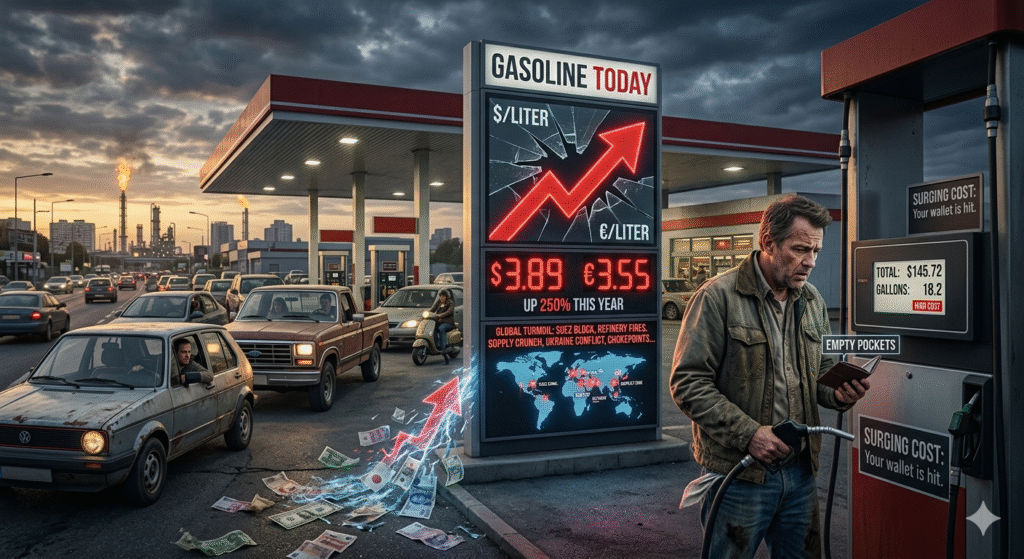
In the spring of 2026, filling a petrol tank has become a political act, an economic burden, and for millions of families, a quiet crisis. Across the globe, from the highways of Texas to the three-wheelers of Sri Lanka, the price of fuel has exploded. Brent crude, the international benchmark, has soared past $105 per barrel, while in some Asian spot markets, diesel has briefly touched an eye-watering $238 per barrel .
This is not a routine fluctuation. It is a structural shock driven by war, blocked shipping lanes, and the nervous calculations of oil traders who are betting that the world is about to get much more expensive.
Here is how the petrol price crisis unfolded—and why the money in your wallet may never stretch as far again.
Part 1: The Geopolitical Spark – A War in the Gulf
The immediate cause of the price surge is kinetic. Following the escalation of the US-Israeli military campaign against Iran in early 2026, the conflict moved from the shadows into the global supply chain. In a desperate strategic move, Iran effectively blocked or severely restricted traffic through the Strait of Hormuz .
This narrow waterway is not just a choke point; it is the jugular of the global economy. Approximately one-fifth of the world’s oil and gas shipments pass through it. When the strait became a war zone, insurance rates for tankers skyrocketed, shipping volumes plummeted, and the world suddenly realized how vulnerable its mobility was.
President Donald Trump’s subsequent announcement that the US would continue “hitting Iran extremely hard” for weeks removed any hope of a quick ceasefire, sending traders into a panic-buying frenzy .
Part 2: The Numbers – What $100+ Oil Looks Like
To understand the pain at the pump, look at the raw data from the first week of April 2026.
- West Texas Intermediate (WTI): Soared 11.4% in a single session to close at $111.54 per barrel .
- Brent Crude: Rallied to settle near $109, after flirting with lows of $98 just days earlier .
- The Diesel Anomaly: While crude is high, refined products like diesel have gone parabolic. In late February, international diesel was roughly $88 a barrel. By early April, it hit $238—a 170% increase .
For the average driver, this means the price of petrol is no longer just following crude oil; it is following the scarcity of refining capacity and the fear that tankers simply won’t dock.
Part 3: The Supply Response – OPEC+ Tries to Stabilize
In response to the chaos, eight OPEC+ members (led by Saudi Arabia and Russia) held an emergency virtual meeting on April 5. They agreed to a production adjustment, increasing output by 206,000 barrels per day starting in May .
On paper, this sounds like a relief valve. In reality, it is a drop in the ocean. The market had already priced in a loss of supply closer to 13% of global availability due to the Hormuz disruption . While the OPEC+ move signaled that the cartel does not want $150 oil (which would destroy long-term demand), it did little to lower the price at the petrol station today.
Part 4: The Economic Theory – Why High Prices Stick
Morgan Stanley has issued a warning to investors that this time is different. In past oil shocks—like the Gulf War or the 2008 spike—prices shot up and then crashed down, limiting the damage to inflation.
Today, economists argue that the market is facing a “persistent geopolitical premium” . Because the war has no end date, companies cannot wait for prices to drop. They must absorb the cost now.
As Morgan Stanley’s Seth Carpenter noted, when there is “no expectation of mean reversion” (prices returning to normal), businesses face a permanent cost shock. They cannot absorb it forever, so they pass it on to the consumer. This changes the inflation calculation from a “blip” to a “trend.”
Part 5: Regional Winners and Losers
The surge is creating a stark new map of haves and have-nots.
- The Losers (Energy Importers): Asia is taking the hardest hit. Nations like Vietnam, Malaysia, and the Philippines have seen diesel prices rise by 50% to 80% . The Philippines has declared a national emergency, implementing a four-day workweek to save fuel. Sri Lanka has introduced digital rationing cards for petrol.
- The “Stable” (Pakistan): Interestingly, Pakistan has shown relative stability, with petrol hovering around $1.10 per liter. While high, this is lower than the Philippines ($1.70) . The government credits timely policy interventions, though analysts warn this stability is fragile.
- The Winners (Exporters): Gulf states and oil-rich nations are seeing a windfall, though even they are suffering from the “creative destruction” of damaged infrastructure.
Part 6: The Recession Red Line – $140 for Two Months
How high is too high? Oxford Economics has run the numbers. According to their models, if the war pushes oil to $140 per barrel for two consecutive months, the world tips into a “mild recession” .
At $140, the United States would see inflation spike back to 5% (from the current ~2.4%). Europe, Japan, and the UK would experience economic contraction. Global inflation would peak at 5.8%. The cost of transport would raise the price of everything else—from a loaf of bread to an iPhone.
Currently, most analysts put the odds of $140 oil as “low,” but Morgan Stanley has raised its Q2 forecast to $110, and no one is ruling out a spike if Israel strikes Iranian energy infrastructure directly .
Part 7: The Long View – Peak Oil vs. Shortage
Ironically, just months before the war, the energy narrative was entirely different. In January 2026, major forecasters like the IEA and EIA were predicting a glut. The consensus was that 2026 would be a year of “price easing,” with Brent potentially falling to $56 .
That forecast is dead. The war has proven that energy security trumps energy transition. While the world wants to move to green energy, the reality of 2026 is that a disruption in the Middle East still freezes the global economy.
Part 8: What This Means for Your Wallet
For the average citizen, the “petrol increase” translates to transport inflation. In the US, a $10 increase at the pump per fill-up translates to roughly $15 less in weekly grocery spending. In Europe, the carbon tax combined with high crude prices is making driving a luxury good.
In emerging markets, the pain is existential. Truckers are striking in parts of South America. Fertilizer prices are rising because natural gas (used to make ammonia) is tied to oil prices, threatening food supplies in Africa .
Conclusion: A New Normal?
The world is looking toward the IMF and World Bank Spring Meetings in Washington (April 14) for answers. The IMF has already warned that it will downgrade global growth and upgrade inflation .
The era of cheap petrol, fueled by globalization and peaceful seas, appears to be over for now. Whether the price retreats depends entirely on whether the guns fall silent. Until then, every mile driven, every product shipped, and every flight taken carries the heavy tax of a world at war.
