

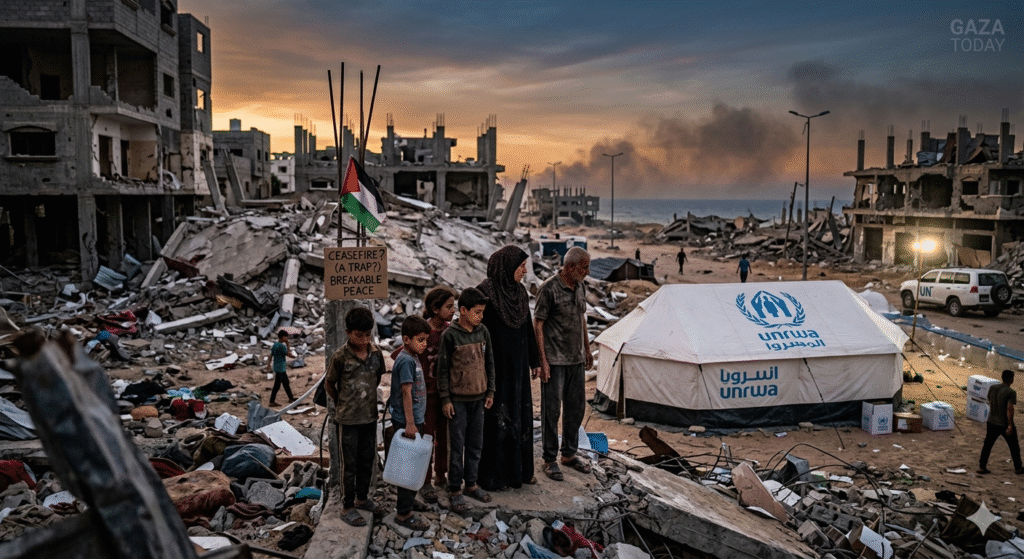
More than two years after the devastating war began, the Gaza Strip remains a landscape of ruin and resilience. While a ceasefire has brought a fragile halt to major hostilities, the 2.3 million Palestinians living in the coastal enclave face what the United Nations describes as one of the most severe humanitarian crises of the modern era. This article examines the grim reality of Gaza today across multiple dimensions of daily life.
The Water and Sanitation Catastrophe
Perhaps no single resource better illustrates Gaza’s collapse than water. Before the war, the Gaza Municipality pumped approximately 100,000 cubic meters of water per day across the city. Today, that figure has plummeted to roughly 35,000 cubic meters. The per capita share of water has fallen from 80 liters per day to a staggering 10 liters—a deficit exceeding 90 percent of the population’s actual needs.
The infrastructure damage is extensive. Approximately 195,000 linear meters of water networks and 220,000 meters of sewage networks have been destroyed, with the majority of wells rendered inoperable. This collapse has created a public health time bomb. Without adequate clean water, sanitation becomes impossible, and disease spreads rapidly. Respiratory infections, acute watery diarrhea, and skin infections are now the most common illnesses reported across Gaza’s remaining health facilities.
Compounding the water crisis is the waste emergency. Gaza City alone accumulates approximately 700 tons of solid waste daily, with total accumulated waste reaching hundreds of thousands of tons. The Firas Market area in downtown Gaza City—once a bustling commercial hub—became a massive, foul-smelling landfill where approximately 370,000 tons of waste piled up during the war. The municipality has begun a plan to remove roughly 2,000 cubic meters of accumulated waste from this area, an operation expected to take about six months given severely limited resources.
The United Nations Development Programme (UNDP) estimates that, at the current pace, removing all the rubble and waste across Gaza will take seven years. Currently, only 0.5 percent of the rubble has been cleared.
Health System Collapse
Gaza’s healthcare system, once among the most developed in the region, has been systematically dismantled. According to UNICEF, no hospital is fully functional in the Gaza Strip. Only 50 percent of hospitals (18 out of 36) are partially functional, while a mere 1.5 percent of primary healthcare centers (3 out of 200) remain fully operational.
The consequences for patients are devastating. Sexual and reproductive health services remain severely disrupted, with screening and treatment services for cervical and breast cancer largely suspended since October 2023. There are an estimated 50,000 pregnant women in Gaza, with approximately 160 to 180 births occurring daily. Severe bed shortages mean women undergoing major procedures, including Caesarean sections, are often discharged within hours and must return to overcrowded displacement settings, dramatically increasing risks of complications and infection.
Medical evacuations, critical for patients requiring specialized care unavailable in Gaza, have been repeatedly disrupted. While the Rafah crossing reopened in February 2026, allowing some evacuations, the process remains complex. Over 18,000 patients in Gaza remain in urgent need of medical treatment unavailable locally. Restrictions on the entry of “dual-use” medical equipment—including ultrasound machines, incubators, ventilators, and mobile maternity units—continue to undermine safe care.
Public health experts have described the conditions in Gaza as “de-healthification”—the systematic destruction of the environment necessary for human health and reproduction. The term “wet tent syndrome” has emerged to describe the interrelated effects of immune deficiency, infections, and the inability to recover due to the destruction of housing and infrastructure. At least ten children reportedly froze to death during the winter of 2025-2026, a stark reminder of the deadly impact of exposure without adequate shelter.
Food Insecurity: Famine Pushed Back, Not Defeated
In March 2026, UN agencies announced cautiously optimistic news: famine had been pushed back in the Gaza Strip following the October ceasefire and improved humanitarian and commercial access. No areas of the Strip are currently classified in famine conditions.
However, this progress remains extremely fragile. According to the latest Integrated Food Security Phase Classification (IPC) analysis, at least 1.6 million people—77 percent of Gaza’s population—still face high levels of acute food insecurity. Over 100,000 children and 37,000 pregnant and breastfeeding women are projected to suffer acute malnutrition through April 2026. Four governorates (North Gaza, Gaza Governorate, Deir al-Balah, and Khan Younis) remain classified in the “Emergency” phase, one step below famine.
The ceasefire has improved some food deliveries, with over 730,000 people receiving assistance since October. However, most families continue to grapple with severe shortages. In February 2026, partners reached approximately 1.2 million people with reduced rations that covered only 50 percent of minimum caloric needs. The closure of all crossings in late February sparked immediate concerns about aid operations, though the subsequent reopening of Kerem Shalom allowed partners to avert critical reductions.
The World Food Programme and other UN agencies warn that without sustained, large-scale expansion of food, livelihood, agriculture, and health assistance, hundreds of thousands of people could rapidly slip back into famine conditions.
Economic Erasure: 80 Percent Unemployment
The war has effectively erased Gaza’s economy. According to the Palestinian Central Bureau of Statistics, unemployment in the Gaza Strip has increased to 80 percent. The local GDP has plunged by 87 percent over the past two years to a mere $362 million, with GDP per capita down to $161—effectively erasing 22 years of development.
The government in Gaza estimates that 90 percent of all sectors, including housing and infrastructure, have been wiped out, with total economic losses estimated at $70 billion. Historically, the private sector was Gaza’s main economic engine, contributing to 52 percent of local employment. Today, that backbone has been shattered.
For young Palestinians, the situation is particularly绝望. Approximately 70 percent of Gaza’s residents are under 30, and they face what the UN describes as the fastest and most damaging economic collapse on record. Mahmoud Shamiya, a university graduate with a degree in basic education, now spends his days fetching water, scavenging for firewood, and surviving in a tent. “The occupation and this war came and destroyed all the landmarks of education in Gaza,” he told Al Jazeera. “Today, we have become aimless, jobless, and hopeless. We live a deadly routine”.
Educational Erasure: A Generation at Risk
The destruction of Gaza’s educational infrastructure has effectively paused the lives of an entire generation. Israel destroyed most universities and schools in Gaza. For students trapped inside the besieged enclave, the future has become a void.
Mona Al-Mashharawi finished high school in 2023, just before the war began. She had secured a place at a university in Algeria and was scheduled to travel in November 2023. Instead, she remains trapped in Gaza, unable to complete her education. “Two years of my life have been lost, and I am now entering the third. These years are automatically vanishing from our lives,” she told Al Jazeera.
Some educational efforts continue. Since January 2026, the Education Cluster has reached 107,540 school-aged children and 4,200 kindergarten-aged children across 110 temporary learning spaces, providing school-in-a-carton kits and recreational materials. But these interventions, while vital, cannot replace the systematic education that has been lost.
Displacement and Shelter Crisis
The vast majority of Gaza’s population remains displaced. Approximately 1.5 million people are living in catastrophic conditions, many in makeshift tents and among the rubble. The UNDP has begun replacing rudimentary tents with recovery housing units, but 4,000 units ready for distribution are a fraction of the 300,000 needed.
Displacement has not stopped with the ceasefire. Since October 2025, more than 730,000 people have been displaced, many moving multiple times as conditions shift and areas remain inaccessible. Deadly shelling continues almost daily, particularly along the so-called “Yellow Line” dividing Israeli-controlled and Palestinian areas, leaving people in a constant state of fear.
Humanitarian Access: The Critical Bottleneck
The single greatest obstacle to relief and reconstruction is access. Despite the ceasefire, more than half of Gaza remains inaccessible due to the presence of Israeli forces. Only two crossings—Rafah and Kerem Shalom—remain open, and Israeli authorities heavily restrict deliveries.
The situation remains highly volatile. In late February 2026, Israeli authorities closed all crossings into Gaza, suspending the entry of aid, fuel, and commercial supplies, as well as coordination of humanitarian movements and medical evacuations. While Kerem Shalom reopened for fuel and some aid cargo, the Rafah crossing remained closed for evacuations and staff rotations as of early March.
International humanitarian workers face severe restrictions on entering Gaza. Nickolay Mladenov, High Representative for Gaza at the Board of Peace, told a UN Security Council session in March 2026 that “essential services are operating at a fraction of pre-war capacity. The healthcare system is in collapse. There is no functioning economy”.
Regional Tensions: A Dangerous Distraction
As of April 2026, the United Nations has warned that escalating regional tensions—including US-Israeli military action against Iran—are diverting global attention from Gaza. Olga Cherevko of the UN Office for the Coordination of Humanitarian Affairs noted that this decline in attention began even after the ceasefire took effect, and that “deadly shelling continues daily, and Israel is blocking the agreed deliveries of food, medicine, medical supplies and shelter materials to Gaza”.
The risk is that as the world’s focus shifts elsewhere, Gaza’s fragile gains will reverse. The UN has the funds and capacity to scale up relief and reconstruction operations, but it does not have the necessary access to carry out these vital tasks.
The Human Toll: Numbers Beyond Comprehension
Since October 7, 2023, the human cost has been staggering. As of early February 2026, 71,803 Palestinians have been reported killed in the Gaza Strip, including at least 21,289 children. Additionally, 171,230 Palestinians have been reported injured, including 44,500 children. Even since the ceasefire began on October 10, 2025, 529 Palestinians have been reported killed, including more than 120 children.
These numbers, drawn from the Gaza Ministry of Health, represent individuals—fathers, mothers, children, students, doctors, teachers—whose lives have been violently interrupted. Behind each statistic is a story of loss that no ceasefire can restore.
A Fragile Hope
The ceasefire of October 2025 brought a desperately needed pause to the killing. Famine has been pushed back. Some aid is flowing. The Rafah crossing has partially reopened. But these are fragile gains, dependent on continued international attention and political will.
For the people of Gaza, the end of active hostilities has not meant the end of suffering. Two million people remain trapped in a territory where water is scarce, hospitals are broken, the economy is in ruins, and the rubble of their former lives surrounds them on every side. As Mahmoud Shamiya, standing by the Mediterranean Sea, told Al Jazeera: “Our years have been stolen, and the knife of time is constantly stealing from us. We are growing older without a goal”.
The question facing the international community is whether Gaza will be rebuilt—or whether, once again, the world will look away.
