

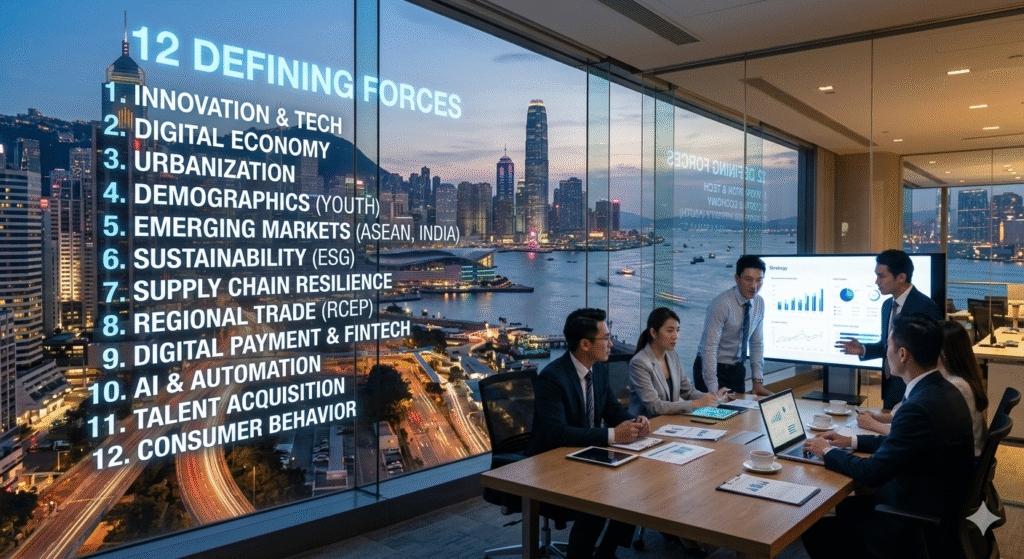
From the fintech alleys of Jakarta to the semiconductor foundries of Taiwan and the green hydrogen plants of Saudi Arabia, Asia is no longer just the world’s factory—it is the world’s laboratory. In 2026, doing business in Asia means navigating a landscape of extreme contrasts: record-breaking growth alongside demographic collapse; AI adoption alongside protectionist resurgences. This report breaks down the state of Asian commerce into 12 critical parts.
Part 1: The Great Supply Chain Pivot – From “China Plus One” to “China Plus Many”
For a decade, multinationals spoke of the “China Plus One” strategy—keeping a foothold in China while adding Vietnam or India. Today, that strategy has evolved into “China Plus Many.” The decoupling is real, but it is not a stampede; it is a surgical reweaving.
Vietnam has emerged as the undisputed winner in light manufacturing, surpassing China in textile exports to the US and EU. But Vietnam’s infrastructure is creaking under the weight: ports are congested, and electricity blackouts disrupted factory output in mid-2025. Meanwhile, India’s production-linked incentive (PLI) schemes have turned the country into a smartphone export powerhouse, with Apple now assembling nearly 20% of its iPhones in Tamil Nadu. However, India’s complex customs regime remains a headache. The savvy Asian business leader today maintains at least three supply chain nodes: China for high-end components, Southeast Asia for assembly, and a domestic hub for regulatory resilience.
Part 2: China’s Deflationary Hangover – A Consumer Who No Longer Binge-Shops
China remains Asia’s largest economy, but the narrative has flipped. After decades of conspicuous consumption, the Chinese consumer has become radically pragmatic. Real estate wealth has evaporated, youth unemployment hovers near 20%, and the “lying flat” mentality has migrated from social media meme to purchasing behavior.
Luxury brands are hurting. LVMH reported a 12% drop in Chinese sales in late 2025. Conversely, discount retailers like Miniso and budget electric vehicle (EV) maker BYD are thriving. The lesson for business today: the Chinese market is no longer a fountain of endless premium spending. Success requires value engineering and a focus on the “silver economy”—the 400 million Chinese citizens over 50 who hold the majority of the country’s savings.
Part 3: India’s Inflection Point – Formalization Finally Arrives
For thirty years, India’s economy was defined by a chaotic, cash-based informal sector. That era is ending. The combination of Goods and Services Tax (GST), digital payments (UPI), and a relentless formalization drive has created a unified market for the first time.
In 2026, India is the fastest-growing major economy at 7.5% GDP growth. But the story is beneath the headline. Logistics costs have dropped from 14% to 8% of GDP thanks to the Dedicated Freight Corridors. Warehousing has become an institutional asset class. For foreign investors, the opportunity has shifted from IT services (which are now mature) to industrial manufacturing, specialty chemicals, and aviation—India just placed an order for 1,000 new aircraft.
Part 4: Southeast Asia’s Data Center Gold Rush
The cloud has landed in Southeast Asia. Driven by AI processing needs and regional data residency laws, a frenzy of data center construction is sweeping across Johor (Malaysia), Batam (Indonesia), and Bangkok. Singapore, once the region’s undisputed hub, imposed a moratorium on new data centers due to energy constraints.
The result is a belt of hyper-scale facilities. By 2027, Malaysia alone will host over $15 billion in data center investment. However, a looming problem exists: energy. These centers consume massive amounts of water and electricity. In water-stressed Thailand, new projects face community opposition. The smart money is now betting on data centers powered by floating solar or small modular reactors (SMRs), a technology Asian utilities are quietly piloting.
Part 5: The EV Battery War – Beyond Lithium
Asia dominates electric vehicle battery production, with China’s CATL and BYD controlling over 60% of global capacity. But the next frontier is not lithium—it is sodium-ion and solid-state batteries. Chinese firms are already mass-producing sodium-ion batteries for low-cost EVs, reducing reliance on imported lithium.
Japan is fighting back. Toyota finally launched its first commercial solid-state battery EV in late 2025, promising a 10-minute charge and 1,000km range. Meanwhile, Indonesia is leveraging its nickel reserves to become a downstream processing giant, banning raw nickel exports to force Tesla and Hyundai to build smelters locally. For Asian businesses, the battery war is no longer about who mines the metal, but who controls the chemistry.
Part 6: Japan’s Quiet Renaissance – Inflation, Wages, and Shareholder Activism
After three lost decades, Japan is noisy again. For the first time since 1992, the country has sustained inflation above 2% for two consecutive years. Wages are rising—Toyota just gave its largest pay hike in 25 years. This has broken the deflationary mindset.
But the more seismic shift is corporate governance. The Tokyo Stock Exchange is publicly shaming companies with price-to-book ratios below 1, forcing them to return capital to shareholders or face delisting. Activist investors like Elliott Management and Oasis have won board seats at major Japanese firms. The result: Japanese equities are no longer a “value trap.” They are a genuine growth story, particularly in defense, robotics, and specialty finance.
Part 7: Korea’s Chaebol Crisis – Succession and Scandal
South Korea’s conglomerates—Samsung, Hyundai, SK—remain global powerhouses. But the hereditary succession model that built them is fracturing. The Lee family’s grip on Samsung has loosened after legal battles and the de facto leadership vacuum following Jay Y. Lee’s legal troubles. Younger Korean workers reject the “iron rice bowl” corporate culture, leading to a talent exodus toward startups.
Paradoxically, this is healthy. Korea’s startup scene is booming in bio-tech (Celltrion) and gaming (Shift Up). The government is actively promoting a “Korean Sandbox” to deregulate fintech. Business today in Korea means understanding that the old chaebol are no longer the only game in town; the venture capital corridors of Pangyo and Busan are where the real innovation lives.
Part 8: The Rise of Asian Private Credit – Banking’s New Shadow
When Western banks retreated from Asia after the Credit Suisse collapse and US regional banking crisis, a vacuum appeared. Asian private credit funds—from Singapore’s Azalea to Japan’s Advantage Partners—rushed to fill it. In 2025, private credit in Asia grew by 30% year-over-year, funding everything from Vietnamese real estate to Australian infrastructure.
Unlike the West, where private credit is often leveraged buyouts, Asia’s version is predominantly growth capital and rescue financing. For mid-sized family businesses in Indonesia or the Philippines that cannot meet the strict covenants of a traditional bank, private credit is the oxygen. The risk? Regulation is coming. The Monetary Authority of Singapore and Hong Kong’s SFC are both drafting rules to prevent a shadow banking crisis.
Part 9: Digital Public Infrastructure – The Asian Model Goes Global
The most exported Asian business idea is not an app—it’s a system. India’s “India Stack” (digital ID, payments, data sharing) has become a blueprint. From the Philippines to Morocco, nations are adopting similar architectures. The commercial implication is profound: any digital business can now verify identity, collect payments, and access consent-based data without building its own infrastructure.
This has spawned a generation of “API-first” startups. In Indonesia, a fintech lender can onboard a rural farmer in 90 seconds using the national digital ID. In Thailand, health insurance claims are processed instantly via the national data exchange. The winners in Asian business today are those who build on top of this public infrastructure, not those who try to own the infrastructure itself.
Part 10: The Green Dilemma – Coal, Carbon Credits, and Hypocrisy
No region faces a starker energy trilemma than Asia: how to grow economies, lift millions from poverty, and decarbonize simultaneously. The uncomfortable truth is that coal is not dead. China is building new coal plants. India’s peak power demand hit a record 250 gigawatts in 2025, met largely by thermal power.
Yet the green business opportunity is enormous. The voluntary carbon credit market in Southeast Asia is exploding, with nature-based credits (protecting mangroves, reforesting Borneo) fetching premium prices. Solar manufacturing is shifting from China to Vietnam and India to avoid US tariffs. The pragmatic Asian executive does not preach net-zero purity; they hedge. They buy both carbon offsets and coal futures. Honesty about this contradiction is becoming a competitive advantage.
Part 11: Geopolitics as a Business Variable – The Chip Curtain
For most of modern history, Asian businesses could ignore geopolitics. No longer. The “Chip Curtain”—a de facto technological border between US-aligned and China-aligned semiconductor supply chains—is now a reality. Companies must choose, or at least declare.
Nvidia’s specially designed “H20” chips for China are legal but hobbled. Chinese firms like Huawei are building an alternative ecosystem, from lithography to packaging. For a Taiwanese semiconductor materials supplier or a Malaysian chip tester, this means maintaining two separate compliance teams. The cost of doing business in Asia now includes a “geopolitical risk premium.” Boards are hiring former diplomats as strategy heads. Ignoring US-China tensions is no longer an option; it’s a liability.
Part 12: The Demographic Cliff – Automation, Immigration, and the Silver Dividend
Asia is aging faster than anywhere on Earth. Japan, South Korea, China, and Thailand are all past the demographic turning point. Shrinking workforces mean shrinking domestic markets. But savvy businesses see three counter-strategies.
First, automation. Chinese factory robot density now exceeds Germany’s. Second, internal migration liberalization—Japan is quietly opening its doors to Southeast Asian nurses and construction workers. Third, and most powerfully, the “silver dividend.” South Korea’s elderly poverty rate is high, but their spending power is rising. From Tokyo to Taipei, businesses are redesigning everything: housing, finance, and healthcare for people aged 65 to 85 who are healthy, wealthy, and bored. The company that cracks the Asian senior market will mint a trillion-dollar fortune.
Conclusion: No Single Asia, No Single Strategy
The most dangerous mistake in business today is treating Asia as a monolith. The economic reality of a tech startup in Bangalore bears no relation to a trading house in Shanghai or a palm oil plantation in Kuala Lumpur. Asia in 2026 is not a single story. It is 12 different stories—each with its own risks, its own rhythms, and its own unprecedented opportunities. The winners will be those who read all twelve chapters at once.