

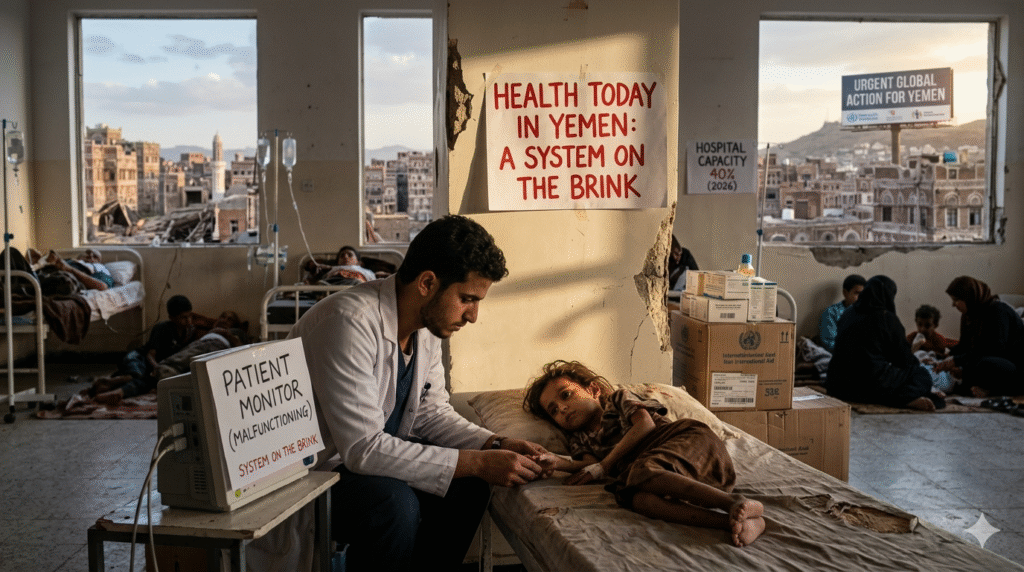
As Yemen enters April 2026, the country’s health sector is teetering on the edge of complete collapse. After more than a decade of conflict, economic devastation, and mounting disease outbreaks, the nation faces what the World Health Organization describes as “one of the world’s most complex health emergencies” . With only half of health facilities functional, funding shortfalls threatening to shutter 70 percent of remaining services, and a resurgence of cholera claiming lives daily, Yemen’s health crisis is deepening at an alarming rate.
The Funding Catastrophe
The most immediate threat to Yemen’s health system is financial. In February 2026, Minister of Public Health and Population Qasim Buhaibeh issued a stark warning: approximately 70 percent of health facilities are at risk of shutting down due to a sharp decline in donor funding . In some cases, funding decreases have reached 100 percent, crippling the operational budgets of hospitals and health centers already strained by rising costs and currency depreciation .
The World Health Organization has appealed for US$38.8 million to deliver life-saving emergency health assistance to 10.5 million people across Yemen in 2026 . The broader UN-led Humanitarian Needs and Response Plan for Yemen requests US$2.16 billion to reach 12 million of the most vulnerable people, including 9.4 million prioritized for targeted life-saving interventions .
The consequences of this funding gap are already visible. According to the Minister of Health, the number of functional health facilities has already dropped from 60 percent to 50 percent of the country’s approximately 5,000 total facilities. If the funding decline continues, operational capacity could plummet to just 30 percent, directly threatening all health indicators in the country .
Cholera and Disease Outbreaks Surge
As the health system weakens, infectious diseases are spreading unchecked. According to the European Centre for Disease Prevention and Control, Yemen reported 1,626 new cholera cases and one death between late December 2025 and early February 2026 . Since October 2025, more than 124,000 suspected cases and 923 deaths have been recorded nationwide .
The cholera outbreak is driven by multiple factors: low immunization coverage, unsafe water and sanitation systems, population displacement, and limited access to care . Climate-related shocks, including floods and extreme weather, are intensifying transmission risks and damaging already fragile health infrastructure . Nearly 15 million people have no access to safe water or sanitation, creating ideal conditions for waterborne diseases to flourish .
Yemen is also experiencing concurrent outbreaks of measles, dengue fever, polio, and diphtheria . The decline in free vaccination programs has created openings for vaccine-preventable diseases to resurge, threatening children who had previously been protected .
In response to the emergency, Qatar Charity recently completed a three-month humanitarian intervention, supplying essential medicines, IV fluids, and medical consumables to 13 health facilities across Hudaydah, Hajjah, Taiz, and Aden, reaching approximately 48,000 people . Dr. Fouad Al-Haddad, Director General of the Republican Hospital in Taiz, said the support provided crucial relief for the facility, the city’s primary referral center for acute watery diarrhea cases .
Malnutrition Reaches Critical Levels
The food security situation in Yemen has deteriorated to catastrophic levels. According to the UN Office for the Coordination of Humanitarian Affairs, 18.3 million people are acutely food insecure nationwide . The latest Integrated Phase Classification analysis indicates further deterioration, with districts shifting from crisis to emergency levels and pockets of catastrophic conditions affecting the most fragile communities .
The impact on children is devastating. More than 2.2 million children under five are acutely malnourished, including 516,157 suffering from severe acute malnutrition (SAM)—a condition that can be fatal without immediate medical treatment . An additional 1.3 million pregnant and breastfeeding women are also expected to be malnourished, creating intergenerational consequences for child health and development .
Minister Buhaibeh has highlighted that nearly 50 percent of children suffer from chronic malnutrition, with one-quarter of children under five experiencing stunting—irreversible damage to physical and cognitive development .
Health Infrastructure in Ruins
The scale of destruction to Yemen’s health infrastructure is staggering. According to a report released by the Ministry of Public Health and Environment on March 29, 2026, the conflict has directly targeted health facilities, destroying 670 facilities and ambulances—165 completely destroyed and 376 partially damaged, along with approximately 129 ambulances struck while carrying out humanitarian duties .
The report documented the complete destruction of 21 hospitals and partial damage to 51 others across 14 governorates. Hajjah, Sa’ada, the capital Sana’a, Hodeida, Amran, and Taiz were among the hardest-hit areas . Additionally, a pharmaceutical factory and two oxygen plants were destroyed. Initial estimates place the cost of damage to health facilities at $7 billion .
The human toll of the conflict is equally devastating. Since the beginning of the aggression in March 2015 until March 26, 2026, the total number of dead and wounded who reached hospitals reached 60,000, including 24,000 killed and 36,000 injured . Among them were 3,243 children killed and 5,019 injured, while 3,250 women were killed and 3,436 injured. Sixty-six medical and emergency personnel were killed while performing their duties .
The Human Exodus: Brain Drain and Medical Migration
The destruction of infrastructure has been accompanied by a devastating loss of human capital. The conflict has caused over 95 percent of foreign medical staff to leave the country and led to the migration of more than 7,000 specialized Yemeni medical professionals . Minister Buhaibeh describes a “brain drain” of medical personnel moving abroad or to the private sector due to weak incentives in the public sector and a hiring freeze that has lasted over a decade .
This exodus places unbearable pressure on the remaining health workforce, who must serve a population of more than 30 million with severely limited resources. Many health facilities operate with skeleton crews, unable to provide even basic services.
Maternal and Child Mortality
The collapse of the health system has had a catastrophic impact on maternal and child health. According to UNICEF, maternal mortality in Yemen stands at 118 deaths per 100,000 live births—among the highest in the region . Neonatal mortality is 21 per 1,000 live births, accounting for approximately half of all childhood deaths .
The Minister of Health has reported even higher maternal mortality figures, estimating 183 deaths per 100,000 live births . For pregnant women and newborns, the absence of functioning health facilities, trained birth attendants, and emergency obstetric care means that complications that would be treatable elsewhere become death sentences.
Chronic Disease Crisis
Amid the focus on infectious diseases and malnutrition, a silent crisis of chronic illness is unfolding. The Minister of Health has warned of a significant rise in cases of cancer, kidney failure, and heart disease . According to the Ministry’s recent report, around 8,000 dialysis patients are struggling for survival due to medication shortages, with 5,000 deaths recorded among them. Meanwhile, 100,000 cancer patients face critical shortages, with 60 percent of medications unavailable .
More than 40,000 patients with thalassemia and genetic blood disorders are at risk, with 684 deaths recorded among them due to lack of treatment. Shortages of hemophilia and leukemia drugs have reached 30 percent, with hundreds of leukemia patients requiring treatment abroad .
The blockade has severely restricted the import of medicines. The report documented a 60 percent decline in pharmaceutical imports and the suspension of over 83 importers . Many local pharmaceutical factories have ceased operations due to restrictions on importing raw materials. Hundreds of thousands of patients in need of specialized treatment have been prevented from traveling abroad, especially cancer and heart patients. More than 90 percent of patients cannot travel due to economic conditions and restrictive procedures .
The Blockade’s Toll
A central theme across all health data is the impact of the ongoing blockade. Since March 2015, Yemen has faced a comprehensive blockade that restricts the import of food, medicine, fuel, and essential supplies. The Ministry of Health report states that 1.4 million people have died due to the blockade, disease outbreaks, and malnutrition—a figure that underscores the lethal consequences of restricted access to basic necessities .
The blockade has particularly affected the fuel supply, crippling water and sanitation systems, hospital generators, and the cold chain for vaccines and medicines. Without fuel, water pumping stations cannot operate, leading to the waterborne disease outbreaks that have become endemic. Without fuel, hospitals cannot keep the lights on or run life-saving equipment.
Glimmers of Support
Amid the devastation, some international support continues to flow, though it remains far below what is needed. In February 2026, the Government of Japan provided a new aid grant of $611,000 to UNICEF Yemen to address urgent emergency health needs and respond to public health emergencies through primary healthcare system services . The grant will support 10 primary care health facilities, reaching 13,500 children under five and 5,700 women over a one-year period .
UNICEF Representative to Yemen Peter Hawkins expressed gratitude for the support, emphasizing that it will help deliver essential health services to the most vulnerable girls, boys, and women in the most affected areas . However, such targeted interventions, while valuable, cannot compensate for the systemic collapse of a health system that once served millions.
Outlook
Yemen’s health crisis is not merely a humanitarian emergency—it is a slow-motion catastrophe that has claimed hundreds of thousands of lives and continues to threaten millions more. The combination of active conflict, economic collapse, funding shortfalls, and disease outbreaks has created a perfect storm from which the health system cannot recover without sustained, large-scale international intervention.
The WHO’s $38.8 million appeal and the broader $2.16 billion Humanitarian Response Plan represent the minimum required to prevent further deterioration . Yet as of early April 2026, these appeals remain significantly underfunded, with the Minister of Health warning that 70 percent of facilities could close without urgent intervention .
For the people of Yemen, the consequences are measured in lives lost, children stunted, mothers dying in childbirth, and patients with treatable conditions left to suffer. As Dr. Syed Jaffar Hussain, WHO Representative in Yemen, warned: “Every delay in funding translates into lost opportunities to save lives” .
The international community faces a choice: provide the resources needed to sustain Yemen’s health system or witness its complete collapse, with consequences that would reverberate across the region for generations. For now, Yemen’s health system remains on life support—and time is running out.