

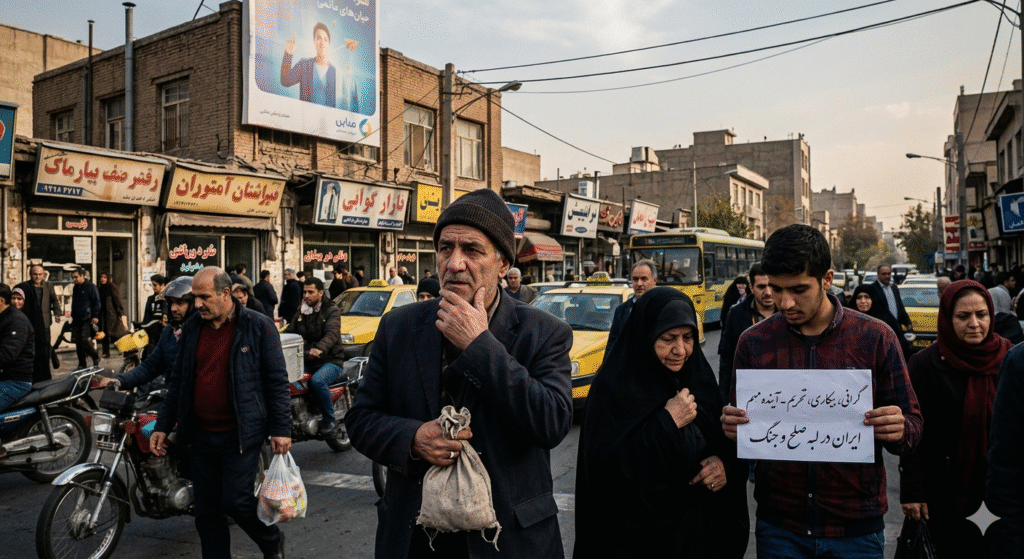
As March 2026 draws to a close, the Islamic Republic of Iran stands at the most perilous crossroads in its 47-year history. The country is simultaneously grappling with the devastation of an active war against the United States and Israel, an economy in freefall, and the most profound domestic instability since the 1979 revolution. With the death of Supreme Leader Ayatollah Ali Khamenei on February 28 and the imposition of a total internet blackout now entering its fourth week, Iran faces an uncertain future where regime survival hangs in the balance .
War and the New Geopolitical Reality
The landscape of the Middle East was irrevocably altered on February 28, 2026, when the United States and Israel launched “Operation Epic Fury”—a coordinated kinetic campaign targeting Iran’s nuclear facilities and military leadership. The operation resulted in the death of Supreme Leader Ayatollah Ali Khamenei, who had ruled Iran since 1989, along with dozens of senior defense figures . The strikes marked a dramatic escalation from years of shadow warfare to open military confrontation.
As the conflict enters its fifth week, Iran has retaliated by widening its attacks on targets in neighboring Gulf states, driving up global energy costs and threatening the stability of the Strait of Hormuz, through which approximately 40 percent of China’s oil passes . While U.S. President Donald Trump has publicly stated that regime change is the objective, the Islamic Republic’s complex power structures—comprising the presidency, the Islamic Revolutionary Guard Corps (IRGC), the judiciary, and the cleric-led Guardian Council—have thus far prevented total collapse. A provisional leadership council now oversees the country until a new Supreme Leader is chosen, with Khamenei’s son, Mojtaba Khamenei, widely viewed as the frontrunner .
Economic Freefall: From Struggle to Terminal Contraction
Even before the war, Iran’s economy was deteriorating under the weight of decades of mismanagement, corruption, and the “maximum pressure” sanctions campaign reinstated during Trump’s first term. Today, the situation has become catastrophic. The International Monetary Fund projects real GDP growth of just 0.6 percent for 2025, with only a modest rebound to 1.1 percent expected in 2026—figures that now appear optimistic given the war’s escalation . More recent assessments from Fitch Solutions paint a grimmer picture, forecasting a contraction of 3.0 percent in the current fiscal year and a further decline of 1.4 percent in 2026/27 .
Inflation, the “most terrible disease” afflicting Iran’s economy according to a member of the Chamber of Commerce, has officially reached 42.4 percent, though independent analysts suggest the real rate is substantially higher . Food inflation has been particularly devastating, with staple items like bread and cooking oil surging by 142 percent and 207 percent respectively . The Iranian rial has hit a historic low of approximately 1.5 million to the U.S. dollar, rendering savings worthless and pushing millions into poverty .
The currency collapse has triggered a cascade of economic dysfunction. Imported raw materials have become prohibitively expensive, squeezing manufacturers already struggling with liquidity shortages. Domestic demand has collapsed, and factories face growing inventories with no buyers. Business associations now warn that parts of Iran’s industrial base face shutdowns, threatening job losses and the permanent erosion of productive capacity . For many producers, exporting has shifted from a growth strategy to a necessity for survival .
The Internet Blackout and Business Paralysis
Since the war began on February 28, Iran’s authorities have imposed the longest internet shutdown in the country’s history—a 25-day and counting disconnection from the global internet . Unlike previous restrictions, authorities have offered no timeline for restoration, leaving more than 90 million Iranians cut off from the outside world.
The economic impact has been devastating. Small businesses that relied on platforms like Instagram and Telegram for e-commerce have been forced to suspend operations entirely. A young woman who ran an online jewelry business told Al Jazeera she has not had sustainable income in months, noting that “it is not only humiliating, but it is also forcing businesses to close down and inflation to grow” . Even the historic Grand Bazaar in Tehran, the heart of the capital’s commercial district, reported sales at roughly one-third of usual levels during the critical Nowruz holiday season—normally the busiest time of the year .
The judiciary has compounded the economic pain by confiscating the assets of Iranians deemed to be aligned with “hostile countries,” including celebrities and business owners who expressed solidarity with protesters. The government has announced it now has the capability to “identify and confiscate assets online” for those believed to oppose the regime .
The Development Plan Mirage
Against this backdrop of war and economic collapse, the government of President Ebrahim Raisi is attempting to implement the Seventh National Development Plan, a sweeping economic blueprint that critics have called “delusional” and “over-ambitious” . The plan envisions a $1.2 trillion budget that would require GDP growth of 46.9 percent, oil export increases of 79.4 percent, and investment growth rates of 22.6 percent—targets that bear no relationship to Iran’s current economic reality .
The plan has drawn sharp criticism for ignoring fundamental structural problems. Iran’s pension funds, which cover 25 million retirees, face bankruptcy unless the government replenishes their coffers. The health sector receives inadequate attention, with rapid privatization threatening to neglect critical health indices in smaller towns and rural areas. Meanwhile, the budget actually increases allocations to the armed forces, the IRGC, and the Basij by approximately $52.2 million, diverting much-needed funds away from the Iranian people .
Investment and the Diplomacy of Survival
Perhaps the most revealing insight into Tehran’s desperation came in late February, when Iranian officials—with Khamenei’s approval—informally floated the prospect of offering U.S. oil and gas companies direct investment opportunities in exchange for sanctions relief . The proposal, modeled on the Venezuelan approach where American energy companies operate despite political tensions, represented the first time since the 2015 nuclear deal negotiations that Iranian officials had hinted at openness to U.S. investment .
The commercial incentives Iran offered were sweeping: opening vital sectors including oil, gas, mining, and aviation to direct American investments, coupled with technical proposals to reduce uranium enrichment from 60 percent to just 1.5 percent or suspend enrichment operations entirely . Tehran even proposed establishing an “Arab-Iranian consortium” to manage nuclear fuel inside Iran, addressing international proliferation concerns while preserving some domestic capabilities.
The overture failed. The United States demanded permanent and comprehensive guarantees without “sunset clauses,” insisting on zero enrichment as the ultimate goal. Iran refused to concede on core demands regarding its nuclear program, and negotiations collapsed before the proposal could be formally presented . Days later, the war began.
The Domestic Front: Repression and Resistance
Amid the external war and economic crisis, Iran’s domestic situation has grown increasingly repressive. Authorities have executed multiple people over the past week on national security charges related to last year’s June war and the nationwide protests in January . The judiciary has explicitly warned that anyone who protests against the establishment on the streets will be shot and killed as an “enemy.”
The internet shutdown serves not only to isolate Iranians from the global community but also to prevent the circulation of footage showing war damage or armed checkpoints. The IRGC-affiliated Fars news agency recently released the “confessions” of an unidentified young woman arrested for filming a missile impact point from her window, with the warning: “Those who send videos to anti-Iranian media must await this moment” .
Even pro-regime figures are expressing concern. Faezeh Hashemi, daughter of the late president Hashemi Rafsanjani, has argued that keeping the IRGC on the U.S. sanctions list serves Iran’s national interests, suggesting that the organization’s aggressive regional activities make it impossible to justify delisting . Her remarks underscore the growing unease among even establishment figures about the trajectory of the Islamic Republic.
Looking Ahead: Regime Survival and Aftermath
The central question facing Iran today is whether the Islamic Republic can survive the current crisis. The regime has demonstrated remarkable resilience over four decades, with careful succession planning and a complex web of power centers that have allowed it to endure despite the loss of its supreme leader . The IRGC, which depends on the regime’s survival for its extensive political and economic influence, has thus far abided by established processes rather than seeking to oust the civilian government .
Yet the scale of the current crisis is unprecedented. The combination of war, economic collapse, and domestic repression has created conditions that no Iranian government has faced since the chaos of the revolution itself. Even if the regime survives the immediate conflict—and analysts at Risk Advisory Group suggest this is “not out of the question”—it will emerge significantly weakened, isolated, and facing the monumental challenge of rebuilding an economy that has been systematically dismantled .
For the Iranian people, the situation is already catastrophic. As one Tehran shopkeeper told Al Jazeera during the Nowruz holiday, “Nobody is sure what comes next when we open back up after the holidays. Things have only gotten worse over the past few years” . The coming months will determine whether that trajectory can be reversed—or whether Iran is entering a prolonged period of instability from which recovery may take generations.
