

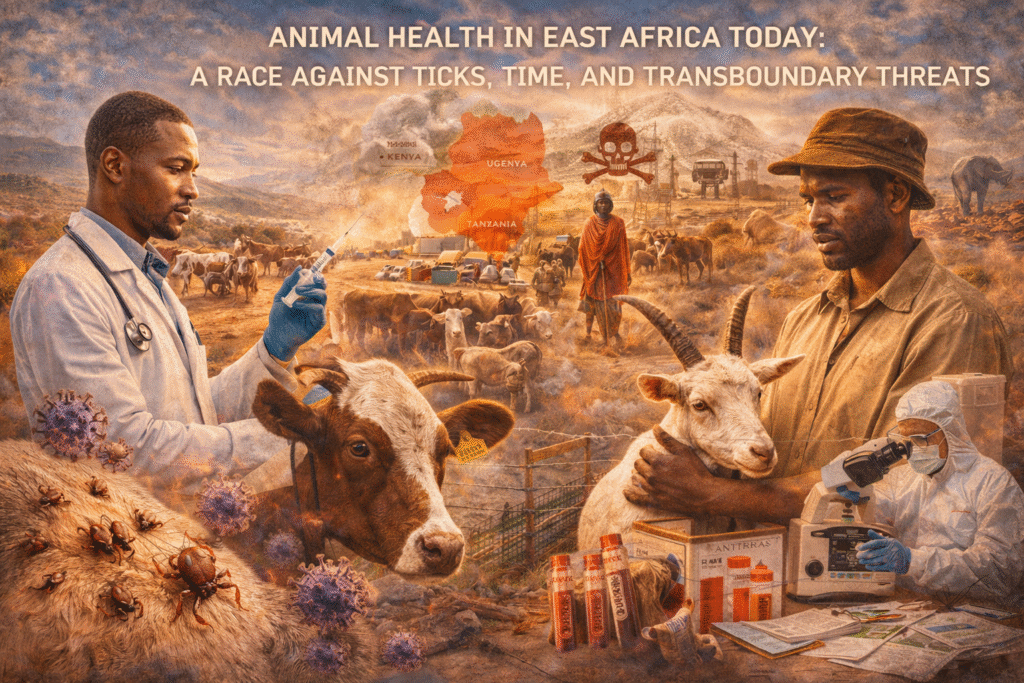
In the arid savannahs of Karamoja, where the borders between Uganda, Kenya, Ethiopia, and South Sudan exist only on maps, a herder’s wealth is measured in cattle—and his greatest fear is disease. Every 30 seconds, somewhere in East and Central Africa, a cow succumbs to East Coast Fever (ECF) . For the pastoralist families whose lives and livelihoods depend on healthy livestock, this is not a statistic; it is a daily tragedy that pushes households closer to the edge of hunger and poverty.
Animal health in East Africa today stands at a critical juncture. The region is witnessing unprecedented scientific breakthroughs—from next-generation vaccines to containerised laboratories—that promise to transform disease control. Yet the fundamental challenges remain as intractable as ever: porous borders, climate-driven migration, and the relentless spread of transboundary diseases that respect no national boundaries. This is the story of a region racing to protect its animals, and by extension, its people.
The Heavy Toll: Why Animal Health Matters
To understand the urgency, one must grasp the scale of what is at stake. Livestock underpin food and nutritional security for hundreds of millions of people across Eastern Africa . Yet according to the Food and Agriculture Organization, 34 percent of people in East Africa remain undernourished . Animal illness is a major contributor to this crisis: currently, 25 percent of protein from farm animals is lost due to disease , reducing the supply of high-quality milk, meat, and eggs while creating devastating economic losses for farmers .
The World Organisation for Animal Health (WOAH), during a recent high-level visit to Kenya, emphasised the critical link between robust veterinary systems and sustainable development. As Director General Emmanuelle Soubeyran noted, investing in animal health is not merely about treating sick cows—it is about protecting public health, empowering farmers, and building resilient food systems .
East Coast Fever: The 30-Second Killer
If one disease symbolises the animal health challenge in East Africa, it is East Coast Fever (ECF) . Caused by the single-celled parasite Theileria parva and transmitted by the brown ear tick, ECF is a cancer-like disease that often kills cattle within three weeks of infection . Last year alone, more than 1 million cattle in 11 countries died from ECF, causing losses estimated at Sh26 billion (approximately $200 million) . Some 28 million cattle in East and Central Africa are currently threatened by the disease, with one animal dying every 30 seconds .
The burden falls heaviest on the poor. Many of the animals threatened by ECF belong to pastoralist herders and smallholder farmers for whom the loss of even one cow can be catastrophic . In Tanzania, Kenya, Uganda, and beyond, families who depend on a handful of cattle for milk, income, and social standing watch helplessly as their animals sicken and die.
A Breakthrough in the Laboratory
But there is hope—and it comes from a laboratory in Nairobi. Scientists at the International Livestock Research Institute (ILRI) have launched a project to develop a superior third-generation vaccine against East Coast Fever . The new vaccine aims to replace the existing first-generation strain, which—while instrumental in protecting some 620,000 cows—has significant limitations.
The current vaccine costs between Sh680 and Sh1,020 (approximately $5-8), putting it beyond the reach of many smallholder farmers . It requires refrigeration to remain potent, a significant challenge in remote, off-grid areas. It takes 18 months to produce a single batch . And critically, vaccinated animals can still carry and transmit the parasite .
The new vaccine project, supported by an $11 million grant from the Bill & Melinda Gates Foundation, focuses on recent breakthroughs that have isolated proteins in the parasite—called antigens—likely to be crucial in protecting cattle . Some of these antigens appear capable of stimulating the production of protective antibodies.
The research has implications beyond cattle. Because ECF is caused by a parasite related to the one that causes malaria, and because it prompts white blood cells to multiply rapidly—much like cancerous cells—the vaccine research could also help scientists understand malaria and cancer transmission in humans .
Simple Solutions: Zero-Grazing Works
While scientists pursue high-tech vaccine solutions, ILRI researchers have confirmed that low-tech interventions remain powerfully effective. A recent study found that zero-grazed cattle have an 80 percent lower chance of contracting ECF compared to animals in free-range systems without tick control .
The study, which placed 548 zebu cattle under surveillance and assessed their infection status every five weeks, provides compelling evidence for a straightforward intervention: keep cattle confined and control ticks . For farmers who can afford the infrastructure and feed, zero-grazing offers a proven pathway to dramatically reduce disease risk.
Foot-and-Mouth Disease: A 10-Year Roadmap
If ECF is the region’s deadliest killer, Foot-and-Mouth Disease (FMD) is its most economically damaging. Routinely ranked among the top three priority diseases by governments and livestock keepers in Eastern Africa, FMD causes frequent outbreaks, major economic losses, and severe restrictions on livestock trade and market access .
In late 2025, governments and stakeholders across Eastern Africa took a decisive step forward, endorsing a 10-year strategic framework to tackle FMD . The “Strategic Framework for the Control of Foot-and-Mouth Disease in Eastern Africa 2026–2035” covers 12 countries: Burundi, Djibouti, Eritrea, Ethiopia, Kenya, Rwanda, Somalia, South Sudan, Sudan, Tanzania, Uganda, and the Democratic Republic of Congo .
Why Regional Coordination Matters
Dr. Huyam Salih, Director of the African Union’s Interafrican Bureau for Animal Resources (AU-IBAR), put it bluntly during the framework’s validation workshop in Nairobi: “No single country can manage FMD independently” . The disease’s transboundary nature—exacerbated by the extensive mobility of pastoral herds and porous borders—means that national initiatives alone cannot succeed .
The new framework rests on three core pillars :
- Knowledge and Evidence : Establishing regional information-sharing platforms, enhancing risk-assessment tools, and advancing epidemiological studies to better understand FMD patterns and impacts .
- Capacity Building : Region-wide training programs, more robust vaccination campaigns, improved diagnostic capabilities—including serotyping and vaccine matching—and promotion of public-private partnerships .
- Coordination and Cooperation : Harmonizing protocols across countries, reinforcing early-warning systems, enabling rapid response mechanisms, facilitating bulk procurement of affordable vaccines, and strengthening regional laboratory networks .
The framework responds to weaknesses identified during a 2024 roadmap meeting in Dar es Salaam: inadequate vaccination coverage, limited laboratory capabilities, fragmented movement control, and insufficient political commitment and financing .
Investing in Infrastructure: Zanzibar’s New Laboratory
Laboratory capacity is the backbone of effective disease control, and East Africa is seeing significant investment in this area. In January 2026, Zanzibar unveiled a modern animal health research laboratory—the first of its kind in East Africa .
The Sh1.2 billion (approximately $9.3 million) facility, established by Germany’s Friedrich Loeffler Institute (FLI) in partnership with Zanzibar’s government, is a container-based laboratory equipped to provide diagnostic services to German and international standards . Across Africa, similar facilities exist only in Ghana and Namibia, making Zanzibar’s the third on the continent .
The laboratory is expected to solve critical veterinary diagnostic gaps that have deterred large-scale livestock investment. As Deputy Minister for Agriculture Dr. Salum Soud Hamed explained: “Whenever investors wanted to invest in the livestock sector, the first question they asked was about the availability of veterinary treatment services” . The new facility will serve not only livestock keepers but also stakeholders in forestry and wildlife, as wild animals are also affected by diseases requiring laboratory-based diagnosis .
The laboratory is digitally linked to FLI’s main facility in Germany, and three Zanzibari specialists have already been sent to Germany for advanced training . This combination of infrastructure and human capacity development represents a model for the region.
Private Sector Innovation: Elanco’s East Africa Growth Accelerator
Governments and international organizations are not alone in this fight. Global animal health company Elanco Animal Health is progressing a groundbreaking “Shared Value” project to address food insecurity in Tanzania, Kenya, and Uganda .
The East Africa Growth Accelerator (EAGA) , supported by a $3.1 million grant from the Bill & Melinda Gates Foundation, focuses on manufacturing and distributing affordable, high-quality veterinary products alongside intensive training initiatives for smallholder farmers and channel partners .
Early results are promising. Dr. Moses Gitonga, a dairy farmer and director of Jesmo Agrovet Ltd in Kenya, reports that EAGA project staff recently visited his farm and business, assisting with training on the elimination of flies and ectoparasites. “The intervention has seen a radical decrease in the fly population and our dairy cows are now at peace during feeding and milking time. Tick-borne diseases are now also very rare” .
The results translate directly to productivity: improved hygiene has led to increased meat and milk output . Elanco’s goal is to enable more than 240,000 dairy and poultry smallholder farmers to access quality products .
Pastoralists Unite: Cross-Border Collaboration
Perhaps the most innovative work is happening at the grassroots level, where pastoral communities themselves are leading the way. The EU-funded PLACE programme (Pastoralism and Livestock Adaptation to Climate Change in Eastern Africa) is a EUR 47 million strategic investment addressing challenges in four cross-border areas across seven countries .
In the Karamoja Cluster—home to the Turkana of Kenya, Karamojong of Uganda, Nyangatom of Ethiopia, and Toposa of South Sudan—movement is a way of life. Herders travel long distances across countries searching for water and pasture. Without coordinated management, this movement brings tension, conflict, and the spread of livestock diseases .
Kobebe Dam in Moroto District, Uganda, illustrates both the challenge and the opportunity. Between 20,000 and 30,000 cows water at the dam daily . The influx of animals increases disease risk, with foot-and-mouth disease, lumpy skin disease, and other outbreaks commonly affecting livelihoods.
The PLACE programme is making a difference. Veterinary officers report improved surveillance and response capabilities. “Disease surveillance, reagents, cold-chain equipment received through the PLACE programme—these are already helping us detect diseases faster,” notes Dr. Moses Okino, District Veterinary Officer of Moroto .
Crucially, the programme fosters cross-border coordination. “With timely disease information sharing between Uganda, Ethiopia, Kenya and South Sudan, we can detect outbreaks early and respond quickly. This helps reduce losses and protects livelihoods,” Dr. Okino explains .
One Health: Connecting Animal, Human, and Environmental Health
Underpinning all these efforts is the One Health approach —the recognition that animal health, human health, and environmental health are inextricably linked. During her recent Kenya visit, WOAH Director General Emmanuelle Soubeyran emphasized that “the central role of One Health in addressing the interconnected challenges of animal, human, and environmental health was a key focus of our discussions” .
Kenya’s leadership in this area is significant. WOAH’s Sub-Regional Representation in Nairobi supports 13 countries, and ongoing initiatives such as the Performance of Veterinary Services (PVS) Pathway, laboratory strengthening, and the handover of cold chain equipment demonstrate Kenya’s commitment to building regional resilience .
A Note of Caution: Regulatory Battles
Not all news is positive. In January 2026, Kenya’s Agriculture Cabinet Secretary Mutahi Kagwe strongly opposed legislative efforts to merge the regulation of human and veterinary medicines . Proposals before Parliament and the East African Legislative Assembly (EALA) would contradict global standards, Kagwe argued, and pose risks to both public and animal health.
“Human medicines and veterinary medicines are fundamentally different. Their use, regulation, risks, and impact on food systems are not the same. That is why the separation introduced in 2015 remains valid and non-negotiable,” Kagwe stated .
The debate highlights ongoing tensions between integration and specialisation. While the One Health approach emphasises connections, it does not mean merging regulatory functions that require distinct expertise. Kenya’s Veterinary Medicines Directorate (VMD) remains a crucial institution, especially during drought when livestock disease pressure is high and misuse of drugs can cause significant losses .
Looking Ahead: The 2026–2035 Agenda
As East Africa moves through 2026, the animal health agenda is clearer than ever. The FMD Strategic Framework now moves toward developing a detailed implementation plan, mobilising resources, and establishing governance mechanisms to guide execution between 2026 and 2035 . The rollout of ARIS3 —an enhanced disease reporting system—will improve situational awareness .
The East Coast Fever vaccine project will continue its critical research, with consortium partners including the Centre for Ticks and Tick-Borne Diseases (Malawi) and GALVmed . ILRI’s work on antigens and protective antibodies offers genuine hope for a breakthrough that could save millions of cattle—and millions of livelihoods.
And across the region’s drylands, pastoralists will continue to move with their herds, searching for grass and water. They will continue to share resources with their neighbours across invisible borders. And they will continue to need what the PLACE programme, the new laboratories, and the vaccine researchers are working to provide: a fighting chance to keep their animals healthy.
Conclusion: A Region on the Move
Animal health in East Africa today is a story of contrasts. The disease burden remains staggering: one million cattle dead from ECF last year, billions of dollars drained by transboundary diseases, a quarter of animal-source protein lost before it can reach human stomachs .
Yet the response is equally impressive. A 10-year regional framework for FMD. A next-generation vaccine for ECF. A state-of-the-art laboratory in Zanzibar. Private sector innovation through Elanco’s EAGA programme. Grassroots cross-border collaboration through PLACE. And a renewed commitment to One Health from global leaders like WOAH and ILRI .
For the herder in Karamoja watching 30,000 cattle gather at Kobebe Dam, these developments may seem distant. But they are not. The vaccines being developed in Nairobi, the laboratory standards being established in Zanzibar, and the cross-border coordination being tested in the PLACE programme will eventually reach him. They will help ensure that when his cattle drink from the dam, they do not carry away disease. They will help ensure that the next generation of calves survives to adulthood. And they will help ensure that his family—and millions like them—can continue to thrive in one of the world’s most challenging environments.
The race against ticks, time, and transboundary threats is far from won. But East Africa is running it together.
