

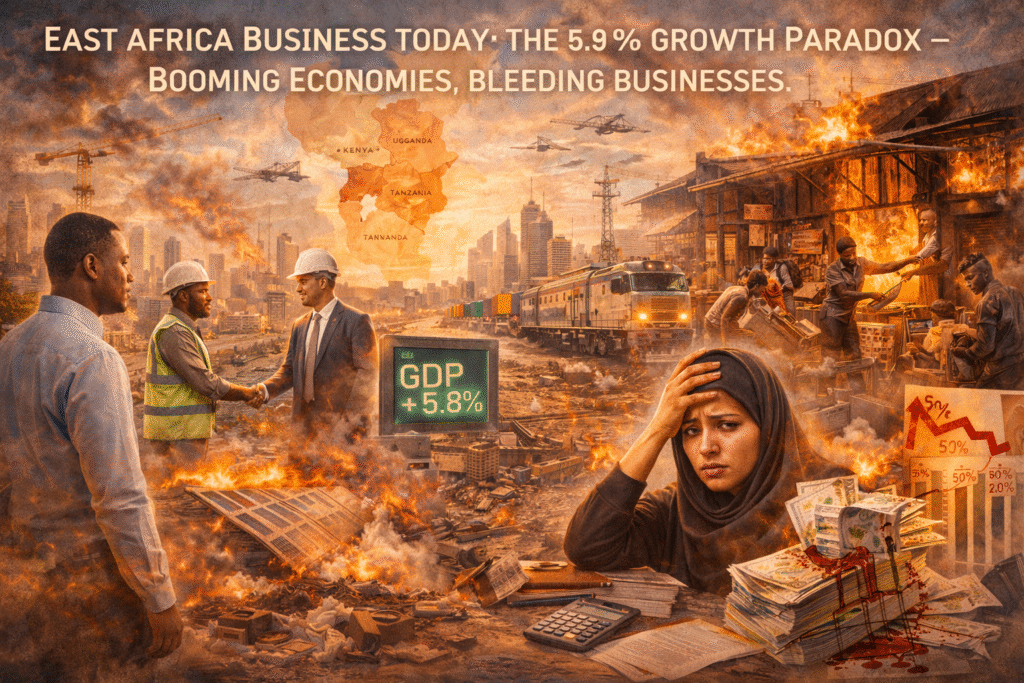
East Africa in early 2026 is a study in contradictions. The region is officially the fastest-growing economy on the African continent, with the United Nations projecting a robust 5.8% growth rate for the year . Ethiopia and Kenya are leading the charge, fueled by renewable energy expansion, infrastructure investment, and a private sector that refuses to slow down . Yet, walk into any boardroom from Nairobi to Dar es Salaam, and you will hear a different story—one of frustration over non-tariff barriers, unpredictable tax regimes, and a frustrating gap between the promise of integration and the reality of moving goods across borders .
This is the East African business paradox: the macro numbers look fantastic, but the micro reality for traders, manufacturers, and investors is a daily struggle against bureaucracy, policy inconsistency, and infrastructure gaps. As the East African Business Council warned at the recent Nairobi summit, the region will miss its 2030 targets unless member states start dismantling the very barriers they built .
The Growth Story: What’s Driving the Numbers?
Let’s start with the fundamentals, because the optimism is not unfounded. According to the UN’s World Economic Situation and Prospects 2026 report, East Africa is outpacing every other sub-region on the continent . North Africa is projected at 4.1%, West Africa at 4.4%, and Southern Africa at a sluggish 2.0%. East Africa’s 5.8% is in a league of its own .
The engines of this growth are familiar: Ethiopia and Kenya. Ethiopia, despite its complex internal dynamics and recent conflicts, is showing remarkable macroeconomic recovery. The launch of the Ethiopian Securities Exchange (ESX) in January 2025—ending a 50-year stock market absence—signals a serious commitment to modernizing the financial sector . Kenya, meanwhile, continues to demonstrate that its private sector is the region’s dynamo. The Nairobi Securities Exchange (NSE) saw its market capitalization cross the Sh3 trillion ($23.25 billion) mark for the first time in 2025, with the All-Share Index rising more than 18% .
The UN report credits this acceleration to improved macroeconomic stability in major economies, supported by regional integration initiatives and the rapid expansion of renewable energy . The Eastern Africa Power Pool (EAPP) is preparing to launch a regional electricity market by mid-2026, a move that could transform energy access and industrial competitiveness across borders .
The Summit of Discontent: Business Leaders Speak Truth to Power
Behind the glossy GDP projections, however, lies a raw frustration that spilled over at the East African Business and Investment Summit & Expo 2026, held in Nairobi in late February. For two days, more than 450 delegates—including government ministers and industry captains—heard a consistent message: the frameworks exist, but the implementation is failing .
John Lual Akol, chairperson of the East African Business Council, put it bluntly: “Frameworks exist, but implementation gaps persist.” He urged governments and businesses to move decisively “from reform to attain tangible results” .
Jas Bedi, vice chair of the EABC, was even more pointed. He identified non-tariff barriers and inconsistent regulations as the “primary anchors dragging down regional competitiveness.” His prescription? An aggressive pivot toward trade-enabling infrastructure—specifically modern transport corridors and “interoperable” digital platforms to replace aging, paper-based customs systems .
The numbers back up the frustration. Despite decades of integration efforts, intra-regional trade currently accounts for less than 15% of the bloc’s total commerce. The target for 2030 is 40%. At the current pace, that target is a fantasy .
Beatrice Askul Moe, Kenya’s cabinet secretary for East African Community and regional development, acknowledged the need for a shift. “It is now time to translate policy reforms into measurable economic outcomes,” she told the summit . The summit ended with a formal commitment to operationalize the Single Customs Territory and harmonize domestic tax regimes—promises that have been made before but now carry a renewed sense of urgency .
Capital Markets: The IPO Drought and the Glimmer of Recovery
If the goods trade is struggling with barriers, the capital markets are showing signs of life—but not without their own challenges. The region’s stock exchanges endured another year without a single initial public offering (IPO) in 2025. The Nairobi Securities Exchange, Uganda Securities Exchange, Dar es Salaam Stock Exchange, and Rwanda Stock Exchange all recorded zero new listings .
The reasons are familiar: a resurgence of private equity deals as firms opt to raise capital off-market to avoid stringent listing and disclosure requirements, and investor interest shifting to high-yield government bonds .
Yet beneath this drought, there are green shoots. The NSE’s performance in 2025—crossing the Sh3 trillion market cap threshold and an 18% index rise—signals “renewed domestic and foreign institutional investor confidence,” according to NSE chief executive Frank Mwiti .
“We are no longer just witnessing a market recovery; we are architecting a capital markets renaissance for East Africa,” Mwiti said. “Our outlook for 2026 is not merely optimistic; it is strategic” .
The NSE is now targeting a major share sale of the State-owned Kenya Pipeline Company (KPC) , after the government announced plans to sell a 65 percent stake valued at Sh100 billion ($775.19 million) . If successful, this could be the breakthrough that ends the IPO drought and signals a new era of public offerings.
Elsewhere in the region, the picture is mixed. In Rwanda, the stock exchange focused on corporate bond issuances, with four bonds worth Rwf33 billion ($22.53 million) issued in 2025. Market capitalisation reached Rwf4.65 trillion ($3.17 billion) . In Tanzania, DSE market capitalisation rose to Tsh23.99 trillion ($9.7 billion) in 2025 from Tsh17.86 trillion in 2024 .
The New Players: Ethiopia and Somalia Join the Game
Two significant developments are reshaping the region’s financial landscape. Ethiopia launched the Ethiopian Securities Exchange (ESX) in January 2025, ending a 50-year absence of a stock market. The country last had a functioning exchange until 1974, when Emperor Haile Selassie was overthrown and share trading was abolished. The ESX represents a monumental shift for Africa’s second-most populous nation .
Meanwhile, Somalia launched the National Securities Exchange of Somalia (NSES) in June 2025, with trading expected to begin in early 2026. The exchange aims to mobilise domestic capital, attract foreign investment, and link local businesses with diaspora investors .
These new entrants expand the region’s financial architecture and create opportunities for cross-border capital flows—but they also highlight the uneven pace of development. Regional exchanges have set up investment clinics and pursued market integration to lower trading costs, though progress has been slow .
One key milestone: Uganda, Rwanda, and Tanzania have interconnected their trading systems under the Capital Markets Infrastructure (CMI) platform. Kenya exited the project in 2015 over procurement concerns but rejoined last year—a crucial development given Nairobi’s status as the region’s largest market with 64 listed firms, many cross-listed elsewhere .
The Energy Frontier: Powering the Future
If goods and capital are struggling to move freely, electricity is poised to break down borders. The Eastern Africa Power Pool (EAPP) is preparing to launch a regional electricity market by mid-2026, according to reports .
Regulators from the East African power pool recently conducted a study visit to the Southern African Power Pool (SAPP), which already operates a regional electricity market. The mission concluded with the signing of a memorandum of agreement on February 20 in Harare, calling for stronger cooperation and technical experience sharing .
Infrastructure projects are moving forward to deepen grid integration. The Zambia–Tanzania–Kenya (ZTK) interconnection is intended to link the electricity systems of Southern and Eastern Africa, facilitating electricity exchanges and strengthening regional energy security .
These efforts are part of a broader continental program to integrate Africa’s electricity systems, leading eventually to the African Single Electricity Market (AfSEM) . For businesses in the region, a functional regional power market could mean cheaper, more reliable electricity—a game-changer for manufacturing and industrial competitiveness.
The Investment Pitch: Uganda’s Strategic Play
Amid these regional dynamics, individual countries are making their own plays for investment. Uganda is positioning itself as a stable gateway to East Africa and the wider African market. President Yoweri Museveni recently hosted a high-level UK–India–Uganda trade delegation, emphasizing access to a domestic market of nearly 50 million people, 300 million in East Africa, 600 million in COMESA, and a continental market of over 1.5 billion people under the AfCFTA .
The UK has invested over £1.3 billion in Uganda, with an additional £1 billion in the pipeline. New initiatives under the “Ambition for Ten-fold Growth Strategy” include support for agricultural exports, power transmission infrastructure, and nationwide solar-powered irrigation systems .
Museveni’s message to investors was clear: “Africa is the next big business centre of the world.” He emphasized that while Uganda has abundant raw materials, it seeks capital, technology, and knowledge partnerships to add value and expand production .
The Headwinds: Debt, Inflation, and Global Uncertainty
For all the optimism, the headwinds are real and persistent. The UN report estimates that Africa’s average public debt-to-GDP ratio will reach 63% in 2025, with interest payments consuming nearly 15% of public revenue . Around 40% of African countries remain in a situation of over-indebtedness or are at high risk .
Food inflation continues to pressure household budgets and business costs. Global trade tensions, uncertainty surrounding the African Growth and Opportunity Act (AGOA), and slow implementation of the AfCFTA all pose risks .
The Eastern Africa Association, in its annual “East Africa Prospects” briefing in London, highlighted intensifying political uncertainty—including major election cycles—and persistent debt pressures as realities investors must confront .
Conclusion: The Integration Imperative
East Africa’s business landscape in 2026 is defined by a single, overriding imperative: integration must move from rhetoric to reality. The region has the fundamentals—strong growth, entrepreneurial energy, new capital markets, and transformative infrastructure projects. But these assets are being undermined by the very barriers the member states have committed to dismantling.
The Single Customs Territory, the harmonized tax regimes, the interconnected trading systems—these are not new ideas. They have been promised for years. What is new is the urgency. As the East African Business Council warned, the 2030 targets are slipping away .
The businesses operating in East Africa today are resilient. They have to be. They navigate checkpoints where officials demand unofficial fees, customs systems that still run on paper, and regulatory regimes that change without notice. Yet they continue to invest, to trade, and to grow.
The question for 2026 is whether the region’s governments will finally match the private sector’s commitment. The frameworks exist. The policies are on the books. What remains is the political will to turn paper promises into practical reality. For East Africa’s businesses—and the millions who depend on them—that transformation cannot come soon enough.