

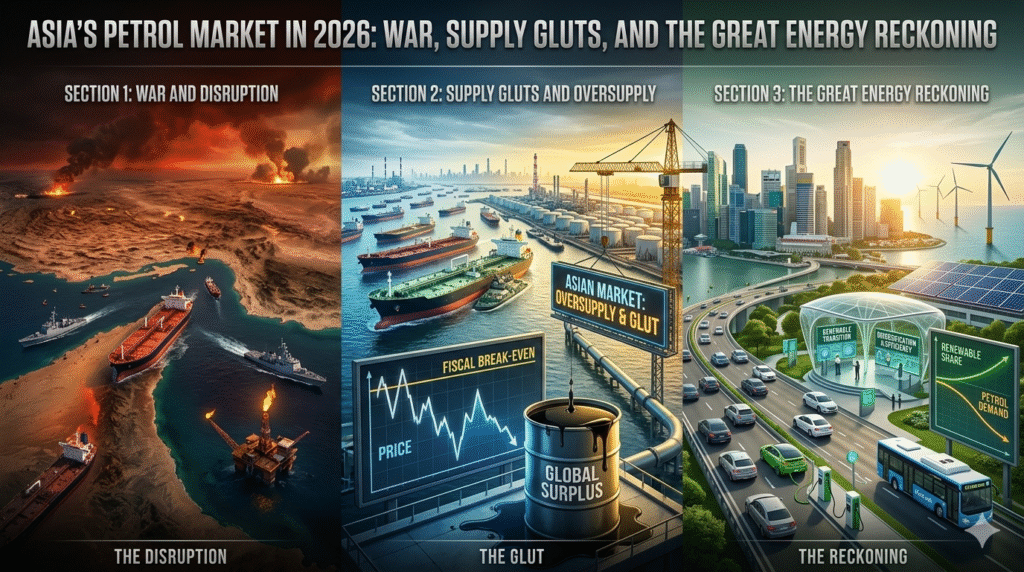
Asia’s petrol markets in early 2026 are caught in a tug-of-war between two powerful forces. On one side, a geopolitical earthquake in the Middle East has sent shockwaves through supply chains, driving crude oil and LNG prices to multi-year highs. On the other, deep structural shifts—from electrification in China to a looming global “superglut” of crude—are fundamentally reshaping how the world’s largest energy-consuming region fuels itself.
The result is a market of extraordinary contradictions: Brent crude spiking above $84 a barrel while gasoline refining margins collapse to one-year lows; LNG prices soaring even as new supply capacity threatens to overwhelm demand; and consumers from Singapore to Kuala Lumpur feeling the pinch at the pump even as refiners warn of weakening profits .
This is Asia’s petrol market today: volatile, fractured, and undergoing its most significant transformation in a generation.
The Geopolitical Shockwave: War at the World’s Energy Chokepoint
To understand Asia’s petrol prices in March 2026, one must look west—specifically, to the Strait of Hormuz. On February 28, the United States and Israel launched joint military strikes on Iran following the death of its supreme leader, Ali Khamenei. Iran retaliated with attacks targeting Israel and Gulf states, including Qatar, Kuwait, and the UAE .
The impact on energy markets was immediate and severe. Brent crude, the international benchmark, jumped 15% in just five days, reaching a 20-month high of $84 per barrel on March 4 . In China, the impact was even more dramatic: Shanghai crude futures surged an astonishing 13.85% in a single trading session .
But crude oil was only part of the story. The conflict’s most disruptive blow landed on the world’s LNG market. QatarEnergy, the world’s largest producer of liquefied natural gas, was forced to suspend production after Iranian strikes targeted its facilities . The result was immediate: Asian LNG spot prices skyrocketed to a three-year high of $35.40 per million British thermal units .
For India, which relies heavily on long-term contracts with Qatar for its gas needs, the supply disruption meant cuts of up to 40% for industrial consumers and city gas distribution companies . India’s Petroleum Minister Hardeep Singh Puri sought to reassure markets that strategic inventories were adequate for short-term disruptions, but the vulnerability of Asia’s energy architecture was laid bare .
At the Pump: Consumers Feel the Heat
For ordinary Asian consumers, these geopolitical tremors translate directly into higher prices at the pump. In Singapore, petrol prices rose for the second consecutive day on March 3, with Shell increasing its popular RON-95 grade by 1.39% to S$2.92 (US$2.28) per liter. Other operators including Caltex, Esso, and Sinopec quickly followed suit .
The price hikes extended across the region. In Malaysia, the government announced weekly fuel price adjustments, with RON97 petrol rising 10 sen to RM3.25 per liter and unsubsidized RON95 increasing 8 sen to RM2.67 . Diesel prices in peninsular Malaysia also climbed to RM3.12 per liter .
Singapore-based economists warn this may only be the beginning. Selena Ling, chief economist at OCBC, told The Business Times that a sustained halt in physical flows through the Strait of Hormuz could keep crude prices elevated for months rather than weeks. For Asia, heavily dependent on imported energy, such an interruption would stoke inflation and pressure consumer prices across the board .
The Paradox: Margins Collapse Even as Prices Surge
Yet beneath the headlines of surging crude prices lies a strange and telling paradox: refining margins are collapsing.
Gasoline processing profits in Asia fell to near one-year lows in early February, according to LSEG data. The benchmark Singapore margin for 92-octane gasoline against Brent crude dropped to just $3.73 per barrel on January 30—the lowest since January 2025. This represents a staggering decline of more than 77% from the November peak of $17.71 per barrel .
How can petrol prices rise while refining margins fall? The answer lies in the distinction between crude oil (the raw material) and refined products (the finished goods). When crude prices spike due to geopolitical risk, refineries face higher input costs. But if they cannot pass those costs fully to consumers—because of weak demand or oversupply of finished products—their margins get squeezed .
And oversupply is precisely the problem. Analysts at Rystad Energy describe the Asian gasoline market as “oversupplied,” with major exporters China, India, South Korea, and Japan all adding to the glut . India, Asia’s largest gasoline exporter, shipped 1.2 million tonnes (10.32 million barrels) in January—a massive increase from 820,000 tonnes in December, as refiners like Reliance’s Jamnagar complex ramped up runs .
The Great Supply Wave: From Shortage to “Superglut”
The current price volatility is superimposed on a much larger structural shift: the global oil market is moving from scarcity to abundance.
Commodities trader Trafigura warns that the world is lurching toward an oil “superglut” as new projects—years in the making—finally come online . Global refinery runs are forecast to reach 84.4 million barrels per day in 2026, up from previous estimates, driven by “the resurgent share of diesel and jet fuel within demand growth, the healthy margin environment and growing crude surplus,” according to the International Energy Agency .
S&P Global analysts expect Asian gasoil (diesel) supply to build significantly in 2026, driven by robust regional refinery operations coinciding with sluggish demand growth. The outlook for gasoil consumption remains dim, particularly in China, where electrification and LNG substitution are gaining ground .
In October, LNG maintained a clear cost advantage over diesel, with the price ratio rising to 66% from 63% in September. This supported LNG heavy-truck sales that surged nearly 150% year-over-year, while new-energy heavy truck penetration reached 45% . The message from the world’s largest energy market is clear: the internal combustion engine’s dominance is eroding, and with it, demand for traditional transport fuels.
LNG: The Great Hope and the Great Uncertainty
If crude oil markets face a superglut, LNG markets face an even more dramatic reckoning. Wood Mackenzie, the energy consultancy, identifies five key themes for global gas and LNG in 2026, centered on a fundamental tension: abundant new supply meets uncertain demand .
After a record-breaking 2025 that saw nine projects totaling 72 million tonnes per annum (mmtpa) reach final investment decisions, the pace is expected to moderate. With 225 mmtpa of LNG supply currently under construction, the expectation is for lower LNG prices and rising construction costs. Projects face delays from inflated costs, supply chain constraints, and evolving financing conditions .
Yet Asian LNG demand is expected to rebound in 2026 after contracting sharply in 2025. The region’s demand fell by more than 12 million tonnes (4.5%) last year, with China alone declining by 11 million tonnes due to a mild winter, high prices, and US trade tariffs. But supply growth of nearly 30 million tonnes in 2026 is likely to drive spot prices below oil price parity, encouraging more spot procurement from emerging markets .
Wood Mackenzie predicts Asian LNG demand will increase by 14 million tonnes (+5%) in 2026. China’s gas demand should grow by 5% on infrastructure projects and real estate recovery, with LNG filling the gap as domestic production and pipeline imports remain flat. New gas-fired power stations and regasification capacity will contribute to increased demand across Taiwan, Bangladesh, and Vietnam. The weather, as always, remains the wild card .
The Suppliers: South Korea’s Steady Hand
Amid the volatility, one supplier is holding steady. South Korea, Asia’s top clean oil products exporter and the world’s largest jet fuel supplier, plans to collectively supply about 400 million barrels of clean oil products in 2026—roughly steady year-over-year .
This commitment comes despite weaker refining margins and a low oil price environment early in the year. Asian oil products’ crack spreads and domestic refining margins have pulled back since November amid high US refinery utilization rates, while low outright clean product benchmark prices are hurting export values .
Yet South Korea’s refiners are pushing ahead, renewing term supply contracts with regular customers across Asia, Oceania, and the Americas. Global tourism events like the soccer World Cup in June (hosted by Canada, Mexico, and the US), as well as a recovery in Asia’s high-tech and semiconductor industries, are expected to support jet fuel and diesel demand .
South Korea’s jet fuel sales to the US reached 38.4 million barrels in the first 11 months of 2025, up 13.3% from a year earlier, driven by refinery closures in California that have created arbitrage opportunities for Northeast Asian suppliers .
The Future: Balancing Security and Transition
Looking ahead, Asia’s energy markets face a delicate balancing act. The immediate crisis triggered by the US-Iran conflict will eventually ease, but the structural trends reshaping the region’s petrol demand—electrification, LNG substitution, and the gradual greening of transport—are only accelerating.
Vietnam offers a glimpse of this future. According to a semi-annual industry report by Vietcombank Securities, the country’s oil and energy industry is entering a “new growth cycle,” supported by firmer crude prices and strengthening global market fundamentals. But the report describes LNG as a “strategic transition fuel,” particularly in Asia, where governments seek to balance energy security with emissions reduction commitments .
For Vietnam, domestic oil and gas fields are experiencing natural decline, with gas output estimated to fall by about 5% annually. This underscores the need to advance new upstream developments while expanding LNG import infrastructure to secure fuel for gas-fired power generation . Policy adjustments are helping: the reduction of LNG import tariffs from 5% to 2% is expected to improve the cost competitiveness of LNG-to-power projects .
Conclusion: A Market Defined by Duality
Asia’s petrol market in early 2026 is defined by duality. Geopolitical crisis has sent crude and LNG prices soaring, yet underlying fundamentals point toward abundance, not scarcity. Refiners face the worst of both worlds: high input costs and weak margins. Consumers face higher pump prices even as the long-term shift away from oil accelerates.
The coming months will test the resilience of Asia’s energy architecture. Can the region withstand a prolonged disruption at the Strait of Hormuz? Will the wave of new LNG supply find buyers in a market that is simultaneously growing and transitioning? And how will the balance between energy security and climate commitments evolve?
For now, one thing is certain: the only constant in Asia’s petrol market is change. The region that consumes more energy than any other is navigating a transition unlike any in history—and the world is watching to see where it lands.
