

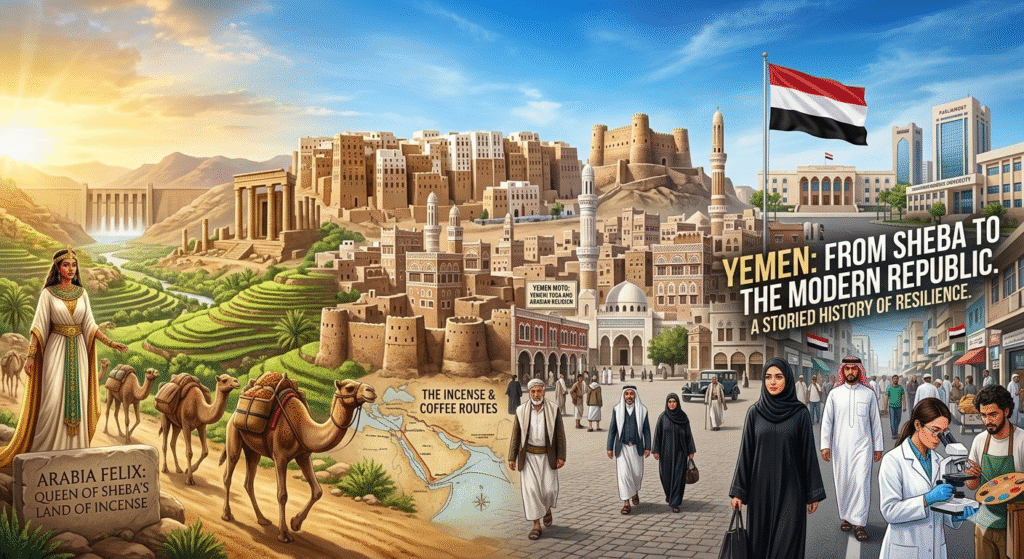
Yemen holds a unique place in the story of human civilization. The ancient Greeks called it Eudaimon Arabia—”Fortunate Arabia” or “Happy Arabia”—a name earned through its fertile highlands, prosperous trade routes, and legendary wealth . For more than three millennia, this land at the southern tip of the Arabian Peninsula has been a crossroads of cultures, faiths, and empires. Its history is an epic narrative spanning ancient kingdoms, the rise of Islam, colonial occupation, Cold War division, and a difficult unification that continues to shape the region today.
The Ancient Kingdoms: Land of Frankincense and Myrrh
Yemen’s recorded history stretches back over 3,000 years, making it one of the oldest centers of civilization in the Near East . Its relatively fertile land and reliable rainfall in ancient times sustained a stable population and gave rise to sophisticated urban societies as early as 5000 BC .
The region’s prosperity was built upon a precious commodity: frankincense and myrrh. These aromatic resins, harvested from trees in southern Arabia, were among the most highly prized substances in the ancient world, used in religious ceremonies, medicine, and burial rites across Egypt, Greece, and Rome . Yemeni merchants controlled this lucrative trade network, and their caravans carried not only local aromatics but also luxury goods from southern Asia and eastern Africa—spices, ostrich plumes, and ivory—to the markets of the Mediterranean .
Between the 12th century BC and the 6th century AD, a succession of powerful kingdoms rose and fell in Yemen. The most famous among them was the Sabaean Kingdom (Saba), believed by many scholars to be the biblical Sheba . The legendary Queen of Sheba, who according to tradition visited King Solomon in Jerusalem, likely ruled from this kingdom . The Sabaeans built the Great Dam of Marib around 940 BC, an engineering marvel that stood for over a millennium and enabled large-scale agriculture in the desert . The dam’s collapse in the 6th century AD came to symbolize the end of Yemen’s ancient golden age .
Other powerful states included the Minaean (Ma’īn), Qatabanian, Hadhramaut, and Himyarite kingdoms . The Himyarites, who unified most of Yemen by 275 AD, abandoned polytheism in favor of a form of monotheism called Rahmanism, and many rulers converted to Judaism . In the 6th century, the Christian kingdom of Aksum in Ethiopia invaded Yemen, followed by the Sassanian Persians, who ruled until the arrival of Islam .
The Islamic Era and Medieval Dynasties
Islam spread readily in Yemen, and by 630 AD, the Prophet Muhammad’s cousin Ali had been sent to Sana’a to consolidate Muslim rule . The last Persian governor of Yemen converted to Islam in 628, and Yemen became part of the wider Islamic world .
For the next millennium, Yemen’s history was shaped by a succession of dynasties and the enduring influence of the Zaydi sect of Shi’i Islam. The Zaydi imamate was established in the northern highlands in the 9th century, creating a unique political and religious tradition that would persist for over 1,000 years . Zaydi imams ruled much of northern Yemen, often competing for control with Sunni dynasties in the south and west.
Among the most significant medieval powers were the Sulayhids (11th century), who were Ismaili Shi’is and ruled from Sana’a; the Ayyubids (12th-13th centuries), the dynasty founded by Saladin that conquered Yemen from Egypt; and the Rasulids (13th-15th centuries), whose long rule firmly established Sunni Islam in southern and western Yemen and left behind a rich administrative and cultural legacy . The Rasulid sultanate, with its capital at Ta’izz, presided over a period of stability and prosperity, fostering trade with India, Africa, and the wider Islamic world .
In the 15th century, Yemen emerged briefly as a global economic player when a Sufi religious leader is said to have discovered the stimulating properties of coffee. The port of Mocha (Al-Mukha) gave its name to the coffee that was exported across the Middle East and Europe, and Yemen became the world’s sole source of Coffea arabica for over a century . However, by the 18th century, the coffee plant had been smuggled out of Yemen and transplanted to colonies in Asia and the Americas, dealing a devastating blow to the Yemeni economy .
The Age of Empire: Ottomans, British, and Division
The 19th century proved fateful for Yemen. The opening of the Suez Canal in 1869 dramatically increased the strategic importance of the Red Sea, drawing European and Ottoman powers back to the region .
In 1839, the British East India Company captured the port of Aden, seeking a coaling station for ships en route to India . Aden was administered as part of British India until 1937, when it became a crown colony. The British gradually expanded their influence into the hinterland, signing protection treaties with dozens of local sultans, emirs, and sheikhs. These territories became known as the Aden Protectorate, divided into eastern and western sections . While Aden itself flourished as a trading port, the protectorate states remained economically stagnant .
Meanwhile, the Ottoman Empire reasserted its authority in North Yemen during the mid-19th century, occupying Sana’a and Ta’izz . The Zaydi imams resisted Ottoman rule, and the frontier between Ottoman-controlled north and British-controlled south was demarcated by a joint commission in 1904—a border that would later become the boundary between two separate Yemeni states .
Two Yemens: Revolution, Marxism, and the Cold War
The collapse of the Ottoman Empire after World War I allowed North Yemen to gain independence in 1918 under the Mutawakkilite Kingdom, an autocratic and theocratic Zaydi imamate ruled by Imam Yahya . Yahya sought to unify “historic Yemen,” including Aden and the British protectorates, but his aggressive claims alienated potential allies and alarmed the British . After Yahya’s assassination in 1948, his son Ahmad continued his father’s repressive policies, though he briefly joined the United Arab States under pressure from Egypt’s Gamal Abdel Nasser .
The modern era began with a revolutionary explosion. On September 26, 1962, Imam Ahmad’s son and successor, Muhammad al-Badr, was overthrown by army officers led by Abdullah al-Sallal, who declared the Yemen Arab Republic (YAR) . Egypt under Nasser rushed to support the new republic with troops and supplies, while Saudi Arabia and Jordan backed royalist forces loyal to the deposed imam. The resulting North Yemen Civil War (1962-1970) drew in regional powers and lasted eight years, ending with a republican victory and Saudi recognition of the YAR in 1970 .
In the south, the British faced growing nationalist resistance. Inspired by Nasser’s anti-colonial rhetoric, the National Liberation Front (NLF) launched an armed campaign against British rule in 1963, triggering the Aden Emergency . Guerrilla attacks escalated dramatically, and by 1967, with the Suez Canal closed and the cost of maintaining the colony unsustainable, Britain announced its withdrawal .
On November 30, 1967, the last British troops departed, and South Yemen became independent as the People’s Republic of South Yemen . In 1970, the country was renamed the People’s Democratic Republic of Yemen (PDRY) , and a Marxist faction seized power, establishing the Arab world’s only avowedly communist state . The PDRY aligned itself with the Soviet Union, China, and Cuba, and nationalized key industries .
Relations between the two Yemens were fraught with tension. They fought brief border wars in 1972 and 1979, though both conflicts ended with agreements affirming the goal of eventual unification . South Yemen supplied arms and funding to leftist rebels in the north, seeking to export its revolution, while the north remained suspicious of its communist neighbor . In 1986, South Yemen was torn apart by a bloody civil war in Aden, leaving thousands dead and further destabilizing the south .
Unification and Its Discontents
Despite decades of division, the impulse for unity remained strong. In May 1988, the YAR and PDRY governments agreed to renew unification talks, establish a joint oil exploration area along their undefined border, and allow Yemenis unrestricted border passage . The discovery of oil in the border region provided a powerful economic incentive for cooperation.
On May 22, 1990, the Republic of Yemen was officially declared, with Ali Abdullah Saleh (president of North Yemen since 1978) becoming president and Ali Salim al-Baidh (leader of South Yemen’s socialist party) becoming vice president . For the first time in centuries, most of Greater Yemen was politically united .
The euphoria of unification proved short-lived. The merger of two vastly different political and economic systems—one a conservative, tribal republic, the other a secular, Marxist state—created deep tensions . Southerners felt marginalized by northern dominance, and key power-sharing agreements unraveled. In 1994, these tensions exploded into a brief but bloody civil war when southern leaders declared secession . Northern forces defeated the southern rebellion, and Saleh consolidated his control, but the underlying grievances never disappeared .
The Modern Era: Revolution, War, and Humanitarian Crisis
President Saleh ruled Yemen for over three decades through a patronage-based system that balanced tribal, military, and political interests . However, by 2011, the Arab Spring protests reached Yemen, with hundreds of thousands of demonstrators demanding Saleh’s ouster . After months of unrest and international mediation, Saleh transferred power to his vice president, Abd Rabbuh Mansur Hadi, in 2012 .
The transitional process excluded key actors, including the Houthi movement (Ansar Allah), a Zaydi revivalist group from the northern highlands that had fought multiple wars with the government since 2004 . In September 2014, the Houthis seized control of the capital, Sana’a, and by early 2015, they had forced President Hadi to flee to Saudi Arabia .
A Saudi-led military coalition intervened in March 2015, launching airstrikes and supporting anti-Houthi forces in an effort to restore Hadi’s government . The conflict quickly became a proxy war, with Iran providing support to the Houthis . The war has created one of the world’s worst humanitarian crises, with widespread famine, epidemic outbreaks, and the collapse of basic services . The country has fragmented into territories controlled by different factions: the internationally recognized government (based in Aden), the Houthis (controlling Sana’a and the north), the UAE-backed Southern Transitional Council (seeking southern independence), and extremist groups like Al-Qaeda in the Arabian Peninsula .
In 2022, President Hadi transferred power to a Presidential Leadership Council headed by Rashad al-Alimi, in an effort to unify anti-Houthi forces . In late 2023, the conflict took on a new regional dimension when the Houthis launched attacks on Israeli shipping in the Red Sea in solidarity with Palestinians during the Gaza war, drawing Israeli and US military responses .
Conclusion
Yemen’s history is a testament to both extraordinary resilience and profound tragedy. This was once Arabia Felix—a land so wealthy and fertile that it captured the imagination of the ancient world. Its people built kingdoms that traded with Egypt and India, developed sophisticated irrigation systems, and created a unique cultural identity at the crossroads of civilizations.
Today, Yemen faces immense challenges: ongoing conflict, economic collapse, and humanitarian suffering. Yet the deep historical roots of Yemeni identity—tribal, religious, and regional—continue to shape the nation’s struggle for peace and unity. The same divisions that led to centuries of rivalry between highlands and coast, north and south, Zaydi and Shafi’i, remain unresolved. But so too does the enduring aspiration for a unified Yemen that can reclaim its place among the nations. Understanding this long and complex history is essential for comprehending both the current crisis and the possibilities for Yemen’s future .