

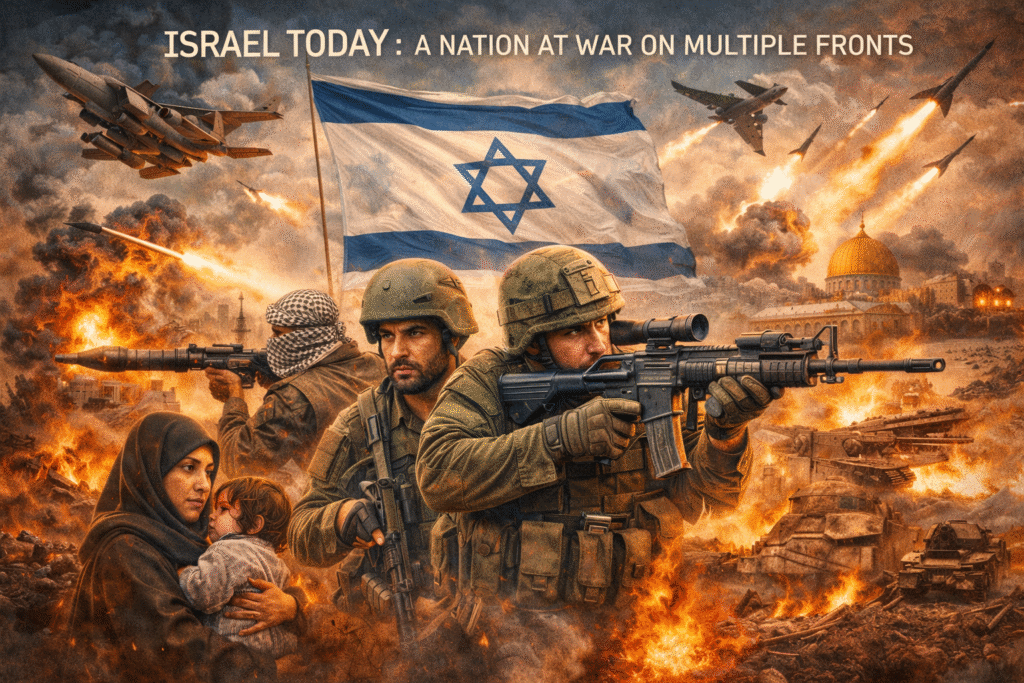
As February 28, 2026, draws to a close, Israel finds itself in the eye of a storm. The past 24 hours have witnessed a dramatic escalation in the long-simmering conflict with Iran, with coordinated Israeli-American airstrikes targeting Iranian military infrastructure and triggering retaliatory missile barrages. Yet beneath the thunder of explosions and the wail of sirens lies a deeper story—of a nation mobilizing for potential prolonged conflict, an economy bracing for impact, and a society grappling with internal divisions even as it confronts an external enemy.
This is Israel today: a country united in crisis but divided in vision, its citizens huddled in shelters while its leaders contemplate strikes that could reshape the Middle East for generations.
The Battlefield: “Operation Epic Fury” and Its Aftermath
The most immediate reality for Israelis on this last day of February is the sound of war. In the early hours of Saturday morning, the Israel Defense Forces announced it had launched a “preemptive strike” against Iran, with explosions rocking Tehran, Isfahan, Qom, and other major Iranian cities . The operation, named “Epic Fury,” was conducted jointly with the United States, marking a significant escalation in the decades-long shadow war between Jerusalem and Tehran .
President Donald Trump confirmed the scale of the operation, declaring that the United States military had begun “major combat operations in Iran” with the objective of “eliminating imminent threats from the Iranian regime” . The strikes targeted Iran’s missile infrastructure, nuclear facilities, and Revolutionary Guard positions, with Israeli media reporting that the first phase of attacks would last four days .
The response was not long in coming. Iranian missiles were launched toward Israel, triggering air raid sirens across the country, from the northern city of Haifa to Jerusalem and beyond . Israeli air defense systems, including the Iron Dome and Arrow systems, were activated to intercept incoming projectiles . Explosions were heard in northern Israel following launches from Iran, and the IDF announced it was “taking action to intercept and neutralize any potential threats” .
The IDF has mobilized on an unprecedented scale. Following an operational assessment, the military announced it is calling up an additional 20,000 reservists, bringing the total to approximately 50,000 reservists now on active duty . These forces are being deployed across all sectors and regional commands, with special forces units activated and reinforcements sent to the Air Force, military intelligence, the Home Front Command, and the Navy .
Dozens of battalions from the Home Front Command’s search and rescue brigade have been deployed nationwide to respond to potential consequences of missile strikes . A nationwide state of emergency has been declared, prohibiting educational activities, gatherings, and non-essential workplace operations .
The scale of the conflict extends beyond Israel and Iran. Missiles struck a US-linked facility in Bahrain’s Juffair area, which hosts the US Fifth Fleet . Qatar intercepted an Iranian missile using its Patriot defense system . Jordan, the United Arab Emirates, and Kuwait have temporarily closed their airspace, and the Jordanian army is conducting aerial patrols to safeguard the kingdom’s airspace . The region is bracing for what could become a wider conflagration.
Perhaps most alarmingly, Israeli officials have signaled that the leadership of Iran itself may be in their sights. The Israel Broadcasting Authority reported that Israel “will not rule out targeting Iran’s Supreme Leader Ayatollah Ali Khamenei” in its strikes . Media reports indicate that explosions were heard near Khamenei’s office zone in eastern Tehran, though the supreme leader has reportedly been moved to a secure location . Israeli sources have stated that “all members of Iran’s leadership are targets” .
The Home Front: Mobilization and Resilience
For ordinary Israelis, the past 24 hours have been a test of the nation’s famed resilience. Sirens have sounded repeatedly, sending families rushing to shelters and safe rooms . The Home Front Command’s apps have been buzzing with alerts, and citizens have been glued to their televisions and social media feeds for updates.
The mobilization of 50,000 reservists means that families across the country are adjusting to the absence of fathers, mothers, sons, and daughters who have been called to active duty . The IDF’s reinforcement of ground troop presence along all borders reflects the military’s assessment that the conflict could expand beyond the current exchange of long-range strikes .
Despite the gravity of the situation, Israeli society has demonstrated its characteristic ability to rally in times of crisis. Emergency services are on high alert, hospitals have activated mass casualty protocols, and volunteers have mobilized to support families of mobilized reservists. The nationwide state of emergency has brought a surreal quiet to normally bustling cities, with streets empty and businesses shuttered .
The Economic Front: War Mode and Financial Strain
Even before this week’s escalation, Israel’s economy had entered what analysts term “war mode.” On February 23, the Bank of Israel made the consequential decision to freeze its benchmark interest rate at 4.0%, despite inflation figures having declined and market expectations of a rate cut .
The central bank’s rationale was stark: “In recent days, geopolitical uncertainty has resurfaced due to the potential for conflict with Iran” . The bank judged that despite inflation falling within the target range, risks from geopolitical developments, supply constraints, and fiscal factors threatened to reignite price pressures .
This decision was not without controversy. Finance Minister Bezalel Smotrich publicly criticized Bank of Israel Governor Amir Yaron, calling it a “wrong decision not supported by macroeconomic data” and arguing that “high interest rates are blocking economic recovery” . The Israel Manufacturers Association expressed “deep regret,” condemning the move as “a disregard for the issue of a strong shekel eroding export competitiveness” .
Yet analysts interpreted the central bank’s move as prioritizing exchange rate defense and inflation volatility preparedness over economic stimulus . The calculation is straightforward: if armed conflict materializes—as it now has—the shekel’s value could plummet and supply chains could collapse, causing prices to surge again . The USS Gerald R. Ford carrier strike group’s arrival at Haifa Port, a strategic hub densely packed with major refineries, underscores the vulnerability of Israel’s economic infrastructure to potential Iranian retaliation .
The 2026 state budget, recently delivered to the Knesset after delays caused by coalition infighting, reflects the fiscal strain of prolonged conflict. Defense outlays were raised to NIS 112 billion ($35.45 billion), up from an initial NIS 90 billion . The budget deficit slipped to 4.7% of GDP in 2025, down from 6.8% in 2023, but still above the 3.9% ceiling set for 2026—a level the Bank of Israel deems too high as it does not allow for reduction in the debt burden .
The Diplomatic Front: Allies and Adversaries
Israel’s military action against Iran has reshuffled the diplomatic deck across the Middle East and beyond. The joint nature of the operation with the United States represents the deepest level of military coordination between the two allies since the 2003 invasion of Iraq . Trump’s declaration that the United States is conducting “major combat operations” in Iran, and his warning to the Iranian people that “the hour of your freedom is at hand,” signals Washington’s alignment with Jerusalem’s maximalist goals .
Regional reactions have been mixed. Oman’s foreign minister, who had been mediating nuclear talks between Tehran and Washington, met with US Vice President JD Vance on Friday—just hours before the strikes—and expressed hope for “further and decisive progress in the coming days,” declaring that “peace is within our reach” . Those hopes now lie in tatters.
Jordan has activated its air defenses and is conducting patrols to safeguard its airspace, walking a tightrope between its peace treaty with Israel and its significant Palestinian population . The UAE, Kuwait, and Syria have closed their airspace, seeking to avoid being drawn into the conflict . Qatar’s interception of an Iranian missile with its Patriot system suggests that Gulf states may align with the US-Israel coalition if the conflict expands .
International reaction has been swift and critical. CGTN, the Chinese state broadcaster, published an opinion piece condemning the “Israel-U.S. joint military actions” as “a reckless act that pushes global stability to the brink” . The analysis argued that the strikes “constitute a blatant violation of a sovereign nation’s territorial integrity and international law” and warned that they would “only harden Iran’s resolve” .
Iran has vowed a “harsh response” and asserted its right to self-defense under Article 51 of the UN Charter, calling on the Security Council and the international community to condemn the attack . The Iranian Foreign Ministry stressed that Tehran had prioritized diplomacy to prevent war but that “the time has now come to defend the homeland” .
The Long View: A Nation at a Crossroads
Yet even as Israel mobilizes for war, a deeper debate continues about the country’s long-term trajectory. An Al Jazeera analysis published just last month posed a provocative question: “Is Israel’s current path setting it on course for collapse?”
The analysis, drawing on interviews with political economists and demographers, warned that Israel faces existential challenges that military strength alone cannot solve. Political polarisation, economic strain, and emigration are eroding the foundations of the state . More than 200,000 people have left Israel since the current government took office in December 2022—a loss of educated, secular Israelis who form the backbone of the country’s technology sector and medical system .
Eugene Kandel, former head of Israel’s National Economic Council, and Ron Tzur, director of Israel’s Strategic Futures Institute, have warned that Israel is unlikely to reach the centenary of its 1948 establishment if it continues on its current path . Their conclusion is based on the deepening divisions within Israeli society between liberal secular Jews, religious Zionists, and advocates for equal rights for all citizens .
The economic burden of supporting a rapidly growing ultra-Orthodox population, combined with spiraling defense costs and reduced investor confidence, threatens the sustainability of Israel’s high-tech economy . Political economist Shir Hever warned that if Israel loses its core elite of 300,000 innovators and professionals, “it stops being a developed economy and becomes a developing economy” .
These long-term concerns stand in stark contrast to the immediate unity that military conflict often generates. For now, Israelis are focused on survival—on the sirens, the shelters, the safety of loved ones in uniform. But when the guns fall silent, the deeper questions will remain.
The Hours Ahead
As February 28 gives way to March 1, Israel faces an uncertain dawn. The first phase of strikes is expected to last four days, with intense joint operations continuing . Iranian retaliation is likely to continue, and the region remains on a knife’s edge.
The Home Front Command continues to issue instructions to civilians. Schools remain closed. Gatherings are prohibited. The nation holds its breath.
For Israelis today, the personal and the national are inseparable. Every family has someone in the reserves or knows someone who does. Every siren is a reminder of vulnerability. Every intercepted missile is a testament to years of investment in defense systems.
Yet amid the fear and uncertainty, there is also resolve. Israel has faced existential threats before and has survived. The question, as this new conflict unfolds, is not whether Israel will survive the coming days—but what kind of country will emerge on the other side.
For now, that question must wait. The sirens are still sounding. The war is just beginning.