

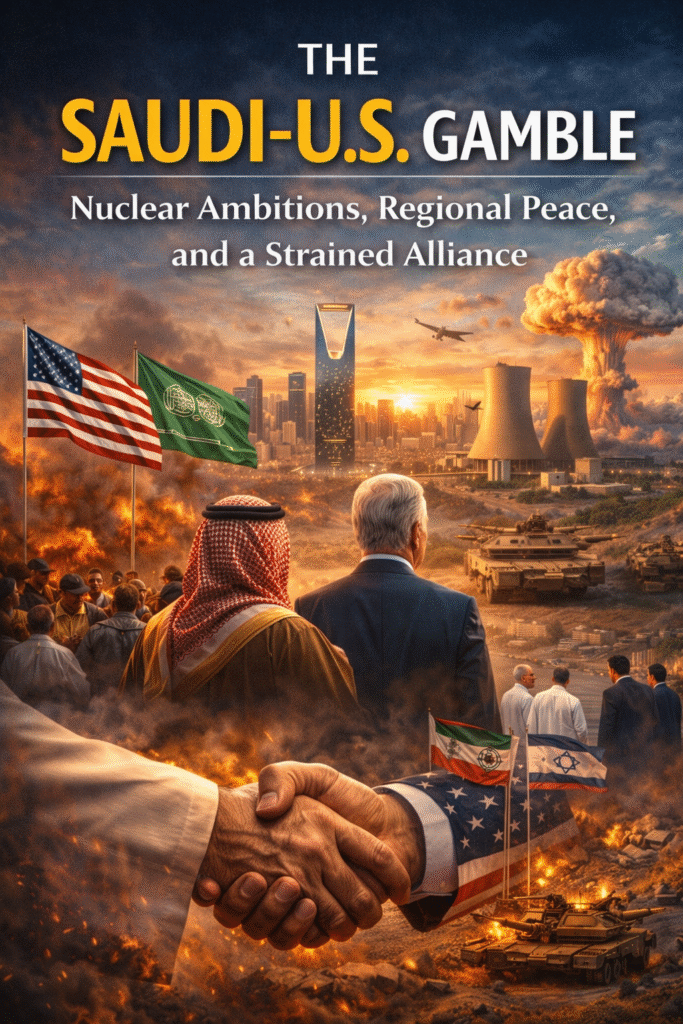
As February 2026 draws to a close, the relationship between the United States and the Kingdom of Saudi Arabia is undergoing one of its most consequential transformations in decades. The strategic partnership that has defined Middle Eastern geopolitics since 1945 is being renegotiated in real time, with high-stakes diplomacy unfolding across multiple fronts. In Washington, the Trump administration is pursuing a sweeping nuclear cooperation deal that could allow Riyadh to enrich uranium—a prospect that has sent shockwaves through the nonproliferation community. In Riyadh, Crown Prince Mohammed bin Salman is simultaneously positioning the kingdom as a linchpin of regional peace while deepening defense ties with nuclear-armed Pakistan. And in the background, the shadow of Iran’s nuclear program looms over every calculation.
This is the state of Saudi-U.S. political relations today: a delicate dance of mutual dependency, clashing ambitions, and the ever-present risk that the partnership itself could become a catalyst for the very proliferation it seeks to prevent.
The Nuclear Gamble: Enrichment on the Table
The most consequential development in Saudi-U.S. relations this month is the revelation that a proposed nuclear deal between the two countries would allow Saudi Arabia to develop some form of uranium enrichment capabilities within the kingdom . Congressional documents and arms control experts suggest that the Trump administration is pursuing a nuclear cooperation agreement that would open the door for Riyadh to acquire enrichment technology—possibly even from the United States itself .
The stakes could not be higher. Nonproliferation experts warn that any spinning centrifuges within Saudi Arabia could provide a pathway to a weapons program, something Crown Prince Mohammed bin Salman has explicitly threatened to pursue if Iran obtains an atomic bomb . “Nuclear cooperation can be a positive mechanism for upholding nonproliferation norms and increasing transparency, but the devil is in the details,” warned Kelsey Davenport, director for nonproliferation policy at the Arms Control Association .
The draft deal would see the United States and Saudi Arabia enter safeguard agreements with the International Atomic Energy Agency, including oversight of the “most proliferation-sensitive areas of potential nuclear cooperation”—specifically enrichment, fuel fabrication, and reprocessing . Davenport’s analysis of the documents raises “concerns that the Trump administration has not carefully considered the proliferation risks posed by its proposed nuclear cooperation agreement with Saudi Arabia or the precedent this agreement may set” .
The contrast with the United Arab Emirates is instructive. When the UAE signed its “123 agreement” with the U.S. to build the Barakah nuclear power plant, it did so without seeking enrichment rights—a position nonproliferation experts have long held up as the “gold standard” for nations wanting atomic power . Saudi Arabia appears unwilling to accept such constraints.
Congressional Alarm: “A Recipe for Disaster”
The proposed deal has triggered sharp opposition in Washington, particularly from Democratic lawmakers with long-standing concerns about nuclear proliferation. Senator Edward J. Markey of Massachusetts, a founder of the national Nuclear Freeze movement, issued a blistering statement on February 20 condemning the administration’s approach .
“Saudi Arabia has already expressed its interest in acquiring nuclear weapons, which would be highly destabilizing for the Middle East and could lead other states to reconsider their nuclear options,” Markey declared. “Given Prince Mohammed bin Salman’s nuclear ambitions, the Trump administration should insist on the strongest possible ‘gold standard’ non-proliferation measures in any nuclear cooperation agreement, including a blanket prohibition on enrichment and reprocessing of nuclear material” .
Instead, Markey charged, “the Trump administration is caving to Saudi demands and is writing a recipe for disaster with its plan to give nuclear-weapon-wannabe Saudi Arabia nuclear technology without the strongest safeguards” . He warned that any such agreement, combined with escalating U.S.-Iran tensions, “could potentially explode the conflict between Iran and Saudi Arabia and between the United States and Iran” .
Markey’s statement concluded with a call to action: “Congress should use its authority to reject this agreement. Anything less risks transforming the Middle East into a nuclear Wild West and creating a devastating new nuclear arms race in the region” .
The Iran Factor: A Regional Arms Race in the Making
The nuclear negotiations with Riyadh cannot be understood in isolation. They are inextricably linked to the parallel crisis unfolding with Iran, where the Trump administration is simultaneously threatening military action while pursuing last-ditch nuclear diplomacy .
The dynamic is inherently unstable. Saudi Crown Prince Mohammed bin Salman has stated unequivocally that if Iran obtains a nuclear bomb, “we will have to get one” . That red line now faces its most serious test. Iran has been enriching uranium up to 60 percent purity—a short, technical step from weapons-grade levels of 90 percent—making it the only country in the world to do so without a weapons program . While Tehran insists its program is peaceful, Iranian officials have increasingly threatened to seek the bomb as tensions with the U.S. escalate .
The Saudi-Pakistan defense pact signed last year adds another layer of complexity. After Israel launched an attack on Qatar, Pakistan’s defense minister stated that his nation’s nuclear program “will be made available” to Saudi Arabia if needed—a warning aimed at Israel, long believed to be the Middle East’s only nuclear-armed state . The prospect of Pakistani nuclear weapons being placed at Saudi disposal, combined with potential U.S.-supplied enrichment technology, creates a proliferation nightmare that keeps arms control experts awake at night.
Yet the administration’s congressional briefings frame the nuclear deal differently. The documents contend that reaching an agreement with Saudi Arabia “will advance the national security interests of the United States, breaking with the failed policies of inaction and indecision that our competitors have capitalized on to disadvantage American industry and diminish the United States standing globally in this critical sector” . China, France, Russia, and South Korea are all competing to sell nuclear technology abroad, and Washington fears being left behind.
The Peace Track: Billions for the Board of Peace
Amid the nuclear controversy, a parallel diplomatic initiative has captured headlines. On February 18, Saudi Minister of State for Foreign Affairs Adel Al-Jubeir announced in Washington that the kingdom would pledge $1 billion over the coming years to support President Trump’s Board of Peace—a new initiative aimed at resolving the Israeli-Palestinian conflict and advancing regional stability .
Speaking at the board’s first meeting in Washington, Al-Jubeir referenced the 2002 Arab Peace Initiative launched by the late King Abdullah, saying Saudi Arabia remains committed to a vision of “peace, prosperity, security and regional integration” under King Salman and Crown Prince Mohammed bin Salman . The Saudi pledge was matched by Qatar, creating a $2 billion fund to support the board’s mission.
Al-Jubeir framed the contribution as an effort to alleviate the suffering of Palestinians and bring peace to the entire region . The Board of Peace was established within the framework of efforts toward a peaceful settlement in Gaza, where a US-backed ceasefire has been in place since October 10, halting Israel’s two-year offensive that killed more than 72,000 Palestinians .
The peace initiative reflects Riyadh’s broader regional strategy. Saudi Arabia has refused to join the US-brokered Abraham Accords that normalized relations between Israel and the UAE and Bahrain, but it has shown increasing openness toward Israel in recent years . In a significant gesture last year, Riyadh lifted overflight restrictions on aircraft traveling to and from Israel—a move President Biden hailed as “historic” .
High-Level Engagement: The Graham Visit
The intensity of diplomatic activity is reflected in the calendar of meetings between Saudi and American officials. On February 19, Crown Prince Mohammed bin Salman met with U.S. Senator Lindsey Graham in Riyadh for what Graham described as a “very friendly, extensive and consequential meeting” .
The discussions covered bilateral relations and regional developments, with Graham later emphasizing that “Saudi Arabia is key to what I hope will happen in the region and the world” . The South Carolina senator, a close ally of President Trump, has positioned himself as a key interlocutor between the administration and the Saudi leadership.
Graham’s visit followed a series of high-level engagements. Earlier in the month, Saudi and U.S. officials had been in regular contact over the nuclear file, the peace initiative, and regional security coordination . The frequency of these meetings underscores the breadth and depth of the issues at stake.
Mediating Gulf Rifts: Trump’s Balancing Act
Beyond the bilateral relationship, the United States is also navigating tensions among its Gulf partners. President Trump suggested on February 16 that he could “easily” bridge the rift between Saudi Arabia and the United Arab Emirates—two of Washington’s most important Arab allies .
The tensions between Riyadh and Abu Dhabi have centered on the conflict in Yemen, where the UAE withdrew its forces following clashes involving the Southern Transitional Council, the main separatist group. Riyadh accused the UAE of backing separatist advances near the Saudi border, a claim Abu Dhabi denied . The confrontation marked one of the most serious rifts within Yemen’s anti-Houthi camp in years.
When asked by reporters on Air Force One if he had plans to get involved in the dispute, Trump confirmed that “they do indeed have a rift, and we can get it settled very easily,” though he added that he had no immediate plans to intervene . The comments reflect Washington’s delicate balancing act: maintaining strong bilateral ties with both Riyadh and Abu Dhabi while encouraging them to coordinate their regional strategies.
The Broader Context: A Partnership Under Strain
The current diplomatic flurry must be understood against the backdrop of a relationship that has experienced significant strain in recent years. The 2018 killing of journalist Jamal Kashoggi in the Saudi consulate in Istanbul cast a long shadow over bilateral ties, with U.S. intelligence agencies assessing that Crown Prince Mohammed bin Salman “approved” the operation .
When President Biden visited Jeddah in 2022, he famously fist-bumped the Crown Prince but later said he raised the Kashoggi case and warned against future attacks on dissidents . The episode illustrated the uncomfortable reality of the relationship: the United States cannot afford to abandon its strategic partnership with the kingdom, but nor can it ignore the profound differences in values and governance.
Yet the relationship has also demonstrated remarkable resilience. During the same 2022 summit, the two countries signed 18 agreements covering energy, space, health, and investment, including cooperation on 5G and 6G technology . A joint statement emphasized “the importance of their strategic economic and investment cooperation, especially in light of the current crisis in Ukraine and its repercussions, reiterating their commitment to the stability of global energy markets” .
The Stakes: What Comes Next
As February 2026 draws to a close, the Saudi-U.S. relationship stands at a crossroads. The nuclear negotiations will test whether the two countries can craft an agreement that advances Saudi Arabia’s civilian energy ambitions without triggering a regional arms race. The peace initiative will test whether the kingdom can leverage its influence to achieve a just resolution of the Israeli-Palestinian conflict. And the Iran crisis will test whether the strategic partnership can contain the region’s most destabilizing threat.
The positions are clearly staked out. Riyadh seeks enrichment rights, a formal defense commitment, and advanced technology. Washington seeks Saudi normalization with Israel, stable oil markets, and cooperation on containing Iran. The contours of a grand bargain are visible, but the details remain fiercely contested.
For the nonproliferation community, the stakes are existential. Kelsey Davenport’s warning echoes through the debate: “Even with restrictions and limits, it seems likely that Saudi Arabia will have a path to some type of uranium enrichment or access to knowledge about enrichment” . Once that door opens, it may prove impossible to close.
For Senator Markey and his allies, the solution is clear: Congress must assert its authority and reject any agreement that falls short of the “gold standard” . Whether they have the votes—and whether the administration is willing to compromise—remains an open question.
Conclusion
The relationship between Saudi Arabia and the United States has always been a marriage of convenience rather than affection. For eighty years, the bargain has been simple: American security guarantees in exchange for Saudi oil and regional cooperation. Today, that bargain is being renegotiated in a far more complex world.
Riyadh is no longer a passive client state. It pursues an independent foreign policy, deepens ties with China and Russia, and asserts its regional leadership with confidence. Washington, for its part, can no longer take Gulf allies for granted, but it remains the indispensable power for those seeking security against Iran.
The nuclear negotiations now underway will determine whether this relationship adapts to new realities or fractures under the weight of competing ambitions. If the two countries can craft an agreement that balances Saudi Arabia’s legitimate energy needs with robust nonproliferation safeguards, the partnership could emerge stronger than ever. If they fail—or if they succeed in ways that trigger a regional arms race—the consequences will reverberate for generations.
In Riyadh, Washington, and the capitals of the Middle East, the clock is ticking. The next few weeks will reveal which path the world’s most consequential bilateral relationship will take.