

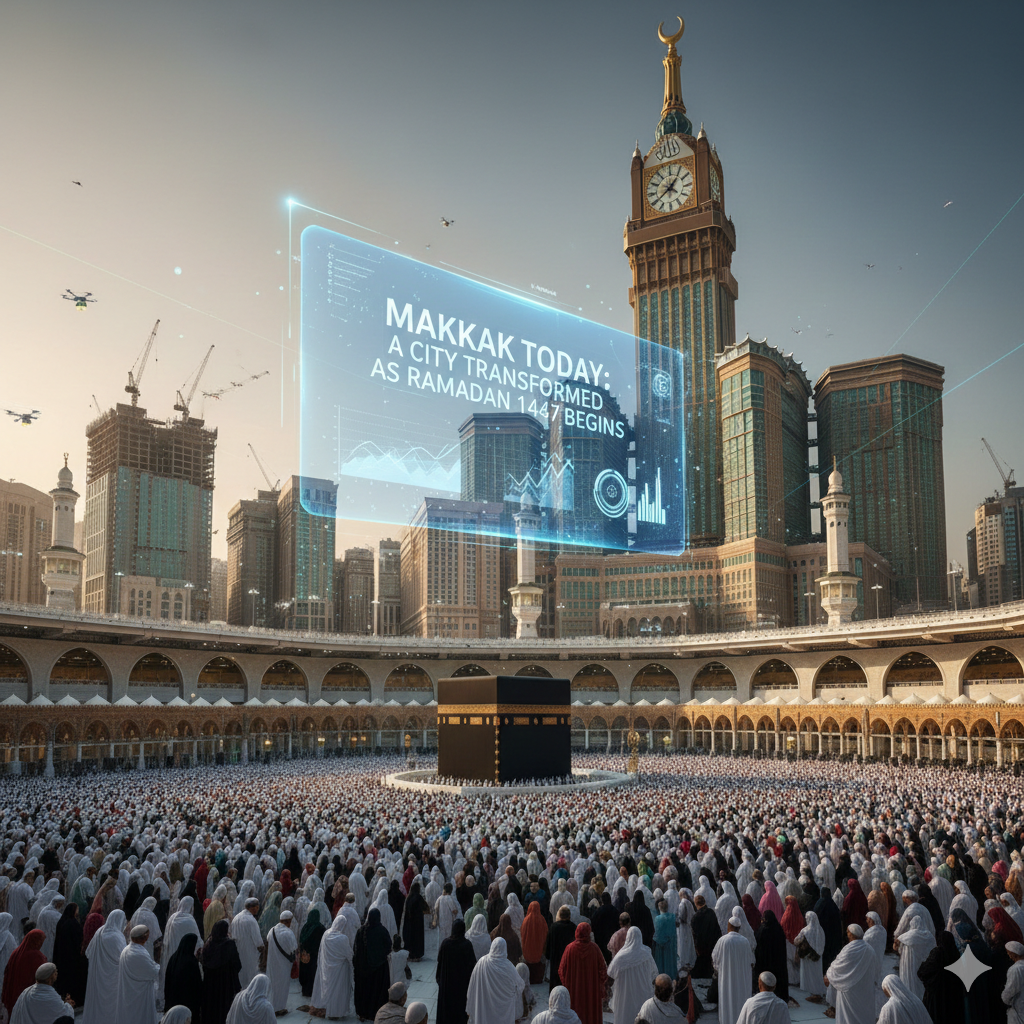
As the sun set over the desert horizon on Tuesday evening, the crescent moon was sighted, and the holy month of Ramadan officially began across Saudi Arabia. In Makkah, the announcement from the Royal Court triggered a spiritual transformation unlike any other place on earth. Within hours, the Grand Mosque was flooded with hundreds of thousands of worshippers, their voices rising together for the first Taraweeh prayers of the month .
This is Makkah today on the first day of Ramadan 1447 Hijri (2026): a city operating at the intersection of ancient faith and cutting-edge technology, where a comprehensive ecosystem of services, smart systems, and human dedication has been mobilized to welcome the world’s Muslims.
The First Night: A Sea of Faith
The scene at the Grand Mosque on the night of February 17-18 was one of profound spirituality and awe-inspiring scale. Hundreds of thousands of worshippers and Umrah pilgrims flocked to the mosque’s courtyards, arcades, and expansion areas to perform the Isha and Taraweeh prayers .
The atmosphere, as described by Saudi Gazette, was marked by “calm and orderly movement” despite the immense crowds . Field teams worked diligently to keep traffic flowing, organize walkways, and guide worshippers to designated prayer areas, ensuring that the performance of rituals could proceed with ease and tranquility .
This surge did not begin overnight. Throughout the month of Sha’ban, which preceded Ramadan, Makkah witnessed a dramatic increase in pilgrims. Footage broadcast by Saudi Arabia’s Al-Ekhbariya channel in early February showed the circumambulation area (Mataf) filled to capacity, yet the crowds moved with remarkable smoothness, supported by a comprehensive system of human and technological services . The live footage revealed meticulous organization, a testament to the extensive planning that had been underway for months .
Leadership on the Ground: Ensuring Readiness
The seamless experience on the first night was no accident. In the days leading up to Ramadan, Saudi leadership conducted intensive field inspections to verify the readiness of all systems serving the holy city.
On February 17, the Deputy Governor of the Makkah Region, Prince Saud bin Mishaal bin Abdulaziz, carried out a detailed field tour of the Grand Mosque and its facilities . Accompanied by relevant authorities, he reviewed operational plans for crowd management, service enhancements, and facility preparations aimed at ensuring smooth movement and enhancing comfort and safety for visitors, particularly during peak times .
Prince Saud’s inspection covered a range of critical systems. He reviewed developmental initiatives and smart services, notably the electric mobility carts designed to transport the elderly, persons with disabilities, and those in need of assistance within the Grand Mosque . He also examined the efforts of multilingual guidance teams deployed across the corridors and courtyards, ensuring that visitors from every corner of the globe could receive assistance in their own languages .
Perhaps most significantly, he was briefed on the digital infrastructure now underpinning the visitor experience. The interactive map and digital mobility platform allows worshippers to plan their routes in advance, identifying service locations, entrances and exits, and less crowded pathways . Crowd management systems, including the visitor density sensor platform and the Tawaf and Sa’i crowd status display service, enable real-time monitoring and allow pilgrims to choose optimal times to perform their rituals .
The tour culminated at the Smart Engineering Command and Control Center, an advanced central platform that links operational systems and monitors performance in real time, boosting efficiency and raising readiness levels throughout Ramadan .
The Spiritual Heartbeat: Imams and Prayers
For Muslims worldwide, Ramadan at the Grand Mosque is defined not only by the crowds but by the voices that lead them in prayer. The General Presidency for the Affairs of the Grand Mosque and the Prophet’s Mosque has announced the schedule of imams who will lead the special Taraweeh and Tahajjud prayers throughout the month .
At the Grand Mosque in Makkah, worshippers will be led by some of the most revered voices in the Islamic world: Sheikh Abdul Rahman Al-Sudais, Sheikh Badr Al-Turki, Sheikh Abdullah Al-Juhaini, Sheikh Yasser Al-Dossary, and Sheikh Bandar Balila . At the Prophet’s Mosque in Madinah, the list includes Sheikh Salah Al-Budair, Sheikh Abdullah Al-Qarafi, Sheikh Khalid Al-Hana, and others .
The General Presidency has framed its operational plan for Ramadan around seven strategic goals: enriching the visitor experience, teaching the Holy Qur’an and the Prophet’s Sunnah, consolidating the Kingdom’s religious leadership, advancing translation and linguistic services, developing human competencies, harnessing modern technologies, and enhancing communications with Muslims worldwide .
The Pulse of the City: Makkah’s Economy Thrives
Beyond the spiritual realm, Ramadan transforms Makkah’s economy. The city is witnessing a significant rise in economic activity, with market footfall, commercial centers, and hotel occupancy rapidly increasing .
In the retail and food sectors, demand is exceptionally strong for essential goods, dates, beverages, and seasonal decorations. Traditional and modern markets are reporting vibrant purchasing activity, bolstered by promotional offers . The hospitality sector is experiencing a similar surge, with early bookings for hotels near the Grand Mosque skyrocketing as Umrah performers and visitors arrive from across the globe .
Transportation and logistics services are also scaling up, with authorities enhancing traffic management and access to the Holy Kaaba . This economic vibrancy underscores Makkah’s dual role as both a spiritual and economic hub during the holy month .
The Backbone: Municipal Services at Full Capacity
Supporting this influx of millions is the Holy Makkah Municipality, which has completed its preparations and mobilized all resources to provide the highest standard of municipal services .
The operational plan covers every aspect of urban management: public cleaning, waste collection and disposal, pest control, and rigorous monitoring of commercial establishments to ensure food safety . In the sanitation sector alone, more than 13,549 workers have been deployed, supported by over 920 cleaning vehicles and more than 88,000 waste containers of various sizes .
Insect control teams comprising over 1,175 specialists and technicians, equipped with more than 2,200 devices and tools, are working to maintain environmental health . Inspection committees are monitoring markets around the clock, collecting food samples for laboratory testing to ensure all products meet health standards .
The municipality’s responsibilities extend to the city’s vast infrastructure: more than 18,000 main and side streets, 62 tunnels, 145,000 lighting poles, 123 bridges, and 458 parks and public squares are all being maintained and monitored to ensure efficiency throughout the season . Preparations also include readying vehicle holding areas at Makkah’s entrances and seasonal parking areas within the city, complete with lighting, landscaping, and public restrooms .
A comprehensive emergency response plan has been developed to handle potential incidents, with field teams present around the clock .
A Precious Resource: Water for the Millions
Among the most critical services during Ramadan is the provision of clean water. On February 16, the President of the Saudi Water Authority, Engineer Abdullah Al-Abdulkareem, personally inspected the water system’s readiness in Makkah and the holy sites .
The tour covered the entire water system: production, transmission, storage, and distribution. Al-Abdulkareem reviewed operational workflows, performance indicators, and seasonal demand management plans, ensuring that the system can maintain continuous supply and high-quality water for visitors to the Grand Mosque .
He also met with the Deputy Minister of Hajj and Umrah to improve collaboration between the two authorities during Ramadan . His concluding message emphasized the need for proactive preparations through institutional integration and optimal resource utilization .
A Personal Journey: Guidance for the Traveler
For the hundreds of thousands who have traveled to Makkah for this Ramadan, the experience is both spiritually elevating and physically demanding. The UK’s National Travel Health Network and Centre (NaTHNaC) has issued guidance for those observing Ramadan while traveling, noting that the approximate dates for the holy month in 2026 are from the evening of February 17 to March 18 .
The guidance reminds travelers to be mindful of those who are fasting, avoiding eating, drinking, or smoking in public during daylight hours . For those fasting, it recommends well-balanced meals at Suhoor (pre-dawn) and Iftar (sunset), along with plenty of water during non-fasting hours . Travelers are also advised to obtain comprehensive health insurance and consult healthcare providers before departure, particularly those with medical conditions .
The Days Ahead: What to Expect
As Ramadan unfolds, the numbers will only grow. The General Authority for the Care of the Affairs of the Grand Mosque and the Prophet’s Mosque has confirmed that all operational preparations are complete, with the aim of enabling visitors to perform their rituals with “ease, comfort, and tranquility” .
The authority has emphasized its commitment to providing a complete spiritual environment, reflecting the Saudi leadership’s dedication to the Two Holy Mosques and their visitors . Dedicated routes for older people and persons with disabilities, operated mobility systems, and carefully regulated cart movements are all part of this comprehensive approach .
Conclusion
Makkah today is a city transformed. It is a place where centuries-old traditions of faith meet twenty-first-century technology, where millions of hearts turn toward the same point in prayer, and where an entire city mobilizes to serve them.
From the Deputy Governor inspecting smart command centers to the municipal workers cleaning the courtyards, from the imams leading Taraweeh to the water engineers ensuring every tap flows—all are part of a single purpose: to welcome the guests of God.
As the first day of Ramadan 1447 draws to a close, the prayers of hundreds of thousands have already risen from the Mataf. In the days ahead, millions more will come. And Makkah, as it has for centuries, will be ready.