

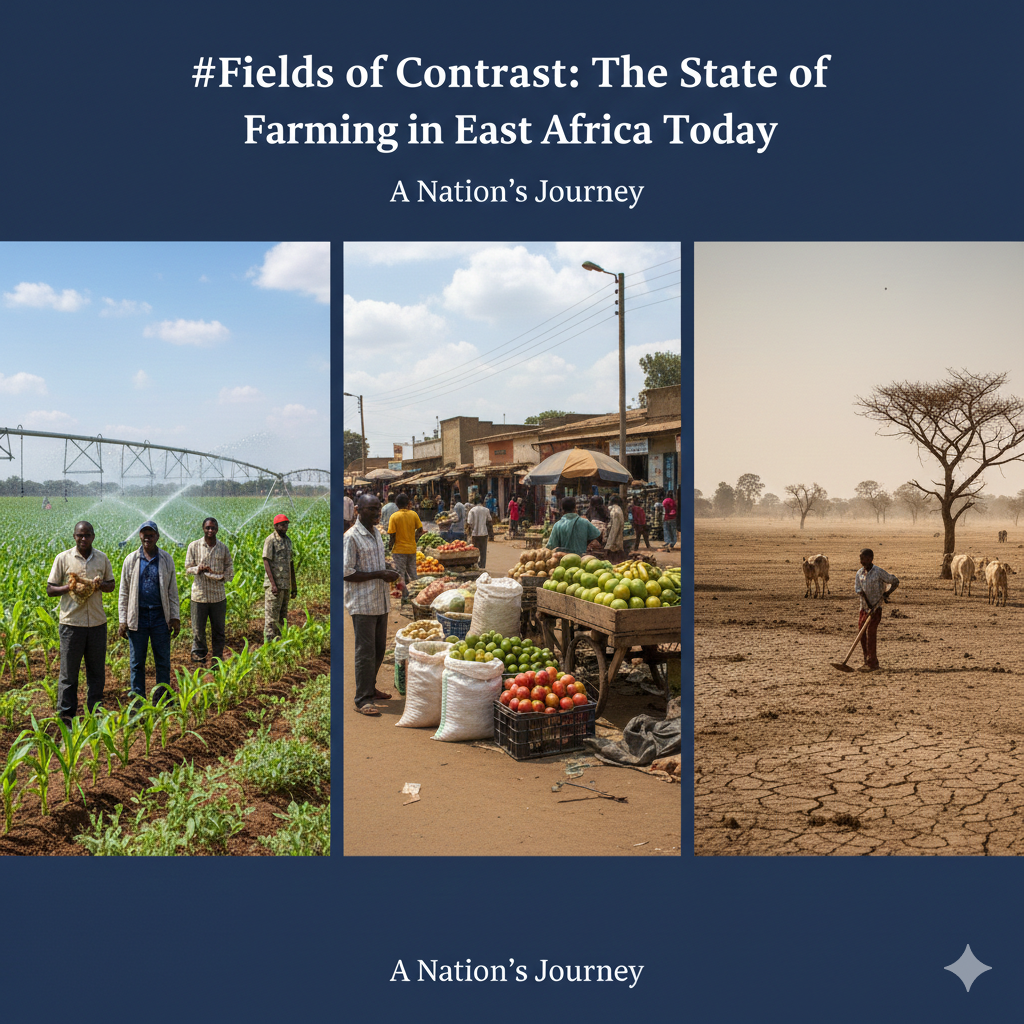
As the short rains fail and the long rains approach, the farmers of East Africa find themselves at a crossroads. Across Kenya, Uganda, Tanzania, Ethiopia, and Somalia, the picture of agriculture in February 2026 is one of stark contrasts. In some regions, post-harvest supplies are stabilizing markets and easing prices. In others, a devastating drought is withering crops, killing livestock, and pushing millions toward hunger. Meanwhile, a quiet technological revolution is underway—one that promises to transform farming from a gamble against the weather into a data-driven science.
This is the state of farming in East Africa today: a sector battling climate volatility, feeding a continent, and embracing innovation all at once.
The Drought: A Crisis Spreading Beyond the Arid Lands
The most immediate and devastating story in East African agriculture is the drought. According to the latest report from the European Commission’s Joint Research Centre, severe drought conditions have gripped the region since September 2025, driven by scarce rainfall and persistently high temperatures . The impact is most acute in Somalia, southeastern Ethiopia, and eastern Kenya, where soil moisture levels are worryingly low and vegetation has been severely damaged .
The numbers are sobering. In Somalia alone, 4.6 million people are already affected, with over 135,000 displaced . Livestock mortality is rising, cereal prices are at record highs, and acute malnutrition in children is increasing across the region . In December 2025, much of East Africa experienced temperatures more than 2°C above the 1991-2020 average over northeastern Kenya, southern Ethiopia, and southwestern Somalia . For farmers, those extra degrees mean the difference between a harvest and a failure.
What makes this drought particularly alarming is its geographic spread. Traditionally, droughts in Kenya have concentrated in the arid north and northeast. But in 2026, the crisis has reached new areas. In Kajiado county, which borders Nairobi and is home to Maasai pastoralists, the impact has been devastating. Maria Katanga, a 24-year-old herder, has lost more than 100 cattle and 300 goats since August . The animals that survive are too emaciated to produce milk, and their value has collapsed.
“A cow that was being sold for 60,000 or 70,000 Kenyan shillings (before the drought) is being sold for 5,000 shillings,” her stepson Emmanuel Loshipae told Reuters . Families are being forced into distress sales just to afford animal feed in the absence of grazing land. Some herders are crossing into Tanzania in search of pasture and water .
Local administrator Lemaiyan Samuel Kureko put it bluntly: “There have been droughts before in the region but this one is the worst. No people have died yet, but the livestock are gone and the sun is getting hotter every day. We have been weakened to such a level that we can only pray for God’s help” .
The EU’s January 2026 assessment confirms that across the IGAD region—which includes Kenya, Uganda, Ethiopia, Somalia, South Sudan, Sudan, and Djibouti—over 33 million people are facing critical food insecurity . The crisis has been marked by widespread crop failure and livestock losses in parts of southern Ethiopia, eastern and northeastern Kenya, and the arid and semi-arid lands of southern Somalia .
Market Signals: Mixed Movements and Regional Divergence
While the drought dominates headlines, agricultural markets across East Africa are sending mixed signals. AGRA’s January 2026 Food Security Monitor reveals a complex picture of staple food prices shaped by seasonal harvest patterns, cross-border demand, and currency fluctuations .
Maize, the region’s most important staple, tells a story of divergence. Prices in South Sudan fell sharply from USD 915 to USD 720 per metric ton—a 21 percent drop—due to improved inflows . Uganda saw an 8 percent increase, and Tanzania a 2 percent rise, as post-harvest supplies tightened . Kenya and Ethiopia recorded modest gains, while Rwanda experienced a slight easing due to seasonal availability .
Rice prices mostly increased across the region, led by Uganda at plus 6 percent and Kenya at plus 2 percent, driven by firm regional demand and high import costs . Tanzania bucked the trend with a 3 percent decline, while South Sudan saw a 6 percent drop—both attributed to currency depreciation and improved supply flows .
Bean markets softened in Rwanda, Uganda, and Tanzania as improved harvest availability brought prices down . But Kenya again stood apart, with gains in both yellow beans (up 5 percent) and red beans (up 4 percent) due to tight domestic stocks and reliance on imports .
Wheat prices also showed mixed trends. Kenya recorded a 3 percent increase on high import costs and miller demand, while Ethiopia saw a 4 percent decline following harvest inflows and steady domestic supply .
Underpinning all these market movements is a concerning environmental reality. Although main-season harvests have concluded in most countries and second-season crops are developing, drought pockets continue to affect eastern Kenya, Somalia, central Uganda, and central-northern Tanzania . These rainfall deficits are straining soil moisture, degrading pasture quality, and increasing vulnerability in agropastoral zones . For farmers and policymakers alike, the concern is what these conditions mean for production stability in the months ahead.
The Technological Revolution: AI and Data in the Fields
Amid the crisis, a different kind of transformation is taking root. Across East Africa, farmers and governments are turning to technology to make agriculture more resilient, more productive, and more profitable.
In Kenya, the government has launched an ambitious agritech initiative called the Crop Measurement and Evaluation system, or CrOME . Leveraging artificial intelligence and satellite technology, CrOME is designed to provide operational products including crop type maps, yield forecasting, field boundaries, crop condition monitoring, and disaster damage mapping .
The system is a collaboration between Microsoft’s AI for Good initiative, the NASA Harvest Consortium, the Regional Centre for Mapping of Resources for Development, and Kenya’s Ministry of Agriculture . At its launch in Nairobi, Philip Tigo, the government’s Special Envoy on Technology, articulated the vision: “In the age of AI, food security must be built on intelligence, not guesswork” .
The problem CrOME aims to solve is a familiar one across Africa: food security decisions have been constrained by fragmented and inconsistent data, weakening insight on production, climate risks, and supply-demand dynamics . By providing real-time, accurate information, the system promises to strengthen early warning and response capabilities.
Beyond field monitoring, Kenya is also exploring digital enablement of its tea value chain—a critical move for the world’s largest exporter of black tea . Meetings between the ICT ministry and the Tea Board of Kenya have focused on expanding e-commerce platforms for direct market access, deploying traceability applications to strengthen brand integrity, and using digital hubs to empower smallholder farmers with data and transparent pricing .
John Tanui, Principal Secretary for ICT and Digital Economy, made the case succinctly: “Digital infrastructure is no longer peripheral. It is central to increasing farmer earnings, strengthening transparency and building trusted global brands” .
The Bigger Picture: AI and Agricultural Transformation
The Kenyan initiatives are part of a broader shift across the continent. As one analyst recently noted, Sub-Saharan Africa holds roughly 60 percent of the world’s uncultivated arable land, yet it remains a net food importer . Historically, the sector’s risk profile—weather exposure, fragmented markets, and limited data—has deterred large-scale investment .
AI is beginning to change that calculus. By enabling precision agriculture—combining satellite imagery, weather data, and machine learning to guide farming decisions—these tools are helping farmers optimize planting schedules, input use, and harvesting times . Even incremental yield improvements materially alter investment dynamics, reducing risk premiums and improving access to finance .
For a region where agriculture employs the majority of the workforce, the implications are significant. AI helps close the yield gap, improving food security while strengthening rural incomes. And crucially, AI reduces risk, making agriculture more predictable and therefore more attractive to capital .
Building Resilience: Partnerships on the Ground
Technology alone cannot solve the challenges facing East African farmers. On the ground, a network of partnerships is working to build resilience from the soil up.
The Kilimo Trust, in partnership with SNV, has launched the Power for Food Partnership in Kenya’s Nandi and Uasin Gishu counties . Running from October 2025 through December 2028, the project aims to achieve renewable energy-driven resilient food systems . Its objective is to restore soil health, enhance resilience to climate shocks, and increase farmers’ access to renewable energy solutions for irrigation, storage, and processing—while linking them to structured markets .
The project operates through Farmer Field Schools and Farmer Business Schools, with plans to form 80 such schools each reaching 30 participants . Master trainers from local agriculture and energy departments are being equipped to cascade skills to communities, and reference farms are being established to demonstrate regenerative agriculture and productive use of renewable energy .
Similarly, the Netherlands Food Partnership is deepening collaboration in Kenya and Ethiopia through initiatives like the Dairy East Africa Partnership, which aligns Dutch expertise with East African priorities to strengthen sustainable and inclusive dairy systems . Insect farming for feed is another emerging frontier, with partnerships advancing adoption pathways in both countries .
At the scientific level, the WATDEV project—funded by the European Union’s DeSIRA programme—is training researchers and professionals from Egypt, Ethiopia, Kenya, and Sudan in sustainable water management and climate-resilient agriculture . The training covers advanced technologies for monitoring crop performance, field instrumentation and sensors, statistical analysis, predictive models, and even the safe reuse of treated urban wastewater for irrigation .
The Long View: What Farmers Need
As February 2026 draws to a close, the message from farmers across East Africa is clear: they need support that matches the scale of the crisis and the promise of the opportunity.
For pastoralists in Kajiado and Turkana, that means immediate relief—water, animal feed, and cash transfers to survive until the rains come. The Kenya Meteorological Department’s forecast for the March-May monsoon offers little comfort, with Kajiado expected to receive near-average to below-average rainfall . The National Drought Management Authority has distributed cash aid to over 130,000 households in historically arid counties, but relief measures have not extended to newly affected areas like Kajiado .
For smallholder farmers across the region, it means access to the tools and training that can make farming viable in an era of climate volatility. The adoption of AI-powered advisory services, digital platforms for market access, and renewable energy solutions for irrigation and storage are not luxuries—they are becoming necessities.
And for governments and donors, it means sustaining investment in both emergency response and long-term resilience. The drought of 2026 is a stark reminder that climate shocks are not going away. But the innovations taking root across East Africa—from satellite-based crop monitoring to farmer field schools on regenerative agriculture—offer a path forward.
Conclusion
Farming in East Africa today is a study in contrasts. In the drought-stricken pastoral lands of Kenya and Somalia, families are watching their livestock die and their livelihoods disappear. In the markets of Kampala and Nairobi, traders are navigating volatile prices shaped by harvests, currency moves, and cross-border flows. And in the research stations and technology hubs, a new generation of agricultural innovators is building tools that could transform the sector.
The thread connecting these stories is resilience. East African farmers have always adapted to challenging conditions. What is different today is the toolkit at their disposal. AI and satellite data, renewable energy and precision agriculture, farmer field schools and cross-border partnerships—these are the building blocks of a more resilient agricultural future.
The question is whether they can be deployed fast enough and at sufficient scale to meet the scale of the crisis. With over 33 million people facing food insecurity across the IGAD region, the urgency could not be greater . As one Maasai elder in Kajiado put it, “The livestock are gone and the sun is getting hotter every day” . For the farmers of East Africa, the rains cannot come soon enough—but neither can the innovations that will help them thrive when the rains fail.
