

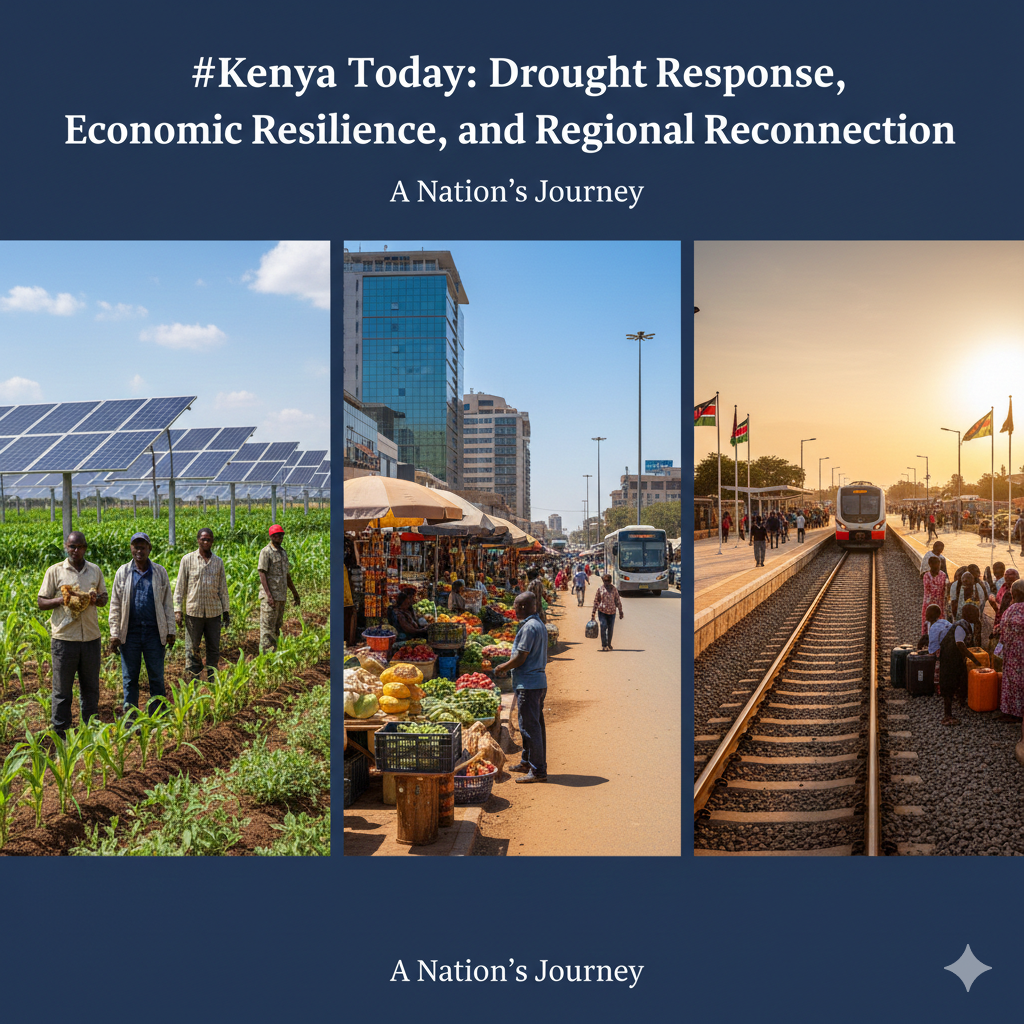
As February 2026 draws to a close, Kenya stands at a fascinating intersection of urgent humanitarian crisis and steady economic revival. From the arid plains of the north to the bustling boardrooms of Nairobi, the nation is navigating a complex landscape defined by three major themes: a relentless drought threatening millions, a surprisingly resilient economy showing strong signs of recovery, and a historic diplomatic move to heal old wounds with its northeastern neighbour.
Here is an in-depth look at the forces shaping Kenya this week.
The Silent Crisis: Battling Drought on Multiple Fronts
The most pressing issue facing Kenya today is the severe drought gripping 23 counties, affecting an estimated 3.3 million people . The situation has deteriorated rapidly since January 2026, following the failure of the October–December 2025 short rains. What was a concern affecting 2.1 million people just a month ago has now escalated into a full-blown humanitarian emergency .
The government has classified four counties—Mandera, Wajir, Kwale, and Kilifi—as being in the most severe “alarm” phase . Another 11 counties, including Turkana, Marsabit, Kitui, and Samburu, are in the crisis stage, with conditions worsening by the week . The human toll is staggering: more than 810,000 children and 104,000 pregnant and lactating women are suffering from acute malnutrition .
A Coordinated Government Offensive
In response, the Kenya Kwanza administration has launched an intensified, multi-agency emergency operation. Deputy President Kithure Kindiki has taken the lead on the ground, chairing high-level coordination meetings in Nairobi to synchronize support across national and county governments . His message has been unequivocal: “I assure the people of Kenya that the government will not spare any resources to make sure we don’t lose human life and mitigate the effects of the drought on livestock and wildlife” .
Following a Cabinet decision chaired by President William Ruto, the Treasury has released KSh 4.1 billion to expand mitigation measures, supplementing earlier allocations from December and January . Public Service CS Geoffrey Ruku revealed that total government spending on drought response from December to January alone reached KSh 6 billion, covering food distribution, livestock feed, and water trucking operations .
Last-Mile Delivery and Local Action
The challenge now is logistics. Officials warn that current relief stocks may last only two to three weeks, making last-mile delivery the critical bottleneck . The government has mobilized assets from the National Youth Service (NYS), the Kenya Defence Forces (KDF), and regional water bodies to support water trucking .
At the county level, responses are being tailored to local needs. In Kwale, Governor Fatuma Achani is overseeing the distribution of over 2,600 bags of maize, 3,600 bags of rice, and 4,000 bags of beans, reaching approximately 179,000 people . Partners like the Kenya Red Cross, Plan International, and World Vision are supplementing government efforts with food assistance, cash transfers, and school fee support . Water bowsers are being deployed to schools and health facilities, and strategic boreholes are being fast-tracked for repair .
Thinking Beyond the Emergency
Crucially, the government is attempting to link immediate relief with long-term resilience. While trucks deliver water today, authorities are investing in water infrastructure for tomorrow. In Kwale, there are plans to promote camel rearing in Kinango and Samburu as a more climate-resilient livelihood . The Hunger Safety Net Programme is also being expanded to additional counties, including Kilifi, to provide a more structural buffer against future shocks .
An Economy Showing Its Mettle
While the drought dominates headlines from the Arid and Semi-Arid Lands (ASALs), the broader Kenyan economy is telling a story of unexpected resilience.
Growth and Stability
The Kenya Private Sector Alliance (KEPSA), in partnership with the Nairobi Securities Exchange (NSE) and KPMG, recently projected GDP growth of between 4.9% and 5.2% for 2026 . This marks a steady recovery from the slower growth of 2024 and 2025. The Central Bank of Kenya (CBK) is even more optimistic, forecasting growth of 5.5% this year and 5.6% in 2027 .
This optimism is grounded in tangible stability. Inflation has cooled to a manageable 4.4% , well within the CBK’s preferred target range of 2.5% to 7.5% . The Kenyan shilling has stabilized, trading at around KSh 129 to the dollar, and sovereign credit ratings from Moody’s and S&P Global have been upgraded . In a bid to further stimulate private sector credit growth, the CBK’s Monetary Policy Committee has cut its benchmark lending rate for the tenth consecutive time, bringing it down to 8.75% .
The Fiscal Balancing Act
However, the road to full recovery is not without potholes. The National Treasury is preparing to table the 2026 Budget Policy Statement (BPS) , projecting a total budget of KSh 4.18 trillion for the 2026/27 financial year . With total revenue estimated at KSh 3.32 trillion, this leaves a fiscal deficit of KSh 866 billion (4.6% of GDP), to be financed through domestic and external borrowing .
Treasury Principal Secretary Dr. Chris Kiptoo has been candid about the challenges, noting that the current budget has been affected by shortfalls in ordinary revenue amounting to KSh 115.3 billion by December 2025 . The government is responding by tightening expenditure controls and prioritizing ongoing projects through a “zero-based budgeting” approach.
Preparing for the Long Rains
Alongside fiscal management, the government is making strategic moves to protect the next harvest. The State Department for Agriculture has rolled out the 2026 Long Rains National Fertiliser Subsidy Programme . Fertiliser is being transported via the Standard Gauge Railway (SGR) and Metre Gauge Railway (MGR) to depots across the country, including Mai Mahiu, Thika, Nakuru, and Bungoma, ensuring farmers have access to inputs ahead of the planting season . This synchronization of immediate relief with agricultural support reflects a broader strategy to stabilize food production in an era of unpredictable climate cycles .
A Historic Reopening: Kenya and Somalia Reconnect
In a development that has captured the imagination of the Horn of Africa, President William Ruto announced this week that Kenya will reopen the Mandera border post with Somalia in April 2026 , ending a 15-year closure .
The crossing, located 1,050 kilometres northeast of Nairobi near the tri-border area of Kenya, Somalia, and Ethiopia, has remained largely shut since 2011 due to insecurity linked to al-Shabaab terror group attacks . Its closure severed movement and trade between communities along the northeastern frontier that share deep cultural and clan links.
Speaking in Mandera, President Ruto acknowledged the profound human cost of the closure: “It is unacceptable that fellow Kenyans in Mandera remain cut off from their kin and neighbours in Somalia due to the prolonged closure of the Mandera Border Post. Accordingly, we will reopen the border post in April, restoring connectivity and revitalising cross-border trade for the mutual prosperity of our people” .
The 680-kilometre Kenya-Somalia border has historically supported informal and formal trade, livestock movement, and family ties. Its reopening is expected to inject new life into the local economy of Mandera County and beyond, reconnecting families and creating opportunities for cross-border commerce.
The Political Undercurrents
While the government focuses on drought and diplomacy, the political landscape remains characteristically dynamic. Internal party dynamics are simmering, particularly within the opposition ODM. Director of Elections Junet Mohamed recently accused the “Linda Mwananchi” faction, associated with Secretary General Edwin Sifuna, of working in concert with DCP Leader Rigathi Gachagua, alleging the group is undermining the party from within . The faction has denied claims of disloyalty, insisting they remain committed to ODM’s founding ideals . These manoeuvrings hint at the realignments likely to shape the approach to the 2027 general election.
Meanwhile, Parliament has resumed sittings, with Speaker Moses Wetang’ula urging lawmakers to focus on policy coherence during the upcoming budget process rather than hasty numerical amendments that could jeopardize key development programmes .
Conclusion
Kenya today is a nation of stark contrasts. In the northeast and coastal hinterlands, communities are fighting for survival against drought. In Nairobi, business leaders and policymakers are charting a course toward 5% growth, buoyed by a stable currency and cooling inflation. And at the Mandera border, a historic reopening promises to heal 15-year-old wounds and rekindle ties with Somalia.
The thread connecting these stories is one of proactive governance. Whether it is Deputy President Kindiki overseeing food distribution, the CBK cutting rates to stimulate growth, or President Ruto personally announcing the border reopening, the administration is projecting an image of hands-on crisis management. The challenge now is to ensure that the resources mobilized for drought relief reach the most vulnerable before the situation worsens—and that the stability being built in the economy translates into tangible opportunities for all Kenyans, from the farmers of Kwale to the traders of Mandera.
