

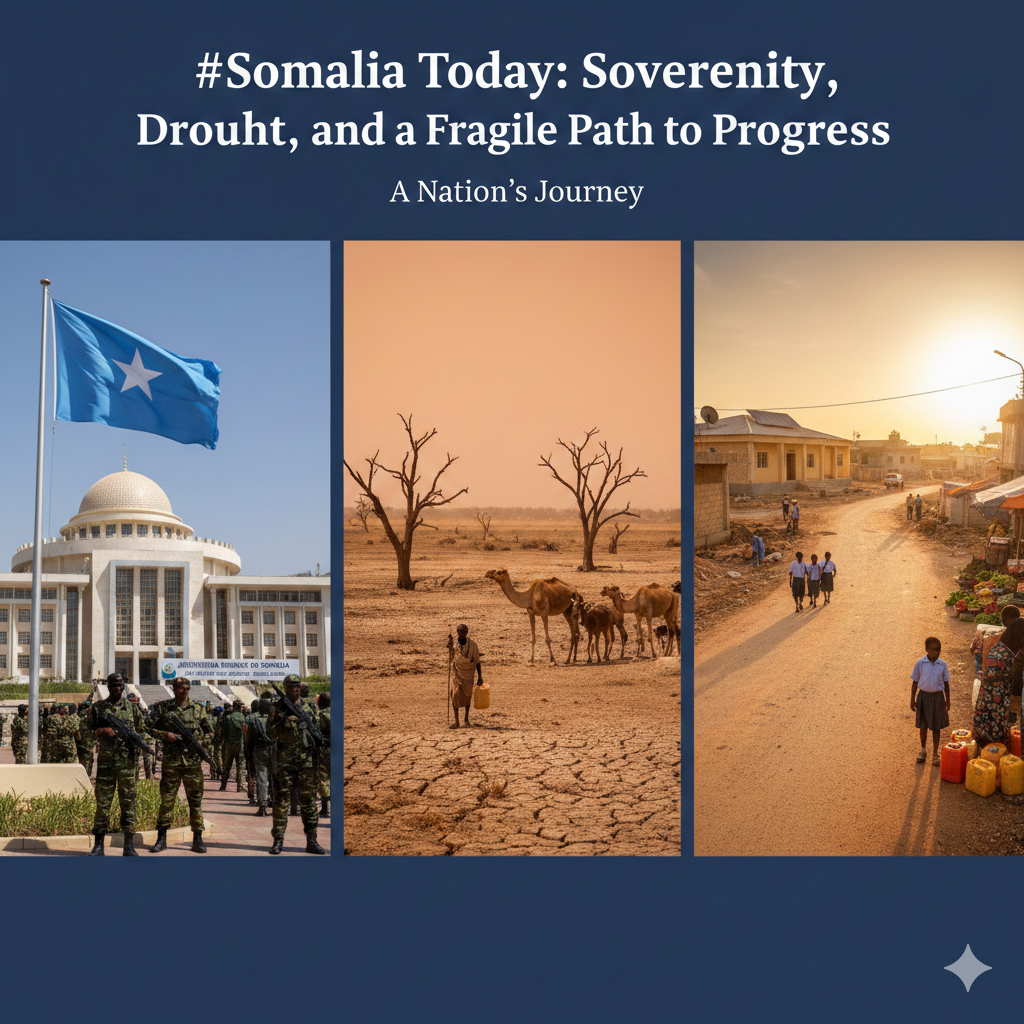
As the sun rises over Mogadishu in mid-February 2026, the narrative of Somalia is one of sharp contrasts. On the international stage, the country is commanding respect and winning diplomatic battles. On the home front, its leaders are grappling with a severe drought that threatens the lives of millions. To understand Somalia today is to look at a nation fiercely defending its sovereignty abroad while urgently trying to stabilize it at home.
Here is an in-depth look at the events shaping Somalia this week.
A Unified Continental Front for Sovereignty
The most significant headlines coming out of Somalia this week center on a major diplomatic victory. At the 39th Ordinary Session of the African Union (AU) Assembly in Addis Ababa, Somalia’s President Hassan Sheikh Mohamud secured a powerful reaffirmation of the country’s territorial integrity .
The assembly issued a draft declaration that strongly condemned and rejected the unilateral recognition of “Somaliland” as an independent entity by Israel—a move that had threatened Somalia’s sovereignty . The AU’s Peace and Security Council was unequivocal, stating that “no actor has the authority or standing to alter the territorial configuration of an African Union Member State,” declaring any such act “null and void” under international law .
In his address to the summit, President Mohamud framed this not just as a Somali issue, but as a continental one. He called for a unified African voice on global platforms like the UN Security Council and warned against foreign interference that could destabilize the Horn of Africa . The strong backing from fellow African nations underscores a collective fear of setting a precedent that could redraw the continent’s colonial-era borders .
The Race Against Time: Fighting a Deadly Drought
While diplomats were securing the nation’s borders in Addis Ababa, back home, the government was fighting a different kind of battle—one against nature. Somalia is in the grip of a severe drought, and the warnings from officials are dire: without immediate, coordinated intervention, the country could face a famine .
President Mohamud has declared the drought a national priority. During a visit to the National Emergency Operations Center of the Somali Disaster Management Agency (SoDMA), he directed all government institutions to redirect the majority of their resources toward urgent humanitarian action . The statistics are alarming. An estimated 4.8 million people are in need of humanitarian assistance, with communities facing displacement, environmental degradation, and loss of life .
In response, the government has taken the extraordinary step of directing financial institutions to provide tax exemptions on all humanitarian aid and relief-related imports to accelerate the delivery of life-saving assistance .
Prime Minister Hamza Abdi Barre has also been vocal on the issue, linking the immediate crisis to the broader fight against climate change. At a briefing following the COP30 conference in Brazil, he highlighted that Somalia has established a dedicated Ministry for Environment and Climate Change and is negotiating with the international community for access to climate finance . He called upon Somali scholars, business leaders, and the diaspora to contribute to the national relief efforts, emphasizing that “collective responsibility” is crucial during this time of crisis .
Stability Through Political Dialogue
In a positive development for internal stability, the government is making strides toward inclusive governance. Just days ago, Prime Minister Hamza Abdi Barre paid a significant visit to former President Sharif Sheikh Ahmed . This meeting, which also included former Prime Minister Hassan Ali Khaire, is part of a broader initiative to foster national unity ahead of a “strategic political dialogue” between the government and the opposition’s Council for the Future (Golaha Mustaqbalka) .
This gesture of goodwill signals a potential warming of relations and a commitment to finding common ground on critical issues, including the ongoing fight against Al-Shabaab and how to counter external interference in Somalia’s affairs . The AU’s Peace and Security Council has also encouraged this path, noting that resolving internal divisions is key to effectively combating terrorist groups .
Building an Economy from the Ground Up
Beyond the immediate crises of drought and security, Somalia is quietly working on the foundational blocks of its economy. This week, President Mohamud met with a senior delegation from the World Bank to discuss macroeconomic stability and regional integration .
The talks focused on sustaining fiscal reforms, attracting foreign direct investment, and accelerating priority investments in infrastructure and energy . Somalia is actively seeking to position itself as a hub for commerce in East Africa through initiatives like the Horn of Africa Initiative .
However, the economic road ahead is steep. A recent analysis of African economies highlights a structural challenge: Somalia is one of the continent’s most import-dependent nations, with imports accounting for roughly 99% of its GDP . This dependence, rooted in prolonged instability and weak industrial capacity, leaves the country highly vulnerable to global market shocks and underscores the urgent need to build local production capacity .
Longer-term data from the African Development Bank shows a mixed picture. While Somalia reached the HIPC completion point in late 2023, achieving significant debt relief, its budget remains heavily reliant on donor support. Domestic revenue reached $429 million in 2025, a significant increase, but it still covers only a fraction of state expenditures .
Conclusion
Somalia today is a nation living in two time zones simultaneously. In one, it is a determined state actor securing its place in the continental order, defending its borders against diplomatic challenges, and building the institutions of a modern economy. In the other, it is an emergency room, racing against the clock to save its most vulnerable citizens from the ravages of drought and climate shock.
The resilience shown by its government on the diplomatic front in Addis Ababa is the same resilience required to deliver aid to displaced families in the hinterlands. As President Mohamud and Prime Minister Barre navigate these parallel realities, their success will depend on translating the unity displayed at the AU summit into tangible results on the ground—and on ensuring that the international community stands with Somalia not just in word, but with the urgent resources its people so desperately need.