

The Blue Gold Rush: How Somalia is Reclaiming Its Fishing Future
Along the 3,333 kilometers of Somalia’s coastline—the longest of any continental African nation—a quiet revolution is taking place . For decades, these waters have been synonymous with piracy, illegal foreign trawlers, and conflict. But as February 2026 draws to a close, a new narrative is emerging. From the bustling port of Bosaso in Puntland to the record-breaking docks of Mogadishu, Somalia is beginning to unlock what many call its “blue gold”: a fishing industry with the potential to feed millions, employ a generation, and transform the nation’s economy.
The story of Somali fishing today is not a simple one. It is a tale of foreign investment meeting local tradition, of environmental sustainability clashing with historical exploitation, and of a nation determined to finally reap the rewards of its most underutilized asset.
The Untapped Bounty of the Somali Sea
To understand the potential, you must first understand the resource. The Somali maritime ecosystem is one of the richest in the Indian Ocean. Seasonal monsoon winds drive a phenomenon known as upwelling, where nutrient-rich deep waters rise to the surface, creating a plankton bloom that sustains an astonishing diversity of life. These waters teem with high-value tuna, kingfish, mackerel, lobster, and shrimp.
For generations, Somali coastal communities have practiced artisanal fishing, launching small wooden boats called houri to feed their families. Yet, despite this natural abundance, the sector has contributed minimally to the national GDP. The reasons are historical: decades of instability left the coastline unpatrolled and vulnerable. Foreign trawlers from Asia and the Middle East moved in, plundering the waters with impunity.
A sobering report published in January 2026 by the ENACT Africa research initiative revealed the devastating scale of this theft. Somalia continues to lose an estimated $300 million annually to illegal, unregulated, and unreported (IUU) fishing . Weak institutions, limited naval capacity, and, at times, corrupt licensing systems have allowed foreign fleets unfettered access to the country’s resource-rich waters . This is not just an economic loss; it is a direct threat to the food security and livelihoods of coastal communities who are outcompeted by industrial-scale plunder.
The Italian Initiative: Building a Blue Economy in Puntland
Against this backdrop of loss, a significant step towards reclamation and development was taken just this month. In Garowe, the capital of Puntland, the Italian government, in partnership with the United Nations Industrial Development Organization (UNIDO) and local authorities, officially inaugurated a transformative new initiative .
The project, titled “Economic and Livelihood Opportunities in the Fishing Sector in Somalia,” was launched nationally in Mogadishu in December 2025 but is now focused on the strategic port city of Bosaso . The goal is nothing less than to transform subsistence fishing into a modern, competitive business system .
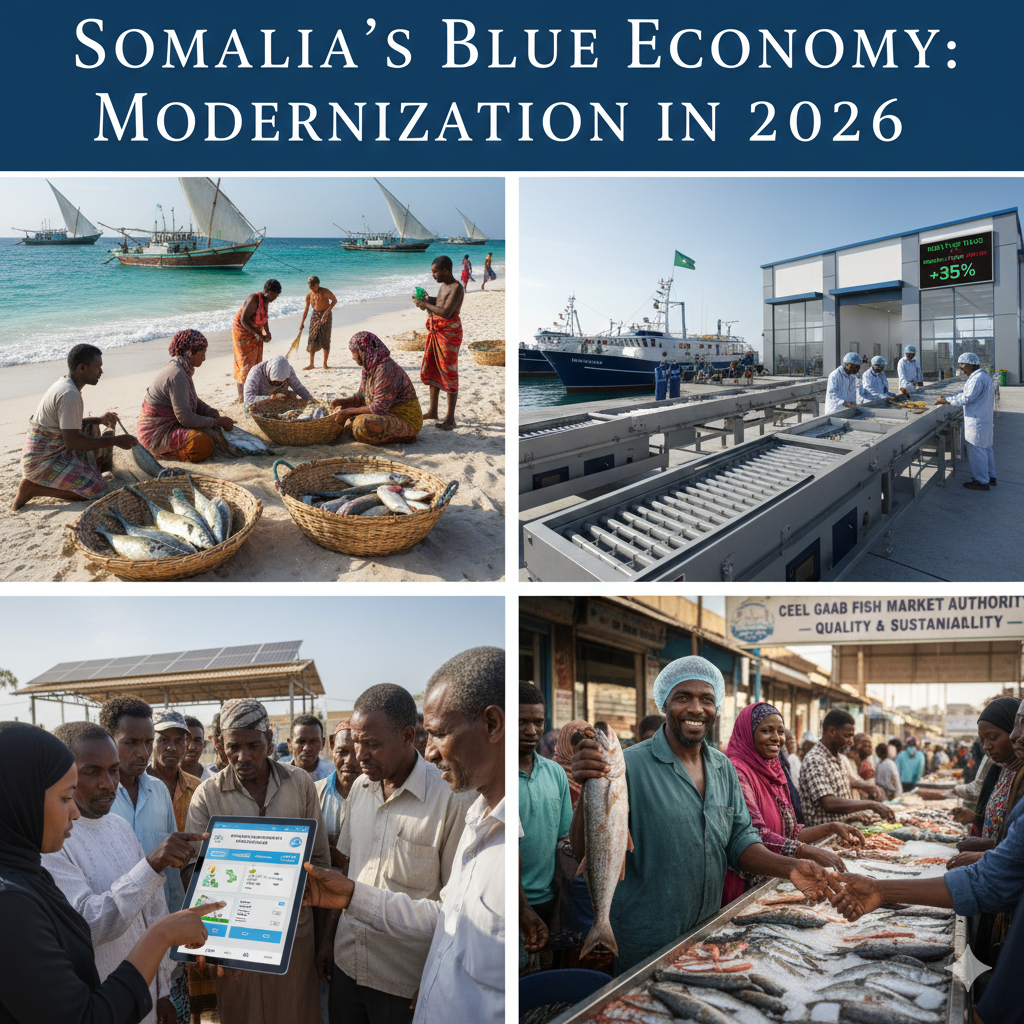
This initiative is built on two main pillars. First, the creation of a Common Service Centre in Bosaso. Owned and operated by local fishing cooperatives, this center will be equipped with modern cold storage and processing facilities . For the first time, Somali fishermen will have access to the infrastructure needed to preserve their catch properly, reduce post-harvest losses, and meet international quality standards.
Second, the project is establishing a Permanent Blue Economy Dialogue Platform, positioning Puntland as a national hub for innovation and policy dialogue in the maritime sector . Critically, the initiative focuses on over 370 local fishing industry members, including a targeted 100 women, ensuring that the benefits flow directly to the community . Italian Ambassador to Somalia, Pier Mario Daccò, emphasized that this goes beyond hardware; it is about building a “model of economic transformation” .
A Clean Energy Revolution on the Water
Infrastructure is only part of the challenge. One of the most crippling barriers for Somali fishers has been the cost of energy. With some of the highest electricity prices in the world—averaging $0.61 per kWh and sometimes exceeding $1 in remote regions—powering freezers and ice machines has been prohibitively expensive .
This is where innovation is stepping in. The Food and Agriculture Organization (FAO) is at the forefront of a clean energy shift, promoting the use of solar power in the fisheries supply chain . The logic is simple: Somalia enjoys an average of 3,100 hours of sunshine per year .
By providing solar-powered refrigerators and ice machines to fishing companies, the FAO is helping to tackle the staggering problem of post-harvest losses. Currently, an estimated 30% of the landed catch in Somalia rots because of inadequate storage and preservation . For a nation grappling with food insecurity, this is a tragic irony. Solar cold storage allows fish to stay fresh from the moment it is caught in the dhow until it reaches markets in Mogadishu or beyond, increasing profitability and food availability simultaneously .
Protecting the Fishermen and the Sea
As the industry grows, so does the responsibility to protect both the marine environment and the people who depend on it. A groundbreaking partnership announced this month aims to do just that. Project ReCon, a global circular economy initiative led by the technology company Satlink, has officially reached Somalia in collaboration with the local NGO MARCOD Centre (Marine Research and Coastal Development Centre) .
The project tackles the problem of marine debris—specifically, the thousands of end-of-life fishing gear and electronic buoys that litter the coastline. These devices will now be recovered, and where possible, repurposed.
The most exciting aspect of this initiative is its human dimension. Recovered buoys are being transformed into tracking and VMS (Vessel Monitoring System) tools for local artisanal fishing boats . As Abdishakur Farah, Director of MARCOD Centre, noted, “Fishers’ safety is crucial for coastal communities all along the Somali coast. Project ReCon gives us access to technology to tackle these issues in both a practical and sustainable way” . Operating in strong currents and challenging conditions, Somali fishermen will now have access to technology that enhances their safety and allows for better monitoring of their own fishing grounds, helping to spot and report illegal intruders.
The Geopolitical Context: Ports and Partnerships
These grassroots developments are occurring alongside a significant geopolitical realignment. Somalia is aggressively positioning itself as a regional maritime hub. In January 2026, the Mogadishu Port Authority announced its most productive month in history, processing a record 21,650 TEUs (shipping containers) . The Mediterranean Shipping Company (MSC) has inaugurated a direct service linking Colombo, Sri Lanka, to Mogadishu, transforming the capital’s port from a final destination into a regional transshipment hub .
Furthermore, the federal Cabinet recently approved a sweeping maritime cooperation agreement with Türkiye . This deal covers everything from port modernization to the mutual recognition of seafar’ certificates, integrating Somalia into global maritime standards. Minister of Ports and Maritime Transport, Abdulkadir Mohamed Nur, described direct sea links with Türkiye as a “strategic necessity” to cut costs and boost trade, while also emphasizing that “the security of global trade is directly linked to the security of Somalia’s coasts” .
The Road Ahead
Despite these positive strides, the path forward is fraught with challenges. Al-Shabaab remains a serious security threat, and the jurisdictional disputes between the federal government and member states continue to complicate governance .
However, the momentum is undeniable. The combination of grassroots empowerment in Puntland, technological innovation in clean energy and safety, and high-level geopolitical port development is creating a perfect storm of opportunity. For the first time in a generation, the fishermen of Somalia are not just hoping for a better future—they are building it, one catch at a time.
