

Giants in a Shrinking World: The State of East African Wildlife in 2026
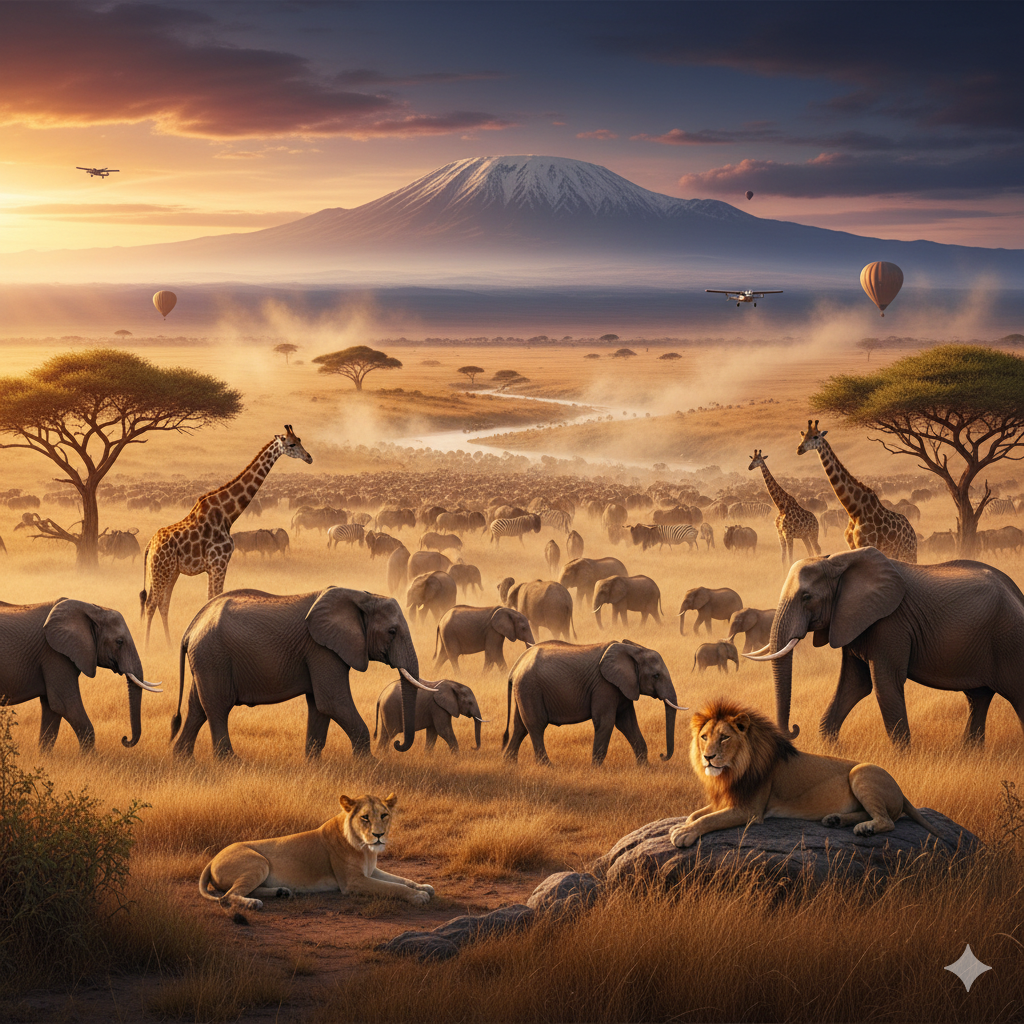
The image is iconic and timeless: a herd of elephants kicks up dust across the golden savanna as they march towards a distant acacia tree, with the snow-capped peak of Kilimanjaro watching over them. It is a scene that has drawn travelers to East Africa for generations. However, beneath this picture-postcard veneer, a complex and often contradictory story is unfolding. In 2026, the wildlife of Kenya, Tanzania, and Uganda is navigating a landscape transformed by climate change, human expansion, and the unexpected consequences of conservation success.
From the discovery of a million “lost” flamingos in a remote Kenyan valley to the desperate relocation of “stranded” giraffes, the region’s animals are adapting, struggling, and in some cases, thriving in ways that challenge our traditional notions of wilderness . This is the state of East African wildlife today.
The Success Story with a Catch
For decades, conservationists fought a rearguard action against poaching and habitat loss. In many areas, they have won. The elephant population in East Africa has climbed by an estimated 15% over the past decade, a testament to relentless anti-poaching efforts . Yet, this victory has created a new, more complicated problem: there are now too many elephants in too little space.
As one conservation report noted, the efforts have been “almost too successful” . While herds have grown, Kenya’s human population expanded by nearly 60% between 2000 and 2020, blocking ancient migration routes with farms, fences, and highways. Elephants, packed into smaller areas, are increasingly pushing into farmland, leading to crop raiding and human-wildlife conflict.
This phenomenon is perhaps most starkly illustrated by the black rhino. Hunted to the brink of extinction, Kenya’s population plummeted to just 381 by 1987. Today, thanks to intense protection, that number has surged past 1,000, with the country now holding nearly 78% of the world’s eastern black rhinos . However, many of these animals were confined to small, heavily guarded sanctuaries designed as temporary refuges during the crisis years. In places like the Ngulia Sanctuary in Tsavo West, the rhino population soared to more than double the ecological carrying capacity. The result was a surge in territorial fights and, tragically, high calf mortality.
The response has been ambitious: the Kenya Wildlife Service (KWS) recently opened the world’s largest rhino sanctuary in an expanded Tsavo West, spanning 3,200 square kilometers. This new space is designed to give the rhinos room to breathe and establish natural territories, aiming to grow the national population to 2,000 by 2037 .
The Climate Crisis on the Ground
While megafauna battle for space, the region’s broader ecosystem is being reshaped by a relentless climate. A severe drought, spreading beyond Kenya’s traditionally arid north into areas like Kajiado county, is having a devastating impact on both livestock and wildlife . For the Maasai pastoralists who have coexisted with wildlife for centuries, this drought is the worst in living memory. With their cattle and goats dying, their livelihoods are collapsing, pushing them into deeper poverty and increasing the pressure to use land for farming rather than grazing—a shift that experts warn is often counterproductive in arid lands .
This environmental stress is forcing wildlife into new patterns. In early 2026, KWS rangers were forced to undertake a complex and risky operation to relocate a herd of “stranded, stressed” giraffes from the Kedong Ranch near Lake Naivasha . The land, once open, had been sold and subdivided for real estate, its new fences blocking the giraffes’ ancient routes to grazing grounds. Such relocations, once a last resort, are becoming increasingly frequent.
Yet, in the face of such adversity, nature is also revealing its resilience in spectacular fashion. In a remarkable discovery, an aerial survey over the remote and inhospitable Suguta Valley in northern Kenya found nearly a million lesser flamingos thriving on the alkaline waters of Lake Logipi . This “lost” flamingo population, representing up to half of East Africa’s total, had gone unnoticed for decades. The lake has become a critical refuge at a time when other iconic flamingo habitats like Lakes Nakuru and Bogoria are becoming less hospitable due to rising water levels and changing salinity—a direct consequence of climate change . The discovery underscores the importance of protecting not just the famous parks, but the entire, interconnected ecosystem.
The Poaching Frontier: The Last of the Super Tuskers
The illegal wildlife trade remains a dire threat, particularly for the most magnificent creatures. The region’s “super tuskers”—elephants with tusks so large they often scrape the ground—are hanging on by a thread. Each tusk can weigh over 100 pounds, making them a “big ticket” prize for poachers and trophy hunters .
Today, fewer than 30 of these genetic giants remain in all of East Africa . During the dry season, they migrate through unprotected wildlife corridors between Kenya and Tanzania, making them extremely vulnerable. To combat this, conservation groups are turning to technology. Drones are being deployed to act as “guardians from the sky,” guiding the elephants away from poaching hotspots and towards safe water sources, and away from human settlements where they might be killed in retaliation for crop damage .
This tech-focused approach is gaining ground across the region. In Tanzania, the organization African People & Wildlife (APW) won a prestigious Tech4Nature award for its work with local communities . By training community habitat monitors to use mobile data collection tools and geospatial dashboards, they are empowering local villages to manage grazing lands more sustainably. This data-driven approach helps prevent overgrazing, manage invasive species, and ensure that vital wildlife corridors remain open, reducing competition for resources between livestock and wild herbivores .
A Future Built on Coexistence
The central challenge for East African wildlife in 2026 is no longer just about creating fenced-off parks. It is about learning to share a crowded continent. The old model of conservation, which sometimes excluded local people, is giving way to a new paradigm of community-led stewardship.
In Kenya, a pioneering “Wildlife Lease Program” is paying Maasai pastoralists to keep their land open for wildlife . In exchange for a fee, landowners in areas like Kitengela, near Nairobi National Park, agree not to fence or subdivide their property, allowing animals to migrate freely. This model recognizes that for wildlife to survive outside park boundaries, it must provide tangible economic benefits to the people who live alongside it.
Similarly, innovative solutions are fostering coexistence on a smaller scale. From beehive fences that deter elephants with their fear of stings—providing farmers with honey as a bonus—to GPS collars that alert communities to approaching herds, the focus is on practical tools that reduce conflict .
The story of East African wildlife today is not a simple tale of decline. It is a narrative of paradoxes: of successful recovery creating new pressures, of climate change destroying some habitats while creating unexpected refuges in others, and of ancient migration routes blocked by development, while technology opens new pathways to coexistence. The giants of East Africa are navigating a world we have built around them. Their future will depend not just on our ability to protect them in parks, but on our willingness to make space for them in our world.