

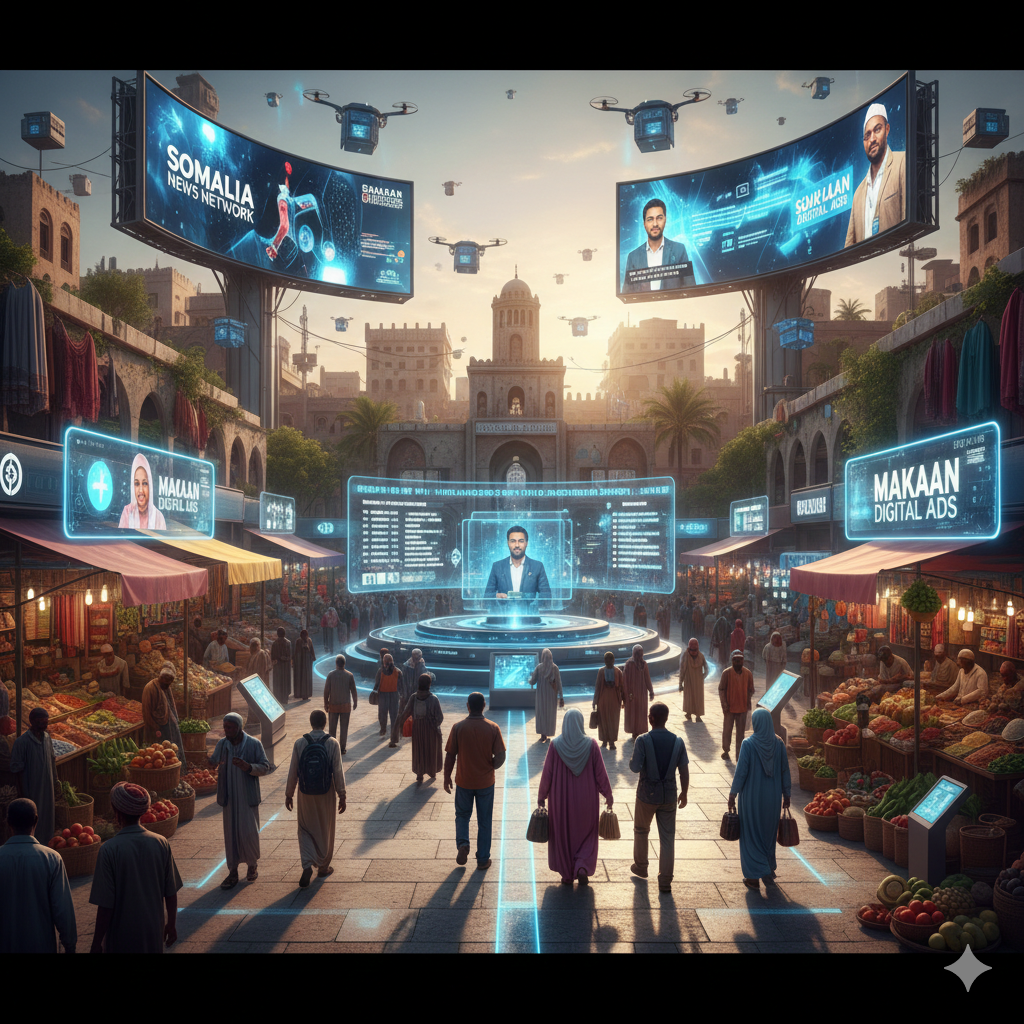
MOGADISHU, Somalia – In the bustling Bakara Market, where merchants have hawked goods for generations, a quiet revolution is underway. A shopkeeper who once relied solely on word-of-mouth now checks his Starlink-connected tablet for wholesale prices. A young woman in Mogadishu’s Hamar Weyne district scrolls through Instagram, discovering a new Somali-owned fashion brand based in Minneapolis. A telecom executive in Hargeisa monitors real-time campaign data from a Facebook ad targeting diaspora communities in London.
This is marketing in Somalia today—a dynamic, mobile-first ecosystem where ancient trading instincts meet cutting-edge digital tools, and where the country’s youthful population is rewriting the rules of commercial engagement. As 2026 unfolds, Somalia stands at a pivotal moment in its digital transformation, driven by connectivity breakthroughs, a deepening partnership with Türkiye, and a generation determined to project a new narrative to the world.
The Digital Foundation: Starlink Arrives
The most significant development for Somali marketing in early 2026 is the launch of Starlink’s high-speed satellite internet service, marking the company’s entry into its 25th African market. Following the National Communications Authority’s approval of Starlink’s operational licence in April 2025, the service is now live across the country .
This deployment represents a quantum leap for a nation where 70 percent of the population has historically lacked reliable broadband access . For marketers, the implications are transformative. Starlink’s low-latency, high-speed connectivity enables video-rich advertising, seamless e-commerce transactions, and real-time data analytics that were previously impossible in areas beyond the reach of fibre optic networks.
At $70 per month with a one-time hardware fee of $390, Starlink’s residential plan is priced higher than local providers . But for businesses, NGOs, and media houses, the premium is increasingly viewed as a necessary investment. The service aligns with the Somali National ICT Policy and Strategy, which prioritises building domestic digital infrastructure and widening access . For the first time, a content creator in Baidoa can upload high-definition video with the same ease as a competitor in Nairobi.
The Numbers Behind the Revolution
DataReportal’s Digital 2026 report paints a picture of a nation rapidly embracing connectivity. As of late 2025, Somalia had 11.5 million cellular mobile connections, equivalent to 58.1 percent of the population, with mobile connections increasing by 7.0 percent over the previous year . Critically, 75.7 percent of these connections are now considered “broadband,” connecting via 3G, 4G, or 5G networks .
Internet users numbered 5.47 million, representing 27.6 percent of the population . While this means 72.4 percent remain offline, the growth trajectory is unmistakable: 178,000 new internet users joined between late 2024 and late 2025 . Social media has followed suit, with 3.51 million active user identities recorded—a 14.1 percent increase year-on-year .
Perhaps most telling for marketers is the demographic profile. Somalia’s median age is just 15.6 years, with 41.8 percent of the population under the age of 12 . This is a staggeringly young nation, one that has never known a world without mobile phones. For brands, the message is clear: those who capture the attention of Gen Z and Alpha today are building loyalty for a generation.
The Advertising Landscape: Google and Meta Dominate
When Somali businesses invest in online advertising, their dollars flow primarily to two American giants. Google AdSense commands 31 percent of the advertising networks market among Somali (.so) websites, followed by Twitter Ads at 19 percent . Criteo holds 12 percent, with Microsoft Advertising and Outbrain each at 10 percent .
This concentration reflects the global nature of digital advertising, but it also masks a more localised reality. Successful marketing in Somalia requires platforms that can deliver Somali-language content, respect cultural norms around family and faith, and operate effectively on mid-range Android devices with variable bandwidth .
Meta’s platforms—Facebook and Instagram—remain the workhorses of Somali digital marketing, prized for their high reach and community presence . TikTok is rapidly emerging as a discovery engine, particularly for youth-oriented brands, with short-form video proving effective for everything from fashion to public health messaging .
On the marketing automation front, MailChimp leads with 31 percent market share, followed by HubSpot at 19 percent and MailChimp for WordPress at 17 percent . These tools enable Somali businesses to nurture leads, automate email campaigns, and track customer journeys with increasing sophistication.
The Türkiye Connection: Trade, Ports, and Marketing Synergy
Beyond the digital realm, a major geopolitical and commercial story is reshaping Somalia’s marketing landscape. Somalia’s Ports and Maritime Transport Minister, Abdulkadir Mohamed Nur, declared in mid-February 2026 that establishing direct maritime shipping routes with Türkiye has become a “strategic necessity” .
Speaking at the Organization of Islamic Cooperation’s Transport Ministers Conference in Istanbul, Nur emphasised that commercial exchanges between the two nations have outgrown existing logistics capacity . “The current level of trade between Somalia and Türkiye has moved beyond the present logistics structure,” he stated, arguing that direct sea lines would reduce costs, shorten delivery times, and boost overall trade volume .
This deepening partnership, which began with President Recep Tayyip Erdoğan’s landmark 2011 visit to Mogadishu, now spans defense, energy, education, infrastructure, fisheries, space, and maritime sectors . For marketers, the implications are significant. Increased trade flows mean more Turkish goods in Somali markets, more Somali exports reaching Turkish consumers, and a two-way exchange of commercial ideas and branding expertise.
Feasibility studies for the New Mogadishu Port Project have been completed and are now entering the tender phase . This ambitious initiative aims to transform regional logistics capacity, positioning Somalia as a gateway not only for its own commerce but for landlocked East African nations. The security of global trade, Nur noted, is “directly linked to the security of Somalia’s coasts” .
Marketing in Practice: A Full-Funnel Approach
For businesses seeking to succeed in Somalia’s evolving market, a sophisticated, multi-channel approach is essential. The mobile-first nature of the audience means that campaigns must be designed for smartphones, with lightweight assets that load quickly on 3G connections and clear calls-to-action in Somali .
Leading agencies like Korhogo Agency now offer end-to-end digital advertising services tailored to Somalia’s unique context. Their approach encompasses market insight, go-to-market strategy, precision audience targeting across Meta, TikTok, YouTube, and Google Ads, and creative development optimised for local sensibilities .
Crucially, successful marketing integrates with Somalia’s ubiquitous mobile money ecosystem. Platforms like EVC Plus (Hormuud), ZAAD (Telesom), and E-Dahab are not just payment methods but marketing channels in their own right, enabling everything from discounted transactions to loyalty programmes .
Influencer marketing has matured significantly. Agencies now curate creators with verified audiences in Somalia and key diaspora hubs—Kenya, Ethiopia’s Somali Region, the UAE, Saudi Arabia, the UK, the US, Canada, and Scandinavia . Long-term ambassadorships, built on trust and repetition, consistently outperform one-off posts .
Projecting a New Narrative: Somalia on the Global Stage
Marketing is not merely about selling products; it is about shaping perceptions. In January 2026, Somalia took a significant step in this direction by participating in a major Cultural and Tourism Exhibition in Madrid .
Leading a high-level delegation, Director General of the Ministry of Information, Culture, and Tourism Abdullahi Hayir Duale showcased Somali cuisine, traditional customs, and untapped tourism potential to an international audience . The Somali pavilion became a focal point of interest, attracting representatives from major international tourism companies and sparking productive discussions with potential investors .
This effort to “introduce the world to the positive narratives of the Horn of Africa nation” represents a sophisticated form of nation-branding . By highlighting heritage and investment potential, Somalia is challenging outdated stereotypes and positioning itself as an emerging destination on the world map. The Somali Aviation and Tourism Agency (SATA) played a critical role in facilitating this participation .
Industries Leading the Charge
Several sectors are at the forefront of Somalia’s marketing evolution:
Telecom and Mobile Money: Companies like Hormuud, Telesom, Somtel, and Golis are sophisticated advertisers, running campaigns focused on acquisition, data bundles, agent networks, and product education .
Fintech and Remittances: With diaspora remittances forming the bedrock of the economy, trust-driven messaging is paramount. Marketing emphasises fee transparency, reliability, and seamless onboarding flows .
E-commerce and Marketplaces: Platforms are using catalogue feeds, dynamic remarketing, and merchant activation campaigns to build critical mass .
NGOs and Public Health: Organisations leverage short videos, radio partnerships, and WhatsApp Q&A flows for outreach on health, education, and humanitarian programmes .
The Road Ahead
As 2026 progresses, Somalia’s marketing landscape will continue its rapid evolution. Starlink’s presence will enable more sophisticated digital services. The Türkiye shipping corridor will deepen commercial ties and introduce new products and brands. A young, digitally-native population will demand content that speaks their language—both literally and culturally.
The challenges remain substantial: 72 percent of the population remains offline , infrastructure gaps persist, and global supply chains remain fragile . Yet the trajectory is unmistakable. In the digital bazaars of Mogadishu, Hargeisa, and Garowe, a new generation of Somali marketers is writing a story of resilience, innovation, and connection to the world.
The shopkeeper in Bakara Market, checking prices on his Starlink tablet, is not just surviving—he is competing, adapting, and building a business for the 21st century. And the world is finally beginning to pay attention.
