

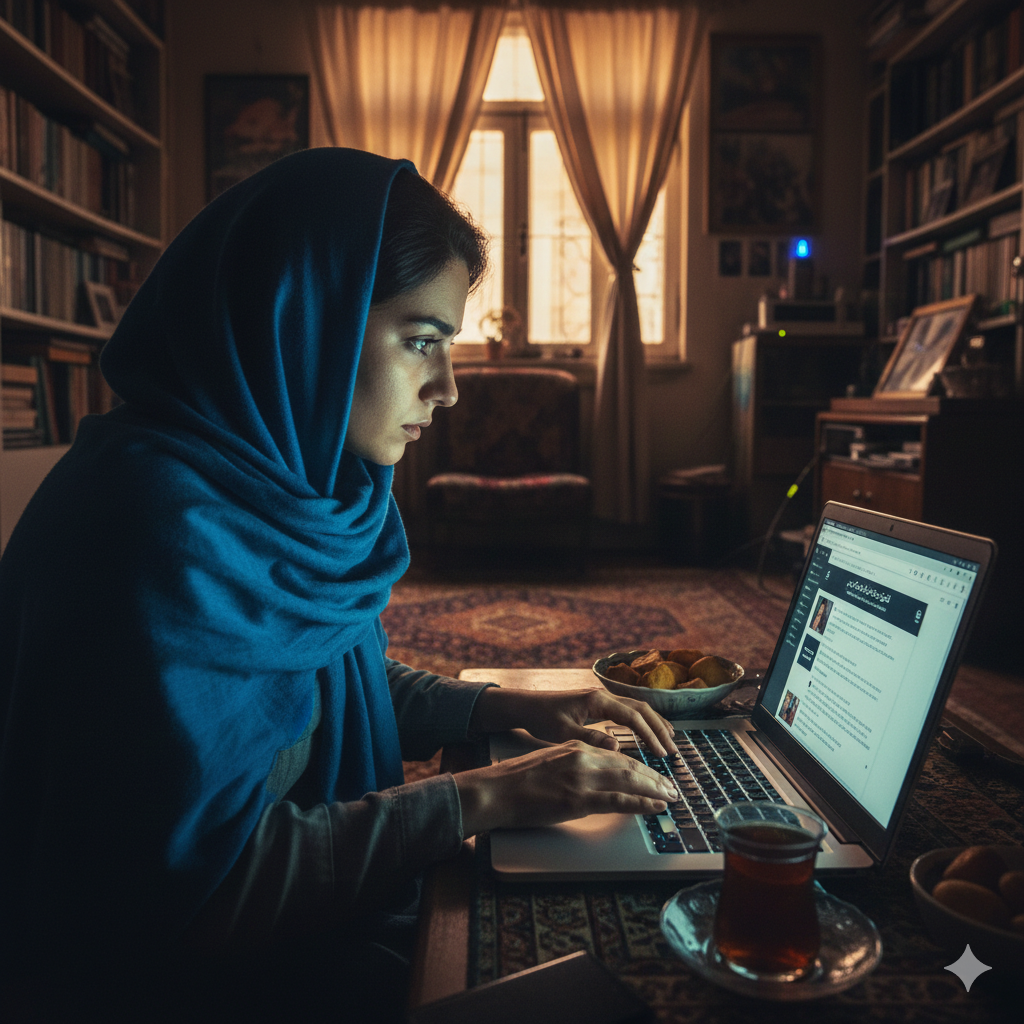
TEHRAN, Iran – In a small apartment in northern Tehran, Amir stares at his laptop screen, refreshing a news aggregator for the hundredth time. It has been over a month since he last posted a video review to his gaming channel. His 200,000 followers on YouTube and Instagram have gone silent. His income has evaporated. His profession—digital content creator—has been rendered illegal overnight by a government that sees the open internet as an existential threat .
Amir is one of millions of Iranians caught in the longest and most comprehensive internet shutdown in the country’s history. Since January 8, 2026, when nationwide protests erupted following weeks of economic turmoil, the Islamic Republic has systematically severed its population from the global web. What remains is a ghost of connectivity—a heavily curated “national internet” that offers government-approved apps, censored news, and little else .
But Iran’s bloggers and digital creators are not simply waiting for the lights to come back on. In the shadows of this digital lockdown, a sophisticated cat-and-mouse game is unfolding—a battle for information, livelihood, and the very right to communicate with the outside world.
The Blogger’s Toolkit: WordPress Dominates, But Access Vanishes
Before the shutdown, Iran’s blogging ecosystem was surprisingly robust and diverse. According to usage statistics for Iranian domains (.ir), WordPress dominated the market with nearly 100 percent share among websites using blogging platforms, followed by negligible fractions for Google’s Blogger, the local platform Virgool, and others . Over 185,000 Iranian websites were actively using these tools to publish content.
But statistics mean little when the infrastructure disappears. Since January 8, access to virtually all international platforms—including the very tools bloggers use to earn a living—has been severed. Instagram, which served as a primary marketplace for Iranian entrepreneurs and a portfolio for visual artists, is completely blocked. YouTube, where creators like Amir earned advertising revenue and built global audiences, is inaccessible. Even WhatsApp, which had been unblocked for nearly a year, has been re-blocked .
The official justification, repeated by Iran’s foreign minister, is that the shutdown is necessary to confront foreign “terrorist operations” and prevent the coordination of “saboteurs” . Rights groups and independent observers offer a blunter assessment: the blackout is designed to mask a government crackdown on protesters and prevent the leaking of videos, documents, and testimonies revealing the scale of violence .
The Economy of Isolation: When Your Office Disappears
The human cost of this digital lockdown is measured in bankruptcies, empty refrigerators, and abandoned careers. Iran’s deputy telecommunications minister has acknowledged that the shutdown costs the economy between $3-4 million per day. Internet monitoring group NetBlocks provides a far higher estimate: over $37 million daily .
For bloggers and content creators, the math is simple and devastating. No internet means no platform. No platform means no income. No income means, for many, no future.
“We used to complain that working under these conditions was difficult, but now it’s affecting every aspect of our livelihoods,” said Amin, a 29-year-old tech reviewer who, like Amir, has been unable to produce content for over a month .
The Chamber of Commerce reportedly allowed merchants just 20 minutes of international internet per day—and even that limited access came under the watchful eye of a security monitor. The decision sparked widespread mockery on social media, but for business owners dependent on global platforms, it was no laughing matter .
A travel agent in Tehran, speaking on condition of anonymity, described how booking international flights has become “unstable.” Flights are cancelled, passengers only informed upon arrival at airports, and the daily stream of customer inquiries has dried to a trickle .
The National Network: A Poor Substitute
Authorities have attempted to compensate for the global blackout with the National Information Network—a fully controlled domestic intranet designed to keep essential services running while isolating citizens from the outside world .
On this internal network, basic functions continue. Buses run. Subway systems operate. Online payment and banking platforms function. Ride-hailing apps, navigation services, and food delivery work. Domestic messaging apps including Bale, Eitaa, and Rubika have been promoted as alternatives to their foreign counterparts .
But for bloggers and creators who built their careers on global platforms, these domestic alternatives are inadequate. Amir, the gaming reviewer, told AFP he has “never used these apps and I will not start now,” citing privacy concerns . His skepticism is widely shared. Independent estimates suggest the national network fails to meet even 10 percent of citizens’ daily needs for information, entertainment, and economic opportunity .
The Technological Arms Race: VPNs, Starlink, and the “White List”
In response to the lockdown, a parallel technological war has erupted. Millions of Iranians are now engaged in a daily battle to bypass censorship, using virtual private networks (VPNs) and other circumvention tools to reach the global web .
The government, anticipating this resistance, has reportedly developed sophisticated plans to counter it. According to Filterwatch, an organization monitoring Iranian internet censorship, authorities are planning to make international access a “government privilege”—a permanent “white list” system where only approved individuals with security clearance can reach the global web, while ordinary citizens are restricted to the domestic network .
This system would use high-capacity “middleboxes” to monitor all network traffic, detect unauthorized VPN usage, and block access to specific websites and tools .
Starlink, Elon Musk’s satellite internet service, has become a forbidden lifeline for those who can afford it. An estimated 100,000 Iranians now use the service, despite government warnings that doing so constitutes a crime. The price of equipment has surged tenfold in just weeks .
The Information War: Truth and Propaganda in a Vacuum
When reliable information disappears, propaganda fills the void. The internet blackout has stanched the flow of verifiable news about events inside Iran. In its place, a deluge of disinformation and influence campaigns has flooded what remains of the digital space .
Researchers have identified multiple coordinated information campaigns on X (formerly Twitter), Instagram, and other platforms. Inauthentic accounts—bots—spread false narratives and misleading images, further muddying an already opaque situation. Some content seeks to bolster the opposition, including by championing Reza Pahlavi, the exiled son of the former Shah. Other narratives echo official Iranian claims that the unrest is orchestrated by foreign enemies .
For Iranian bloggers and citizens, navigating this landscape requires constant vigilance. Unofficial surveys suggest that over 60 percent of Iranians trust only what they see with their own eyes or receive through personal networks. Only 5 percent trust official media .
The Fracturing State: Cracks in the Security Apparatus
Perhaps the most significant development beneath the surface of Iran’s digital lockdown is the emerging evidence of fractures within the state’s own security forces.
The “12 Days War” with Israel in June 2025 not only crippled parts of Iran’s nuclear infrastructure but also drained the country’s last liquid reserves. When the IRIB broadcasting center, the state’s primary propaganda organ, was hit, it signaled more than a military failure—it broke the spell of regime invincibility .
More concretely, there have been documented cases of security personnel refusing orders or expressing dissent. In November 2025, Colonel Ebrahim Aghaei Kamazani of the regular army (Artesh) recorded a direct address that went viral globally. “If we die one by one, it’s better than to give our country to the enemy,” he declared, referring not to a foreign invader but to the domestic “enemy” within the ruling clerics .
Analysts suggest that soldiers, suffering from the same inflation and economic pressure as the civilians they are ordered to suppress, are increasingly showing signs of “passive resistance” .
The Future: A Nation Fighting for Connection
As February 2026 draws to a close, it remains unclear how long the blackout will last. Government spokespeople have hinted that restrictions may continue through the Persian New Year in March . Patchy access to some foreign websites and email services has been reported in recent days, but connectivity remains highly unreliable .
“The only optimistic thing I can say… is that I don’t see them keeping the internet shut completely for a long time,” Amin, the tech reviewer, told AFP. “Otherwise, it will backfire” .
Whether he is right may determine not only the fate of Iran’s bloggers and digital creators, but the trajectory of the country itself. In the battle between a government determined to control information and a population equally determined to access it, the outcome remains uncertain. What is clear is that Iran’s bloggers are no longer just writing about politics, culture, or gaming. They are living it—fighting for their livelihoods, their voices, and their connection to the world, one VPN connection at a time.