

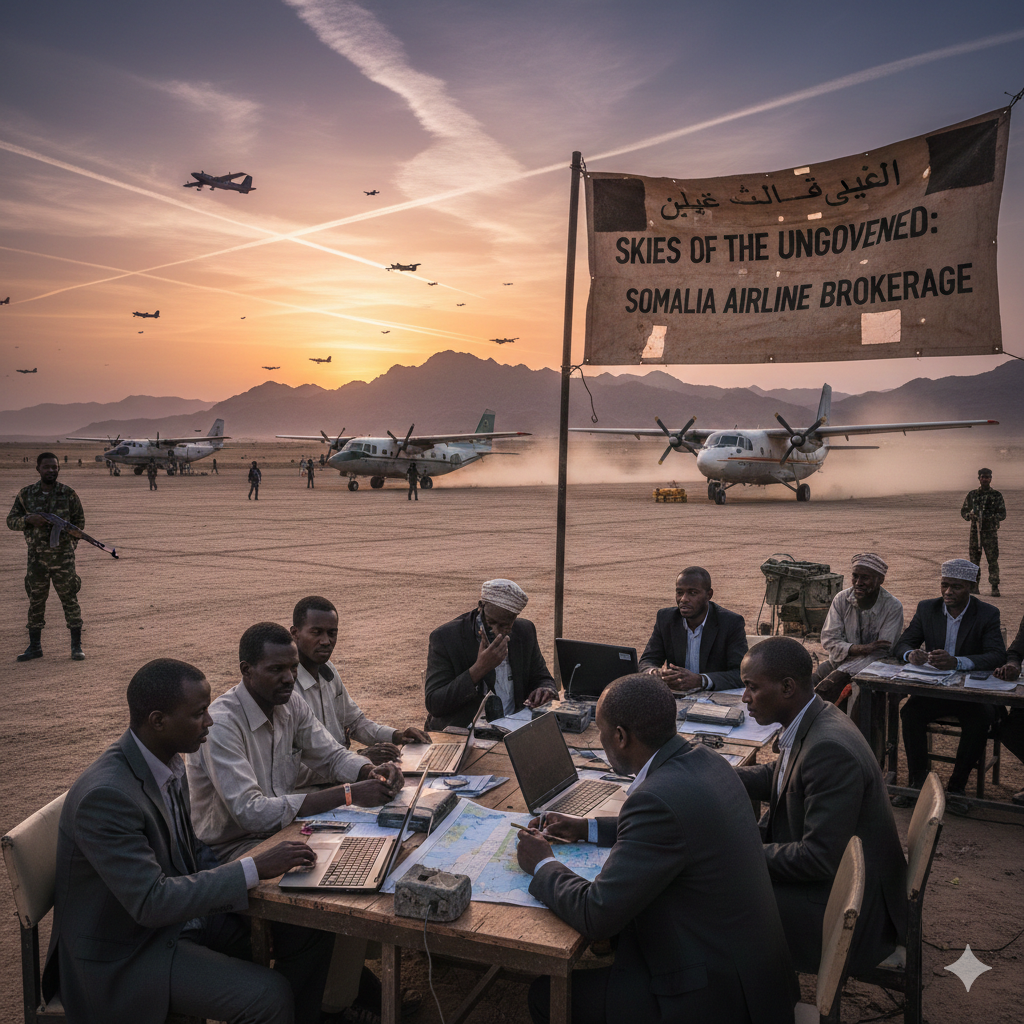
NAIROBI / MOGADISHU – In the shadowy, high-risk corridors of global aviation, few arenas are as opaque, complex, and perilously lucrative as the Somali airspace. Airline brokerage in Somalia today is not the work of besuited agents in glass towers; it is a gritty, entrepreneurial, and often clandestine enterprise operating at the intersection of humanitarian need, diaspora connectivity, clan commerce, and geopolitical intrigue. This is a market where the aircraft is a floating piece of sovereign territory, where contracts are sealed with a handshake and a mobile money transfer, and where every flight is a calculated gamble on politics, weather, and security. For the brokers who navigate this space, the sky is not the limit—it is a fraught and fiercely competitive frontier.
The Landscape: A Fragmented Airspace and a “Buyer-Beware” Market
Somalia’s airspace, formally managed by the UN’s International Civil Aviation Organization (ICAO) since 1996 due to the state’s collapse, is a patchwork of de facto control. The Mogadishu Flight Information Region (FIR) is nominally under the Federal Government of Somalia (FGS), but real authority is contested. Al-Shabaab controls swathes of territory and airspace below, regional states like Somaliland and Puntland manage their own airports with varying degrees of autonomy, and international military actors (the US, Turkey, ATMIS) operate with their own protocols.
In this environment, there is no centralized national carrier like Ethiopian Airlines. Instead, the market is served by:
- Specialist Somali Carriers: Airlines like Jubba Airways, African Express Airways, and Daallo Airlines (based in Djibouti but deeply integrated). These operators possess the hard-won, local knowledge necessary to navigate the bureaucratic and physical minefields.
- Humanitarian and UN Charter Operators: A rotating cast of global and regional charter companies under contract to the WFP, UNICEF, and NGOs.
- “Grey Market” Ad-Hoc Operators: Small, often single-aircraft operators who appear and disappear, flying irregular routes for specific cargo (often khat, electronics, or cash).
The broker’s role is to connect a client—be it an NGO, a diaspora group, a business consortium, or a politician—with the right aircraft and operator for a specific mission within this chaotic ecosystem.
The Broker’s Toolkit: Connections, Cash, and Contingency Planning
A successful Somali aviation broker deals in more than just aircraft specs and hourly rates. Their core assets are intangible and critical:
- Clan and Political Nexus: Understanding which clan controls which airport, which official’s signature is needed for a landing permit, and which militia commander requires a “facilitation fee” is paramount. A broker from the wrong clan lineage may find doors closed and phones unanswered. This network is the primary barrier to entry and the source of a broker’s value.
- Security Intelligence: This is not about generic threat levels. It is about real-time, granular intelligence: Is the road from the Aden Adde terminal to the city safe today? Has Al-Shabaab moved anti-aircraft assets near a particular airstrip? Are tensions between federal and regional forces likely to trigger a sudden airspace closure? Brokers maintain their own informant networks to answer these questions.
- Financial Agility and Discretion: Transactions are conducted in US dollars, often via hawala transfers or mobile money. Upfront cash payments for fuel, landing fees, and “security guarantees” are standard. The broker must have access to liquid capital and manage a web of payments to officials, fuel suppliers, and ground handlers who may not issue receipts. The line between brokerage and money laundering can appear thin to outsiders.
- Mastery of “Logistical Bypass”: When the official system is blocked—a landing permit denied, a cargo manifest rejected—the broker must know the alternative route. This might mean routing a flight through Hargeisa instead of Mogadishu, using a smaller aircraft for a remote airstrip, or reclassifying cargo to satisfy a curious official.
Primary Client Sectors: Who Needs a Broker in Somalia?
- The Humanitarian Industrial Complex: The largest and most stable source of business. Brokers compete for tenders to move NGO staff, medical supplies, and cash-for-work program funds. Here, the premium is on documented reliability and security. Contracts require proof of insurance, air operator certificates (AOC), and safety audits. The margins are thinner, but the volume and regularity are attractive.
- The Diaspora and Political Class: During election periods or religious festivals, brokers arrange charter flights to ferry diaspora voters or pilgrims from Nairobi, Dubai, or Djibouti to Mogadishu, Garowe, or Kismayo. These are high-value, one-off operations where discretion and direct access to VIP terminals are sold at a premium.
- The Commercial Trader: A business needing to move a perishable commodity (like seafood from the coast) or a high-value, low-volume item (e.g., specialized machinery) will use a broker to find aircraft space on an ad-hoc cargo run. This is the most speculative and high-margin end of the market.
- The “Special Cargo” Connoisseur: This is the murkiest segment. It involves moving goods that are sensitive, regulated, or illicit. The transport of khat, the stimulant leaf flown daily from Ethiopia, is a massive, quasi-legal industry with its own dedicated fleet and brokers. Other shipments might involve bulk cash, weapons (ostensibly for government forces), or politically sensitive figures. Brokers in this space operate with extreme discretion and command extraordinary fees for accepting liability.
The Immovable Obstacles: Risk, Regulation, and Reputation
The barriers are monumental:
- The Insurance Conundrum: Insuring an aircraft operating in Somali airspace is astronomically expensive. Premiums can be 5-10 times higher than for regional routes. Many operators fly with minimal or “bespoke” coverage, placing immense risk on the broker and client if an incident occurs.
- The Regulatory Mirage: While the Somali Civil Aviation Authority (SCAA) is being rebuilt, its authority is partial. Brokers must simultaneously satisfy SCAA in Mogadishu, the Somaliland Civil Aviation Authority in Hargeisa, the demands of the airport authority in their destination, and the UN’s ICAO oversight. Navigating this contradictory web is a full-time job.
- The Reputation Economy: In a market devoid of formal recourse, reputation is everything. A broker who fails to get a plane out of a hostile airstrip, or whose cargo is “taxed” 50% by a local militia, is finished. Trust is the only currency that never devalues.
The Future: Between Formalization and the Frontier
The future of Somali airline brokerage hinges on the nation’s political trajectory.
- A Path to Stabilization: Should a more functional federal state emerge, brokerage would slowly formalize. Licensed agencies, transparent fee structures, and standardized contracts would replace the current networked system. Established international brokers might enter the market.
- Prolonged Fragmentation: The more likely near-term scenario is the entrenchment of the current model. Brokerage will remain a specialized, high-risk niche dominated by well-connected Somali entrepreneurs and diaspora figures. It will continue to be an essential, if invisible, lubricant for the country’s economic and social life, operating in the spaces where the state cannot or will not reach.
Conclusion: The Essential Middlemen of the Air
Airline brokers in Somalia are the unsung architects of the nation’s aerial connectivity. They are the fixers who turn impossibility into a flight plan. In a country where the official infrastructure of state has crumbled, they have built a parallel, agile, and resilient infrastructure of relationships and knowledge.
They are not merely salespeople; they are risk aggregators, intelligence analysts, and diplomats of the deal. Their work ensures that aid reaches the starving, that the diaspora can touch home, and that commerce—formal and informal—continues to flow. They operate in the grey zones where chaos meets capitalism, proving that even in the world’s most fragile state, there are those who have learned not just to navigate the storm, but to chart a profitable course through it. The Somali air broker’s office is a satellite phone, a contacts list encrypted on a second device, and a safe full of cash. Their runway is trust, and their most valuable cargo is their word. In the skies above Somalia, that is often the only thing keeping the planes flying.
