

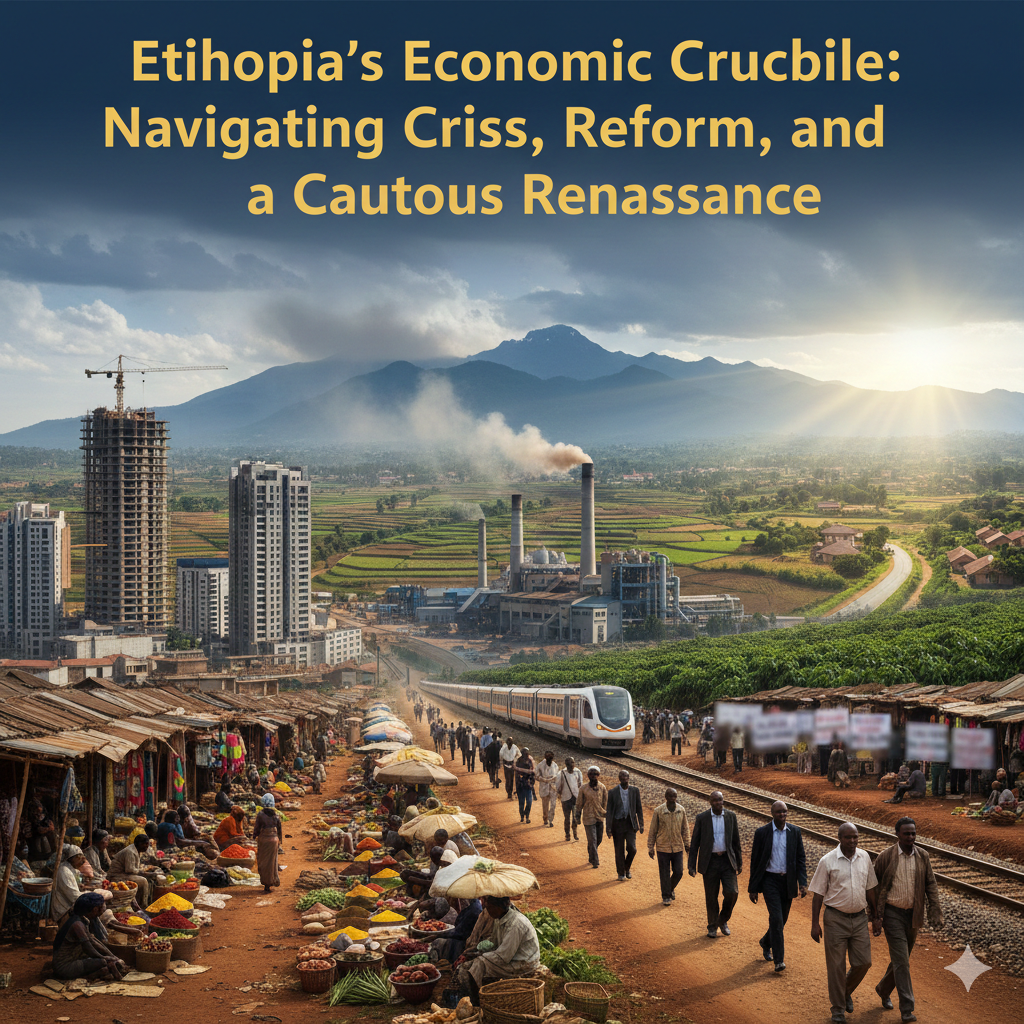
ADDIS ABABA, Ethiopia – The narrative of Ethiopian business today is a story of profound duality. It is a tale of one of the world’s fastest-growing economies for over a decade now emerging from a brutal civil war, confronting a devastating foreign currency shortage, and undergoing a high-stakes economic liberalization program. For entrepreneurs and investors, Ethiopia presents a landscape of immense, foundational potential shadowed by immediate, acute risks. The business environment is not for the faint of heart; it is a frontier market in the truest sense, where long-term ambition collides daily with short-term survival, and the state remains an omnipresent architect and gatekeeper.
The Macroeconomic Balancing Act: From War to Reform
The 2022 peace agreement that ended the two-year war in Tigray was a necessary, but insufficient, condition for economic recovery. The conflict shattered supply chains, diverted billions from development, and shattered investor confidence. Today, Ethiopia grapples with the war’s aftermath alongside deep structural flaws.
The most visceral challenge is hyperinflation, officially near 30% but felt as much higher for basic goods, eroding consumer purchasing power and business planning. This is fueled by a catastrophic foreign exchange (forex) shortage. The Ethiopian birr is artificially overvalued by the central bank, creating a vast black market where the real exchange rate can be nearly double the official rate. For businesses, this means an inability to import vital raw materials, spare parts, or equipment through legal channels, forcing them into a costly, inefficient parallel economy or halting operations entirely.
In response, the government of Prime Minister Abiy Ahmed is pursuing a painful but critical reform agenda championed by the International Monetary Fund (IMF). The centerpiece is the long-awaited liberalization of key, state-dominated sectors. The partial privatization of Ethio Telecom (with a 45% stake sold to a consortium including Safaricom) and the planned sell-off of a significant share in the crown jewel, Ethiopian Airlines, signal a historic shift. Most critically, the constitution is being amended to open the financial services sector to foreign investment for the first time, a move that could revolutionize access to capital. These reforms aim to attract foreign direct investment (FDI), inject efficiency, and ease the forex crunch.
Sectoral Spotlights: Resilience and Opportunity
Within this turbulent macro environment, specific sectors demonstrate both Ethiopia’s enduring advantages and adaptive business models.
1. Agriculture & Agro-Processing: The Unyielding Backbone
Employing over 70% of the population, agriculture remains the economy’s bedrock. The business focus is shifting from raw commodity exports to value addition. Companies are investing in processing plants for coffee (roasting, grinding), horticulture (cut flowers, packaged fruits/vegetables), and cereals. However, climate change-induced droughts and locust invasions pose existential threats to supply chains. Success requires navigating complex land tenure systems and building resilient outgrower networks with smallholder farmers. The potential is vast, but it is a long-term, patient capital play.
2. Manufacturing & The “China+1” Reality Check
Ethiopia’s dream of becoming the “China of Africa” via low-cost, export-oriented manufacturing has been bruised. Industrial parks like Hawassa attracted global apparel giants (PVH, H&M) by offering cheap labor, duty-free access to the U.S. via AGOA, and modern facilities. Yet, the sector has been hit by the war, the forex crisis (needing to import fabrics), and global sourcing shifts. While the “China+1” diversification trend still presents an opportunity, the value proposition must now be rebuilt on more than just low wages, emphasizing reliability, skills development, and improved logistics.
3. Services & The Digital Hustle: The Domestic Engine
Beneath the macro turmoil, a dynamic domestic services economy thrives. Fintech is booming, leveraging the recent launch of telecommunication-led mobile money (M-Pesa’s entry via Safaricom Ethiopia) to offer digital credit and savings. Logistics and distribution companies are innovating to overcome infrastructural hurdles to serve a domestic market of over 120 million. Hospitality and real estate in Addis Ababa show pockets of resilience, catering to a returning diaspora and a growing urban middle class. This sector is often more insulated from forex and global shocks than export-focused industries.
The Human Capital Equation: A Youthful Demographic at a Crossroads
Ethiopia’s greatest asset—its young, vast, and ambitious population—is also a pressing challenge. Universities produce hundreds of thousands of graduates annually, but the skills mismatch is severe. Businesses lament a shortage of technical, managerial, and vocational skills, necessitating extensive in-house training. Concurrently, high youth unemployment creates social pressure. Successful businesses are those that invest deeply in training, viewing human capital not as a cost, but as the core of their competitive advantage in a market where a strong work ethic is a given.
The Geopolitical Chessboard: Ports, Peace, and Partnerships
Ethiopia’s business fate is inextricably linked to its geopolitics. The peace in Tigray, while fragile, has reopened northern trade routes. However, the nation’s access to the sea is its most critical strategic and economic question. The controversial memorandum of understanding with the breakaway region of Somaliland for port access has ignited a diplomatic firestorm. If realized, it could dramatically reduce logistics costs, but for now, it has introduced significant political risk and uncertainty.
Furthermore, Ethiopia is skillfully playing a multi-aligned foreign policy to attract business. It maintains ties with traditional Western partners and the IMF while deepening cooperation with China (infrastructure, manufacturing), the UAE (major investments in agriculture, logistics, and the DP World port deal in Berbera), and Turkey (textiles, retail). This diversification provides alternative investment sources but complicates the geopolitical landscape.
The Business Environment: Navigating the Labyrinth
Doing business in Ethiopia requires mastering a unique set of challenges:
- Bureaucracy and Transparency: Despite reforms, navigating government bureaucracy can be slow and opaque. Corruption, while less visible than in some neighbors, remains a risk.
- The Financing Desert: In the absence of foreign banks, access to credit for all but the largest, state-connected firms is extremely limited and expensive. The hope is that financial sector liberalization will begin to thaw this ice age.
- Infrastructure Gaps: While major roads and the industrial parks are impressive, reliable electricity, water, and last-mile logistics remain inconsistent, increasing operational costs.
Conclusion: The Cautious Bet on the Horn’s Anchor
Business in Ethiopia today is a high-risk, high-potential endeavor. It is emerging from its most severe crisis in decades, armed with a reform agenda that could unlock its tremendous inherent strengths: a massive domestic market, a young workforce, and significant renewable energy and agricultural resources.
The immediate future hinges on the successful implementation of the liberalization program, managing inflation, and stabilizing the forex market. The businesses that will thrive are those with long-term horizons, local partnerships, and immense patience. They must be agile enough to handle volatility and deeply committed to building local capacity.
Ethiopia is not a quick-flip investment. It is a decades-long bet on the transformation of the Horn of Africa’s anchor economy. For those with the fortitude to navigate its present crucible, the rewards could be foundational, helping to build not just a profitable company, but a key pillar of the continent’s future economic architecture. The renaissance is promised, but the path remains steep, rocky, and uniquely Ethiopian.
