

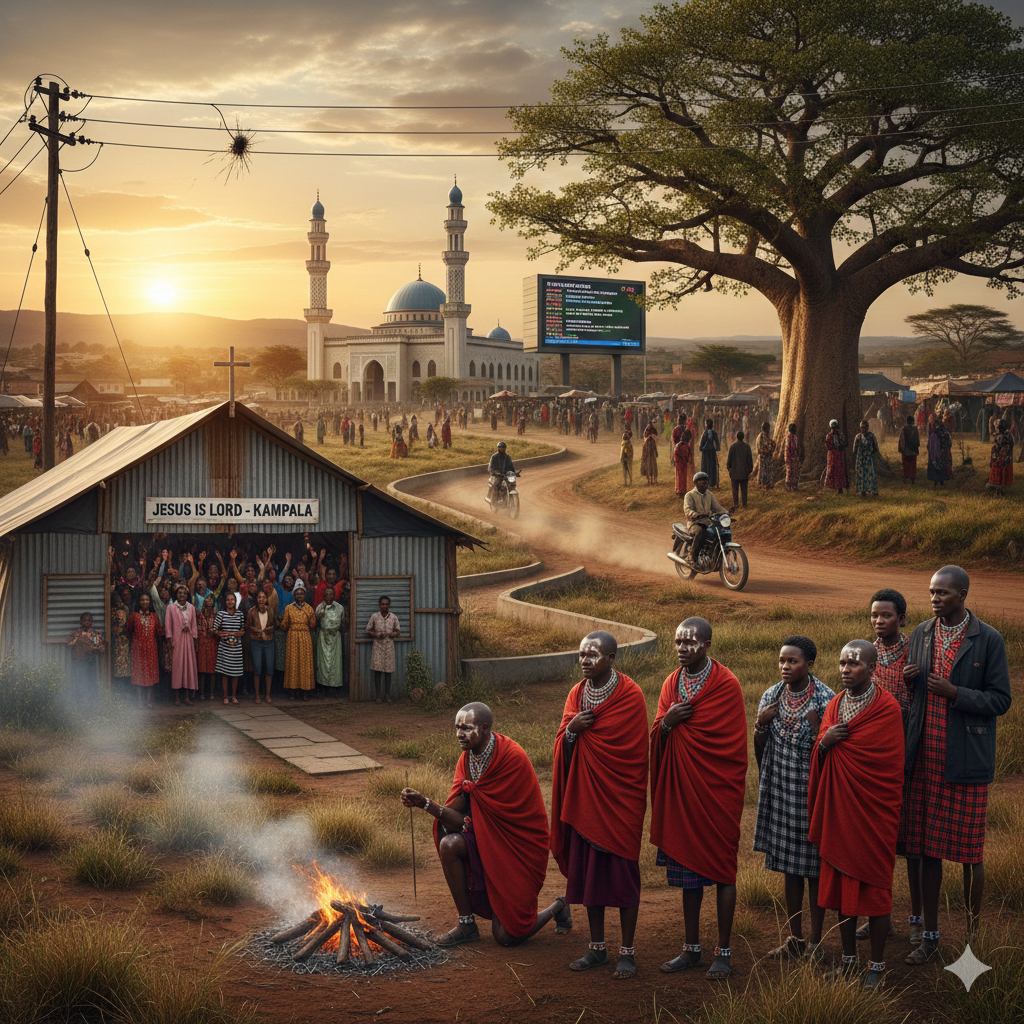
DATELINE: EAST AFRICA – The spiritual landscape of East Africa is a vibrant, dynamic, and often deeply contested tapestry, woven over millennia of migration, trade, conquest, and revelation. It is a region where a traditional healer in western Tanzania, a Catholic priest in central Uganda, an Islamic sheikh on the Swahili coast, and a booming Pentecostal pastor in Nairobi may all minister to communities separated by only a few hundred miles. Today, the religious life of East Africa is defined not by static tradition, but by profound growth, intense competition, and a complex negotiation between faith, modernity, and identity in a rapidly changing world.
The Established Pillars: Christianity and Islam
The dominant religious framework in East Africa is a duality: Christianity and Islam, which together account for the faith of well over 95% of the region’s population.
Christianity is the majority faith in most East African nations—Kenya, Uganda, Tanzania, Rwanda, Burundi, and South Sudan. Its roots are deep, from the ancient Orthodox tradition in Ethiopia and Eritrea (dating to the 4th century) to the arrival of Catholic and Protestant missionaries in the 19th century, whose work in education and healthcare left an indelible institutional legacy. The mainline churches—Catholic, Anglican, Lutheran, and Presbyterian—remain powerful social and sometimes political forces, commanding vast loyal congregations and operating extensive networks of schools and hospitals.
However, the most dramatic story within Christianity is the explosive, continent-leading growth of Pentecostal and Charismatic movements. From Nairobi’s mega-churches, which broadcast to millions via television and YouTube, to countless storefront churches in every town, this form of Christianity emphasizes a personal, experiential faith, the direct intervention of the Holy Spirit, prosperity gospel teachings, and a break from the formalities of mission-founded churches. It is urban, youthful, and media-savvy, offering a theology that speaks powerfully to the aspirations and anxieties of a generation navigating urbanization, economic uncertainty, and social change. Its influence reshapes not only spirituality but also music, fashion, and political discourse.
Islam, the other great pillar, has an equally ancient presence, arriving via Indian Ocean trade routes as early as the 8th century. It is the majority faith in Somalia and Djibouti and holds a very significant minority presence in Kenya (especially the Coastal and Northeastern regions), Tanzania (Zanzibar and the coast), and Uganda. Historically associated with the Swahili coastal culture, Islam is deeply integrated into the social fabric of many cities. The majority practice a Sufi-influenced, moderate Sunni Islam, characterized by its spiritual brotherhoods (tariqas) and veneration of saints.
The Internal Diversities and Tensions
Within these two broad faiths, significant diversity and tension exist:
- Within Islam: The 20th and 21st centuries have seen increased influence from reformist and Salafist ideologies, often funded by educational and charitable networks from the Gulf. These movements, advocating for a puritanical, text-based practice, challenge the traditional, syncretic Sufi customs, leading to intra-faith debates over doctrine, dress, and the role of religion in public life. While the vast majority of East African Muslims reject violent extremism, the militant ideology of groups like Al-Shabaab represents a violent, fringe manifestation of this reformist current, exploiting local grievances for a global jihadist agenda.
- Within Christianity: Tensions exist between the institutional authority of mainline churches and the entrepreneurial energy of Pentecostals. Theological battles erupt over issues like prosperity gospel teachings, the role of traditional culture, and political alignment. Furthermore, the rise of conservative, often American-influenced evangelical movements has fueled active campaigns against LGBTQ+ rights and comprehensive sexuality education, injecting new moral-political conflicts into the public sphere.
The Enduring Substrate: Indigenous African Religious Traditions
To speak only of Christianity and Islam is to miss a foundational layer. African Traditional Religions (ATRs) and spiritual worldviews, though rarely counted as primary affiliations in censuses, remain a powerful, pervasive force. They are not a monolithic system but a complex array of beliefs involving a supreme creator, intermediary spirits, ancestor veneration, and the deep connection between the living, the dead, and the natural world.
Crucially, ATRs often exist not in opposition to Christianity or Islam, but in syncretic combination with them. It is common for a professed Christian or Muslim to also consult a traditional healer (mganga in Swahili) for ailments believed to have spiritual causes, or to participate in rituals honoring ancestors during key life events. This syncretism is a point of contention, with reformist figures in both major religions condemning it as impure, while for many ordinary believers, it represents a holistic spiritual pragmatism that addresses all dimensions of life.
Faith in the Public Square: Politics, Identity, and Conflict
Religion in East Africa is rarely a purely private matter. It is deeply entangled with politics and identity.
- Political Mobilization: Politicians routinely seek the endorsement of influential religious leaders and frame their campaigns in moral terms. Churches and mosques can be powerful voting blocs. In nations like Uganda and Kenya, debates over constitutional reform, term limits, and moral legislation are heavily infused with religious rhetoric.
- Identity and Belonging: In a region of incredible ethnic diversity, religious affiliation can serve as a powerful cross-cutting identity. It can foster a sense of universal brotherhood (the Ummah for Muslims, the global church for Christians). However, it can also be weaponized. Historical tensions, such as those between largely Christian central authorities and Muslim-majority coastal populations in Kenya and Tanzania, often intertwine religious identity with feelings of political and economic marginalization.
- Interfaith Relations: Day-to-day relations between Christians and Muslims are generally peaceful, characterized by mutual respect and neighborly coexistence, especially in long-standing mixed communities. However, this peace is periodically tested by global events (such as wars in the Middle East), local terrorist attacks by Islamic militants, or inflammatory rhetoric from extremist figures on either side. Organizations dedicated to interfaith dialogue work actively to bridge divides and promote shared social values.
New Dynamics: Urbanization, the Digital Age, and the “Nones”
Modern forces are reshaping the religious landscape in new ways:
- The Urban Experience: The anonymity and pressure of city life can weaken traditional communal religious structures while providing fertile ground for the message of Pentecostalism, which offers a new, chosen community and a theology of personal breakthrough.
- Digital Religion: Faith has gone online. Sermons are live-streamed, Quranic apps provide daily prayers, and social media is a battleground for theological debate and evangelism. This democratizes access but also accelerates the spread of both inspiring teachings and extremist ideologies.
- The Rise of the “Nones”: While still a small minority, a segment of the urban, educated youth—influenced by global secular discourse and scientific education—are explicitly identifying as non-religious or agnostic, a historically uncommon public stance in these deeply pious societies.
Conclusion: A Landscape of Vitality and Vigilance
The religious picture in East Africa today is one of astonishing vitality and constant flux. It is marked by deep piety, entrepreneurial fervor, and a search for meaning and mooring in a world of dizzying change. Faith provides a moral compass, a social safety net, a source of immense hope, and, at times, a fault line for conflict.
The future of this mosaic will be shaped by how the region’s leaders—both religious and secular—navigate the challenges of pluralism. Can they foster a public square where robust faith can coexist with mutual respect and equal citizenship? Can the positive social force of religion—its capacity for charity, education, and moral formation—be harnessed while curbing its divisive potential? The answers will determine whether East Africa’s spiritual tapestry remains a source of strength and cultural wealth or becomes a map of new fractures. In this region, the soul of the nation is always at stake, and its conversations with the divine are as urgent and contested as its debates about democracy and development.
