

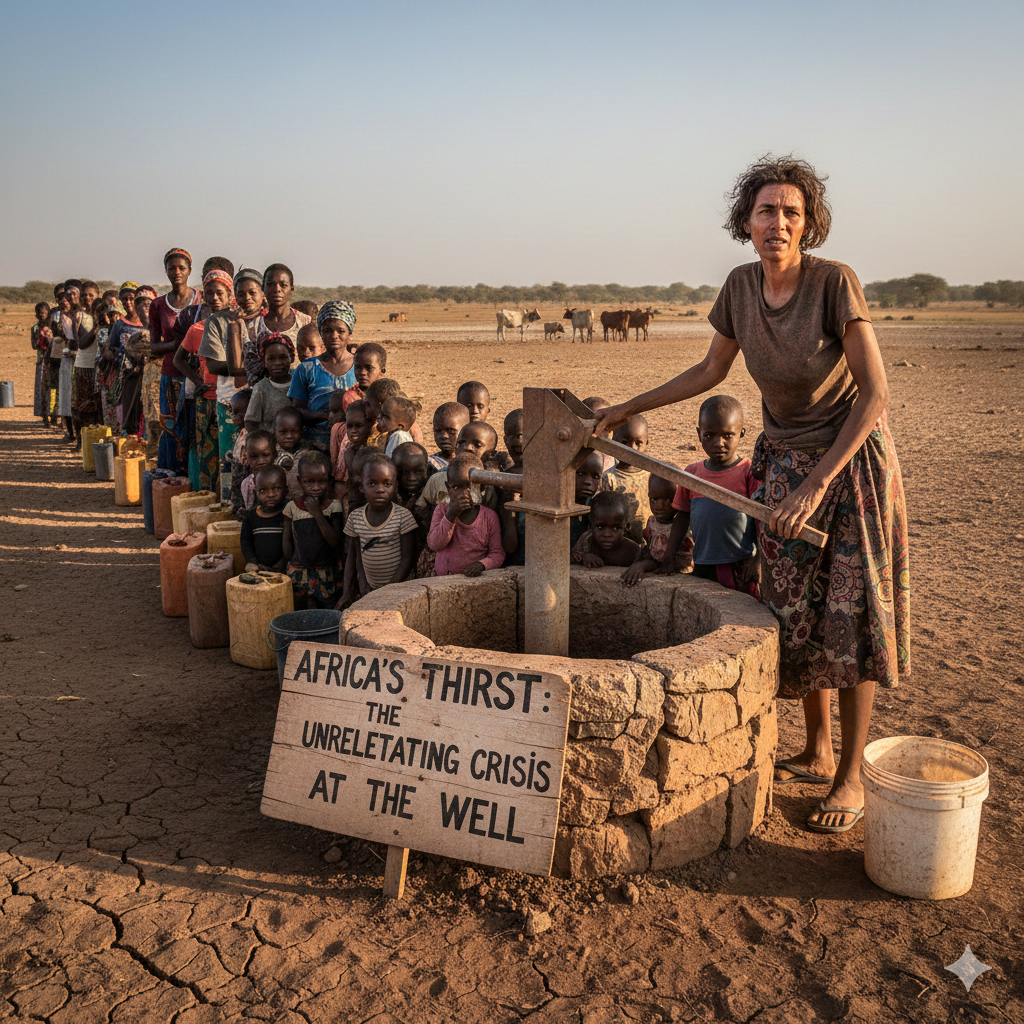
DATELINE: SUB-SAHARAN AFRICA – Water is life. Yet, for hundreds of millions across the African continent, this most basic fact is a daily, grinding crisis. The image of women and girls balancing yellow jerricans on long, dusty walks is not a cultural trope; it is a testament to a profound and systemic failure that cripples health, shackles economic potential, and entrenches gender inequality. While significant progress has been made, the challenge of securing safe, accessible drinking water remains one of Africa’s most urgent and complex developmental problems, a crisis exacerbated by climate change, rampant urbanization, and a gulf between infrastructure and need.
The Scale of the Scarcity: A Continent Parched
The statistics are staggering. According to the World Health Organization (WHO) and UNICEF, nearly 400 million people in sub-Saharan Africa lack access to a basic drinking water service. Of these, approximately 150 million still drink untreated surface water from ponds, rivers, and lakes—water often shared with livestock and rife with pathogens. This is not a remote, rural issue alone. In Africa’s exploding megacities like Lagos, Nairobi, and Kinshasa, informal settlements sprawl without any formal water grid. Residents here pay exorbitant prices to unscrupulous private water tankers for a product of dubious quality, often spending 10-50 times more per liter than their wealthier neighbors connected to the municipal supply.
The consequences are catastrophic. Waterborne diseases—cholera, typhoid, dysentery, and deadly diarrheal ailments—are leading killers of children under five. It is estimated that nearly 1,000 African children die every day from illnesses linked to contaminated water and poor sanitation. The lack of clean water also undermines healthcare itself; hospitals and clinics cannot maintain hygiene, leading to rampant hospital-acquired infections. This is a public health emergency unfolding in slow motion.
The Roots of the Crisis: More Than Just Drought
The water crisis is often mischaracterized as a simple matter of physical scarcity. While true in arid regions like the Sahel and the Horn of Africa, the problem is fundamentally one of management, investment, and inequality.
- The Infrastructure Deficit: Colonial-era pipe systems, built for smaller populations, are crumbling. Leakage rates in many cities exceed 50%. The capital investment required to build and maintain modern, extensive water treatment and distribution networks is enormous, often crowded out by other pressing budgetary needs. Rural areas are even more neglected, with borehole projects frequently failing within a few years due to a lack of maintenance plans and local technical capacity.
- The “Cost-Recovery” Conundrum: For decades, international financial institutions pushed a model of full cost-recovery, pressuring governments to privatize or commercialize water utilities. The results have been mixed and often devastating for the poor. When water is treated purely as an economic good, not a human right, the poorest are priced out. This has sparked “water riots” from Ghana to South Africa and entrenches a system where the rich have water on tap and the poor walk for hours or go without.
- The Climate Change Multiplier: Climate change is not a future threat; it is a present-day water manager. It acts as a vicious multiplier of existing problems. Intensified Droughts are desiccating traditional sources like Lake Chad, which has shrunk by 90% since the 1960s, fueling conflict among farmers and herders. Erratic Rainfall makes surface water unreliable and recharges groundwater unpredictably. Increased Flooding contaminates fragile water sources with sewage and runoff, triggering cholera outbreaks. The continent most responsible for the least amount of global emissions is bearing the brunt of its hydrological consequences.
- Conflict and Governance: In fragile states, water infrastructure is often a casualty of war, deliberately targeted or simply left to decay. More insidiously, water access can become a tool of political patronage, with services directed to loyal constituencies while opposition areas are neglected. Corruption in procurement and management siphons off funds meant for pipes and pumps.
The Gender and Education Burden: The Walk for Water
The burden of water collection falls overwhelmingly on women and girls—an estimated 90% of the time in sub-Saharan Africa. This is not a neutral chore. The average 30-minute walk (often much longer) represents a colossal loss of productive time, preventing women from engaging in income-generating activities and girls from attending school consistently. It is a direct engine of the gender gap in education and economic empowerment. Furthermore, the journey itself can be dangerous, exposing women and girls to the risk of physical and sexual assault.
Innovation and Resilience: Africa’s Solutions
Despite the daunting challenges, the continent is not passive. Innovation and community-driven solutions are emerging, offering blueprints for a more water-secure future.
- Off-Grid Technological Leaps: Solar-powered water pumps are revolutionizing irrigation and community supply, freeing farmers from erratic fuel costs and grid electricity. Atmospheric Water Generators (AWGs), though energy-intensive, are being piloted in arid coastal areas.
- Satellite and Data Intelligence: NGOs and governments are using satellite imagery and GPS data to map groundwater resources with greater accuracy, identifying the best locations for sustainable boreholes and reducing the rate of drilling failure.
- Community-Led Management: The most successful rural water projects are those that place ownership and financial management in the hands of local Water User Associations, particularly women-led committees. When communities collect small tariffs for maintenance, functionality rates soar.
- Urban Entrepreneurship: In the slums, a network of small-scale entrepreneurs is emerging. From licensed water kiosk operators selling affordable, treated water to innovators using mobile money for pay-as-you-fetch water ATMs, the informal sector is filling a critical gap with market-driven, localized solutions.
The Path Forward: A Blueprint for Action
Solving Africa’s water crisis requires moving beyond short-term projects to systemic, sustained commitment.
- Prioritize Water as a Human Right in Policy: National laws and budgets must explicitly prioritize equitable access to safe water, protecting citizens from disconnection and targeting investments to the most marginalized communities first.
- Massive, Smart Investment: The African Development Bank estimates the continent needs up to $66 billion annually to meet its water and sanitation targets. This requires both increased domestic government budgeting and a significant uptick in climate-adaptive financing from the global north, which owes a climate debt to the continent.
- Focus on Maintenance and “Last-Mile” Distribution: The goal cannot just be to drill new boreholes or build new plants. Equal investment must flow into training local technicians, creating supply chains for spare parts, and extending piped networks into informal urban settlements.
- Integrated Water Resource Management (IWRM): Nations must manage water at the basin level, balancing agricultural, industrial, and domestic needs, and forging transboundary cooperation agreements on shared rivers and aquifers to prevent conflict.
- Empower Women as Water Decision-Makers: Policies and projects must mandate women’s leadership in water governance at all levels, from village committees to national utilities. Their expertise is not optional; it is essential for sustainability.
Conclusion: The Foundation of All Development
Water is not one sector among many; it is the bedrock upon which public health, food security, gender equality, education, and industrial growth are built. A continent cannot thrive while half its people are sick, its women are fetchers, and its children are dying from preventable thirst.
The walk for water is a walk away from potential. Ending that walk—by bringing safe, affordable water to every doorstep—is the most fundamental investment Africa can make in its own future. It is a monumental task that demands political courage, unprecedented investment, and global climate justice. The solutions exist. What is required now is the collective will to turn on the tap, for good.
