

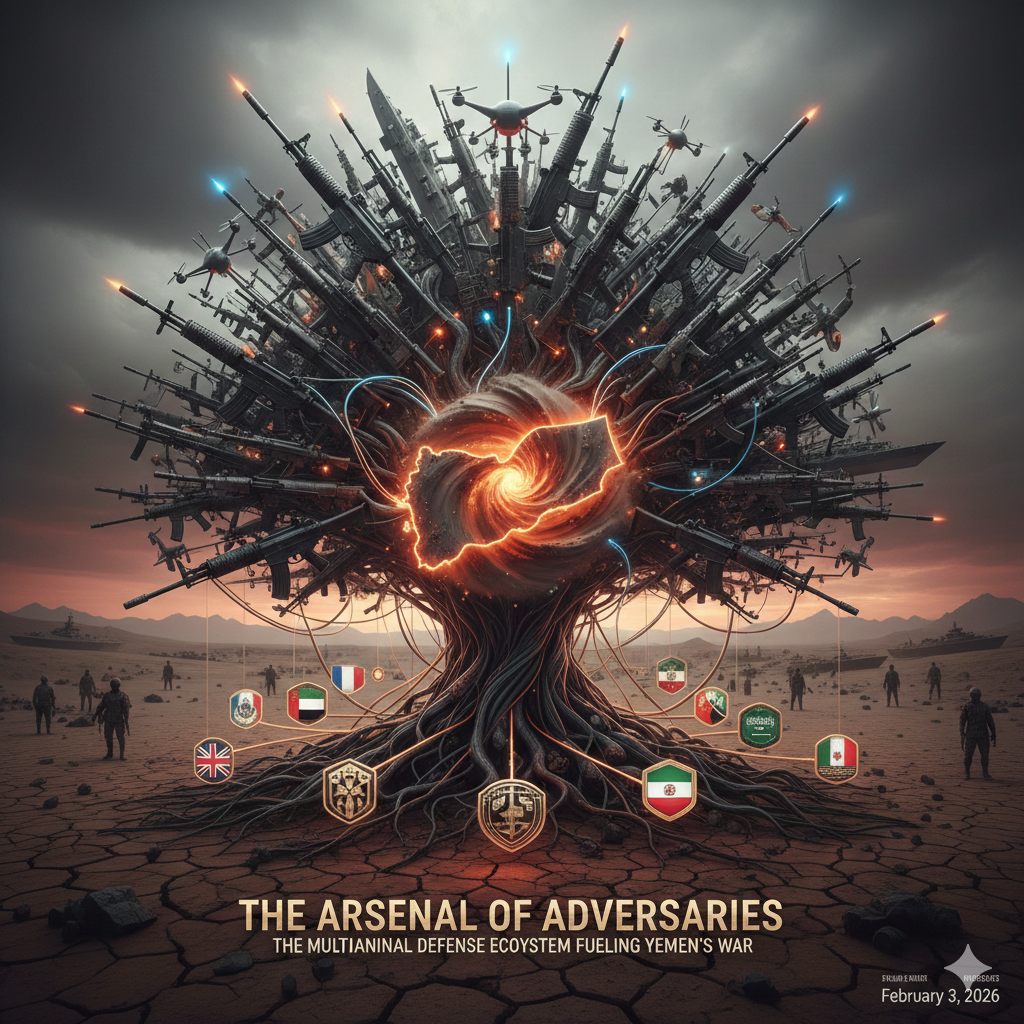
ADEN / WASHINGTON D.C. – The defense architecture underpinning the war in Yemen is not a bilateral affair between the Saudi-led coalition and the Houthi movement. It is a sprawling, globalized, and opaque ecosystem where the arsenals of rival world powers converge on the battlefield, transforming a regional conflict into a grim laboratory for modern weaponry and a proxy struggle for influence. The defense of Yemen, as pursued by its internationally recognized government and its Saudi and Emirati patrons, is a multinational enterprise, funded by petrodollars, supplied by Western and Eastern defense contractors, and executed through a complex web of mercenaries, allied militias, and overstretched national armies. Understanding this ecosystem is key to comprehending the war’s persistence and the profound challenges to any future peace.
The Coalition Core: Saudi Arabia and the United Arab Emirates
The military intervention, launched in March 2015 by a coalition of ten states led by Saudi Arabia and the United Arab Emirates (UAE), was framed as a defense of Yemen’s legitimate government against an Iranian-backed coup. Riyadh and Abu Dhabi provided the overwhelming majority of funding, personnel, and air power. Their defense strategies, however, diverged significantly, reflecting different national priorities.
Saudi Arabia’s approach was initially defined by overwhelming aerial bombardment, utilizing one of the world’s most expensively assembled air forces. This strategy, aimed at degrading Houthi military capabilities and forcing a negotiation, relied on a continuous pipeline of precision-guided munitions, aircraft spare parts, and intelligence support from its Western partners. On the ground, Saudi efforts were hampered by a less experienced army, leading to heavy reliance on Yemeni allies and imported manpower.
The United Arab Emirates pursued a more granular, ground-up strategy. While participating in the air campaign, the UAE focused on building capable local proxy forces, most notably the Southern Transitional Council (STC) militias and the Giants Brigade (Al-Amaliqah). Emirati tactics emphasized special operations, training, and the provision of sophisticated equipment, including armored vehicles, drones, and surveillance systems. The UAE also established key bases in southern Yemen (e.g., Socotra, Aden, and Mokha), projecting power and securing maritime chokepoints critical to its economic and strategic interests.
The Western Arsenal: The United States, United Kingdom, and France
The military effort of the coalition has been fundamentally enabled by a trinity of Western powers: the United States, the United Kingdom, and France. Their support, framed as backing an ally and countering Iranian influence, has taken multiple forms:
- Arms Sales and Sustainment: The U.S. and UK have been the primary arms suppliers to Saudi Arabia and the UAE throughout the war. This includes the sale of fighter jets (F-15s, Eurofighter Typhoons), precision-guided bombs (notably Raytheon’s Paveway series), missiles, and armored vehicles. Sustaining the aerial campaign has required a constant flow of spare parts, maintenance contracts, and munitions replenishment, creating a multi-billion-dollar revenue stream for defense giants like Lockheed Martin, BAE Systems, and Raytheon.
- Logistical and Intelligence Support: The U.S. military has provided critical in-air refueling for coalition warplanes, extended intelligence sharing to aid target identification, and deployed military advisors. The UK has stationed personnel in Saudi command centers. This support has been legally justified as non-combat assistance but is operationally indispensable for the coalition’s warfighting capacity.
- Maritime and Diplomatic Cover: The U.S. Navy’s Fifth Fleet, based in Bahrain, has patrolled Yemen’s waters, intercepting arms shipments and providing a security umbrella for coalition naval forces. Diplomatically, these nations have repeatedly provided political cover for their allies at the UN, using their veto power or influence to shield the coalition from stringent accountability mechanisms like an independent international investigation into war crimes.
This support has sparked fierce domestic debate in these countries, with critics arguing it makes them complicit in a humanitarian catastrophe and a violation of international law. Legal challenges and parliamentary votes have pressured governments, leading to some policy shifts (e.g., the U.S. suspending offensive arms sales in 2021, later reversed), but core support structures have largely remained.
The Mercenary Matrix: Imported Manpower and Private Military Contractors
Facing manpower shortages and hesitant to risk high national casualties, Saudi Arabia and the UAE turned to a global market for fighters. This created a shadowy layer of private military contractors (PMCs) and state-sponsored mercenaries.
- Latin American Contingents: Reports, notably from the UN Panel of Experts, have detailed the recruitment of thousands of fighters from Colombia, Chile, Panama, and Ecuador. Lured by salaries far exceeding their national armies’ pay, these veterans were deployed to frontlines, particularly in central Yemen.
- Sudanese “Rapid Support Forces”: Sudan, under former President Omar al-Bashir, sent thousands of fighters from the state-linked RSF militias to fight alongside the coalition, reportedly in exchange for financial aid.
- Western and South African PMCs: Companies like the now-defunct Academi (formerly Blackwater) and South Africa’s Dyck Advisory Group were contracted for tasks ranging from drone operations and training to direct combat roles.
This outsourcing of warfare diluted the coalition’s cohesion, introduced human rights abuses by unaccountable actors, and complicated the chain of command.
The Local Proxies: A Fragmented Ground Game
The coalition’s ground war has been fought primarily by Yemenis, but these forces are deeply fragmented, reflecting the country’s internal fissures:
- The Official Yemeni Armed Forces: Loyal to the internationally recognized Presidential Leadership Council (PLC), these units are nominally the state’s army but are weak, underfunded, and riven by competing loyalties to different PLC members.
- The Southern Transitional Council (STC): The UAE’s primary proxy, it commands significant military force and governs much of the south. Its ultimate goal—an independent South Yemen—often conflicts with the Saudi-backed PLC’s aim of unity.
- Salafist and Islamist Militias: Groups like the Abu al-Abbas Brigade and others, some with ideological ties to transnational jihadism, have been effective ground forces but are politically problematic allies.
- Tribal Alliances: Both the coalition and the Houthis have bought the allegiance of powerful tribal confederations, making the conflict a patchwork of local deals and rivalries.
This fragmentation means there is no unified “Yemeni” defense force; instead, there are multiple militaries serving different patrons and visions for the country, a major obstacle to post-war stability.
The Adversary’s Arsenal: Iran’s Strategic Deniability
Confronting this multinational coalition is the Houthi movement, which has developed a formidable asymmetric defense of its own. While Iran denies being a direct party to the conflict, its support is pivotal. Tehran provides a lifeline of weapons, technology, and training. This includes:
- Drones and Missiles: The Houthis’ ability to launch long-range drones and missiles at Saudi and Emirati cities, as well as international shipping, stems from Iranian designs and components. These systems have changed the strategic calculus, giving the Houthis a potent deterrent and coercive tool.
- Advanced Armament: The steady supply of anti-tank guided missiles (ATGMs), ballistic missiles, naval mines, and small arms has allowed the Houthis to withstand a coalition with vastly superior conventional firepower.
- Knowledge Transfer: Iranian Islamic Revolutionary Guard Corps (IRGC) advisors have provided critical training in guerrilla tactics, missile deployment, and drone warfare, enabling the Houthis to become a highly resilient non-state military actor.
Conclusion: A War Without a Unified Defense
The defense of Yemen, as pursued by the anti-Houthi bloc, is a paradox. It is simultaneously one of the most internationally supported military efforts of the 21st century and a deeply fractured, ineffective enterprise. It is powered by the world’s most advanced weaponry yet mired in medieval tribal politics and mercenary exploitation.
This multinational model has prolonged the conflict. The constant flow of arms and funds has removed incentives for a negotiated settlement based on compromise. It has also internationalized Yemen’s civil war, embedding it within the broader Saudi-Iranian rivalry and the geopolitical interests of distant capitals from Washington to Moscow.
Lasting peace will require not just silencing the guns but dismantling this perverse international defense ecosystem. It will demand that external patrons cease the unconditional flow of arms, prioritize a unified Yemeni political and security framework over competing proxies, and accept that a stable Yemen cannot be defended solely from the air or through foreign legions, but must be built on inclusive governance and a sovereign, professional military serving a single national interest. Until then, the defense of Yemen will remain a lucrative business for global arms dealers and a death sentence for its people.
