

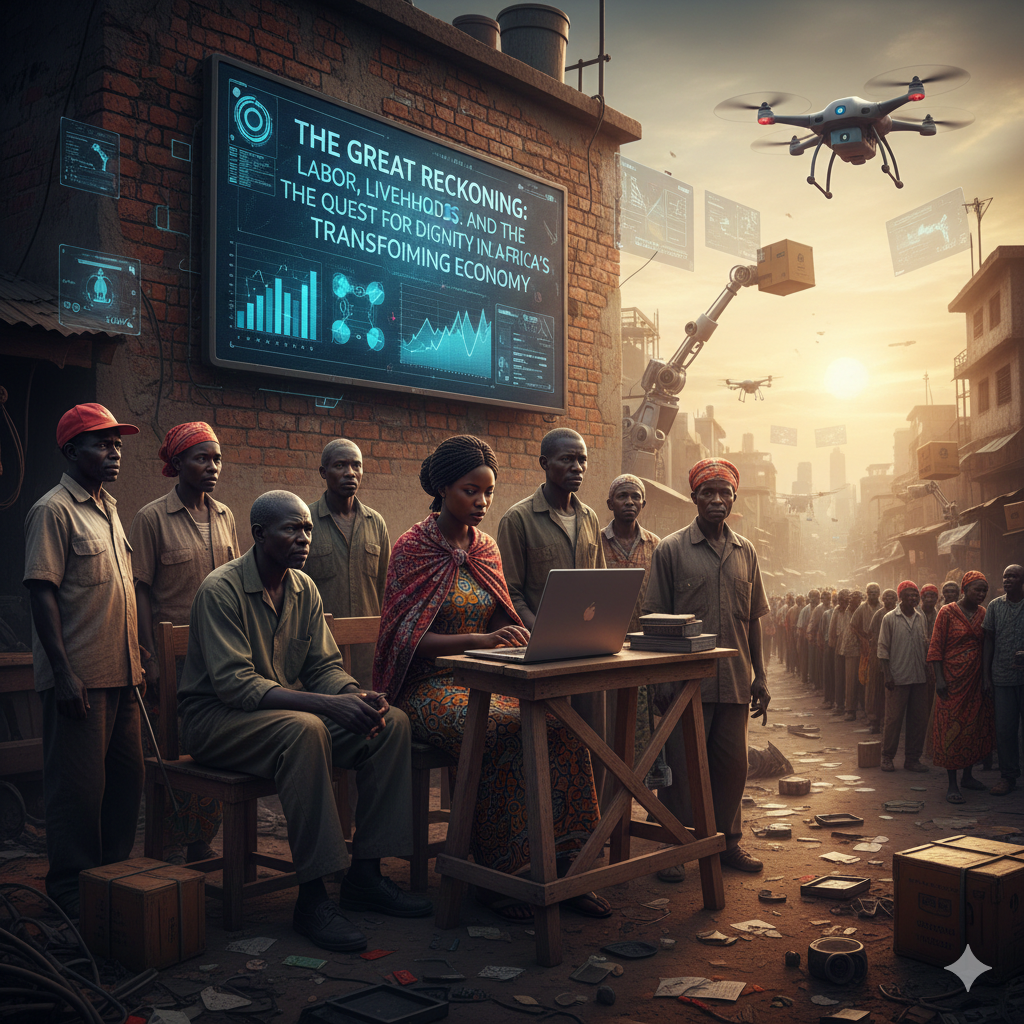
NAIROBI, KAMPALA, DAR ES SALAAM – The labor landscape across East Africa is a terrain of profound contradictions. A celebrated economic growth story, boasting some of the world’s fastest-expanding GDPs, collides daily with the lived reality of millions of youth navigating a chasm between aspiration and employment. The region, powered by a demographic bulge where over 70% of the population is under 30, faces its defining challenge: transforming its vibrant human capital into decent work, sustainable livelihoods, and shared prosperity. Today, the story of work in East Africa is a complex tapestry woven from the threads of digital hustle, enduring informality, globalized competition, and a rising demand for dignity.
The Scale of the Challenge: Growth Without Jobs?
East Africa’s economic narrative has been robust. According to the African Development Bank, the region consistently outperforms the continental average, with growth driven by public infrastructure investment, a burgeoning services sector, and strategic exports. Yet, this macro-story obscures a persistent crisis of jobless growth. The formal economy, comprising registered businesses that pay taxes and offer structured employment, is simply too small to absorb the approximately 4-5 million young people entering the labor force each year across Kenya, Uganda, Tanzania, Rwanda, and Ethiopia.
The result is a vast and sprawling informal economy, estimated to employ over 80% of the workforce. This is the world of jua kali artisans in Kenya (Swahili for “fierce sun”), market vendors, motorcycle taxi (boda boda) drivers, and small-scale subsistence farmers. While a testament to incredible resilience and entrepreneurship, informality is synonymous with insecurity: no contracts, no social protection (pensions, health insurance), volatile incomes, and extreme vulnerability to shocks from illness to climate change. For many, it is not a choice but the only available avenue for survival.
Sectoral Shifts: Where the Work Is (and Isn’t)
A closer look at key sectors reveals both opportunities and structural barriers:
- Agriculture: The Unfulfilled Promise. Still the largest employer, agriculture remains predominantly subsistence-based, low-productivity, and at the mercy of climate volatility. The promise of agribusiness and value addition—transforming farmers into entrepreneurs—is hindered by land fragmentation, poor infrastructure, and limited access to finance and technology. For youth, farming is often seen as a last resort, a symbol of backbreaking toil without reward.
- Services & Gig Work: The Digital Hustle. The services sector, particularly in cities, is the primary engine of perceived opportunity. The explosive growth of platform-based “gig work” has redefined urban labor. Ride-hailing (Uber, Bolt), delivery services (Glovo, Uber Eats), and freelance digital tasks promise flexibility. Yet, they often replicate informal sector precarity in a digital guise—long hours, algorithmic management without oversight, and a complete absence of benefits. The recent protests by drivers across Nairobi and Kampala highlight the struggle for fair algorithmic pay and better working conditions in this new economy.
- Manufacturing & Construction: The Skills Mismatch. The much-heralded potential for labor-intensive manufacturing, poised to benefit from rising wages in Asia, has been slow to materialize. While special economic zones exist, the region often struggles to compete on cost and efficiency with established Asian hubs. A critical bottleneck is the acute skills mismatch: vocational training (TVET) systems are often outdated and stigmatized, leaving a surplus of university graduates in fields with no demand and a shortage of certified welders, electricians, and precision machine operators needed for advanced manufacturing. Large-scale public infrastructure projects create jobs, but these are often temporary and reliant on foreign expertise.
The Youth Bulge and the “Hustler” Mentality
Confronting a system that cannot offer them traditional career ladders, East Africa’s youth have forged a new identity: the hustler. This is not just a term for informal work; it is a mindset of relentless self-reliance, multi-tasking, and navigating opportunity wherever it can be found. It is celebrated in popular culture and political rhetoric (evident in Kenya’s “Hustler Nation” narrative). While embodying resilience, it also reflects the failure of formal structures. The pressure to “hustle” individual solutions to a systemic problem places immense psychological strain on a generation, with underemployment and economic frustration being significant social stressors.
The Rise of Remote Work and the Global Talent Race
A transformative, though uneven, shift is the rise of Africa’s digital talent on the global stage. Companies like Andela (born in Nigeria but with a major East African presence) pioneered the model of training software developers for remote roles with international firms. This created a new aspirational pathway: high-skilled, well-compensated work that bypasses local labor market limitations. The rise of freelance platforms like Upwork and Fiverr has further enabled this.
However, this “brain gain” has a dual edge. It offers life-changing income for a tech-savvy elite but can also accelerate a “brain drain” within the continent, as top talent is pulled into the global digital economy rather than building local enterprises. It raises critical questions about digital colonization and whether East Africa will produce consumers of global platforms or the owners of its own digital means of production.
Policy Crossroads: Between Protection and Flexibility
Governments are grappling with how to regulate this evolving world of work. Key debates include:
- Labor Law Reform: Outdated labor codes, designed for a bygone era of permanent industrial employment, are ill-suited for the gig economy. Should a boda boda driver or a freelance graphic designer be classified as an employee or an independent contractor? The push for fair pay, safety standards, and portable benefits for platform workers is growing.
- Social Protection Expansion: Extending safety nets beyond the tiny formal sector is a monumental task. Innovations like universal health coverage (UHC) schemes and portable, contributory social security funds for informal workers are being piloted but face huge implementation hurdles.
- Education & TVET Revolution: There is a belated but urgent push to revalorize technical and vocational education, aligning curricula with market needs (renewable energy installation, digital marketing, artisanal skills) and partnering with the private sector for apprenticeships.
The Future of Work: Pathways to Dignity
The trajectory of East Africa’s labor market will be shaped by several intertwined forces:
- The Green Transition: Climate change poses a massive threat to agricultural livelihoods but also creates new jobs in renewable energy, ecosystem restoration, and climate-smart agriculture. This “just transition” must be central to labor planning.
- Regional Integration: The East African Community (EAC) common market offers the potential for labor mobility and larger, more attractive markets for businesses, potentially spurring job creation. Progress, however, is incremental.
- The Role of Women: Female labor force participation remains hampered by unpaid care work, cultural norms, and access to capital. Unleashing this potential is not just a matter of equity but of economic necessity.
Conclusion: Beyond Survival, Toward Dignity
The labor question in East Africa today is fundamentally a question of dignity. It is about whether the energy of the world’s youngest population will be channeled into building thriving, stable societies or become a source of destabilizing frustration.
The path forward requires moving beyond celebrating the “hustle” and romanticizing informality. It demands a new social contract where:
- Economic policy is explicitly job-centric, favoring sectors with high employment multipliers.
- Education is decoupled from paper qualifications and tightly coupled with real-world competency.
- Social protection is a universal right, not a privilege of formal employment.
- Innovation is harnessed not just for profit but to create better, more secure work.
The millions seeking work in East Africa are not just a demographic statistic; they are the architects of the region’s future. The test for governments, businesses, and the international community is whether they will be equipped with tools of survival or the foundations for a dignified life. The Great Reckoning is underway, and its outcome will define the century for this dynamic, hopeful, and impatient region.
