

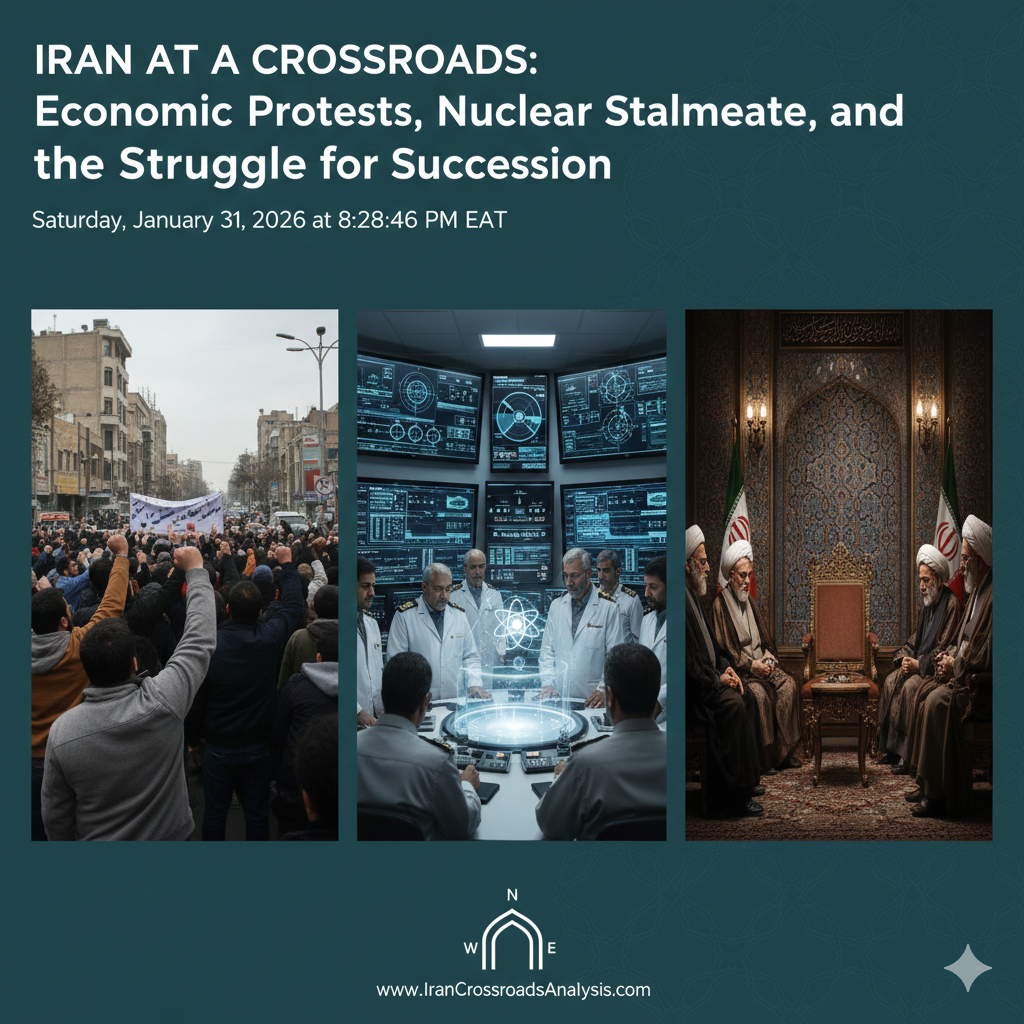
Tehran, Iran – The streets of Iran’s major cities are once again a tableau of simmering discontent, punctuated by the heavy presence of security forces. While the headlines of international media may have shifted, the fundamental crises facing the Islamic Republic have not. Today, Iran grapples with a paralyzing triad of challenges: a deteriorating economy that fuels recurrent public anger, a nuclear dossier at a dangerous diplomatic impasse, and an increasingly opaque behind-the-scenes struggle over the eventual succession of the 85-year-old Supreme Leader, Ayatollah Ali Khamenei. These issues are deeply interwoven, each exacerbating the other, and together they present the most significant systemic test to the regime in over a decade.
The Economic Crucible: Sanctions, Mismanagement, and Public Fury
The most immediate pressure felt by ordinary Iranians is economic. Despite occasional, modest fluctuations, the nation’s economy remains strangled by a combination of crippling international sanctions and profound domestic mismanagement. The rial continues its long slide against the dollar, driving inflation that official figures place near 40% but which citizens experience as much higher for staple goods like meat, dairy, and housing.
The recent subsidies reform and sudden hikes in prices of basic commodities, including bread and fuel, have acted as a recurring trigger for public outrage. While large-scale, coordinated protests on the level of the 2022-2023 “Woman, Life, Freedom” uprising have been suppressed, smaller, localized strikes and demonstrations are chronic. Bazaar merchants shut their doors in protest over new tax policies, teachers rally for unpaid wages, and pensioners gather to decry the erosion of their fixed incomes by inflation. This is not merely an economic complaint; it is a profound loss of trust. The social contract that promised dignity and stability in exchange for political acquiescence is seen by many as broken.
The government of President Ebrahim Raisi, a hardline cleric promoted as a potential future Supreme Leader, has failed to deliver on promises of an “economic leap.” His administration’s focus has been on consolidating political control and pursuing “resistance economy” policies, prioritizing self-sufficiency and tightening grip over key sectors. However, this has done little to attract foreign investment, reverse capital flight, or curb the staggering corruption that pervades the bonyads (revolutionary foundations) and linked conglomerates. For the young generation—over half the population is under 30—the future appears bleak, with unemployment high and prospects dim, fueling a desperate desire for emigration or fundamental change.
The Nuclear Impasse: A Game of Chicken with Global Stakes
On the international stage, the Joint Comprehensive Plan of Action (JCPOA), commonly known as the 2015 nuclear deal, lies in ruins. Diplomatic efforts to revive the agreement have been stalled for over two years. The Biden administration, while initially committed to a return to the deal, has been unable to overcome Iran’s escalating demands and its own domestic political constraints. Tehran, for its part, continues to advance its nuclear program to levels never seen before.
The International Atomic Energy Agency (IAEA) regularly reports that Iran is enriching uranium up to 60% purity—a short, technical step from weapons-grade levels—and has accumulated enough fissile material for several bombs if further enriched. The country’s nuclear breakout time, once measured in over a year under the JCPOA, is now estimated by experts to be a matter of weeks. Iran insists its program is entirely peaceful, but its failure to fully cooperate with IAEA inspectors and its history of clandestine activities have eroded international credibility.
This strategic advance is framed by the regime as both a bargaining chip and a deterrent. The calculation in Tehran appears to be that a more advanced program creates greater leverage for any future negotiation, potentially extracting more sanctions relief. Simultaneously, it serves as a deterrent against perceived threats from Israel or the United States. However, this strategy is fraught with risk. It has unified a broad coalition—the U.S., European powers, Israel, and Arab states—in deepening concern and has triggered a shadow war of sabotage and assassinations targeting the program. Most dangerously, it raises the specter of a miscalculation or a preemptive strike, particularly from an Israeli government that has repeatedly stated it will not allow Iran to obtain a nuclear weapon. The stalemate is a ticking clock, with no clear diplomatic off-ramp in sight.
The Looming Succession: The Ultimate Question of Power
Beneath the surface of these crises lies the most consequential question for the future of Iran: who will succeed Ayatollah Khamenei? At 85 and in reportedly fragile health, the issue of succession is no longer theoretical; it is the central preoccupation of the political elite. The office of the Supreme Leader holds ultimate authority over the military, judiciary, media, and foreign policy. The process for choosing his successor rests with the Assembly of Experts, a clerical body currently dominated by hardliners loyal to Khamenei.
The succession is not a public election but a fierce, hidden battle among powerful factions within the conservative camp. Key players include:
- President Ebrahim Raisi: Long groomed as a potential successor, his political stock may be falling due to his administration’s economic failures.
- Ayatollah Raisi’s son, Mojtaba Khamenei: A powerful and secretive figure within the leader’s office, he commands loyalty from sections of the Islamic Revolutionary Guard Corps (IRGC) and hardline Basij militia. His appointment would signal a move toward a more militarized, less explicitly clerical leadership.
- Other senior clerics: Figures like Ayatollah Alireza Arafi and Ayatollah Ahmad Alamolhoda hold influence, but lack the consolidated power base of the others.
The IRGC’s role is paramount. As the country’s most powerful military, economic, and political institution, its preference will be decisive. The Guard favors a strong, unquestioning leader who will protect its vast interests and maintain the “resistance” ideology against the West. The outcome of this struggle will determine Iran’s trajectory for decades: will it move toward a more rigid, security-state model, or could a crisis force a recalibration of its governance? The uncertainty itself is a source of internal instability, as factions maneuver and consolidate power ahead of the inevitable transition.
A Regime Under Pressure, a People in Waiting
The Iranian regime has proven resilient, employing a familiar toolkit of repression, ideological reinforcement, and efforts to divert attention through regional proxy activities. The IRGC and judiciary have intensified pressure on civil society, arresting activists, imposing harsh sentences on protesters, and further restricting digital freedoms. The moral police have returned to the streets with renewed vigor, enforcing hijab laws in a direct challenge to the spirit of the “Woman, Life, Freedom” movement.
Yet, the fundamental drivers of dissent remain unaddressed. The economic pain is visceral. The diplomatic isolation is real. And the question of “what comes next” hangs heavily over both the ruling class and a weary populace. Iran today is a nation of contradictions: technologically savvy youth navigating a walled-off internet, a rich cultural history stifled by censorship, and vast natural resources wealth that fails to translate into public prosperity.
The coming months will be critical. Will economic desperation boil over into another nationwide uprising? Will the nuclear standoff tip into open conflict? Will the succession process be smooth or spark internal conflict? The answers are uncertain. What is clear is that the Islamic Republic is navigating one of the most perilous phases in its history, where internal fractures and external pressures converge. The decisions made in the halls of power in Tehran and Qom, and the reactions they provoke on the streets of Iran and in capitals worldwide, will shape not only the future of Iran but the security architecture of the entire Middle East. The world watches, and waits, as Iran stands at a profound crossroads.