

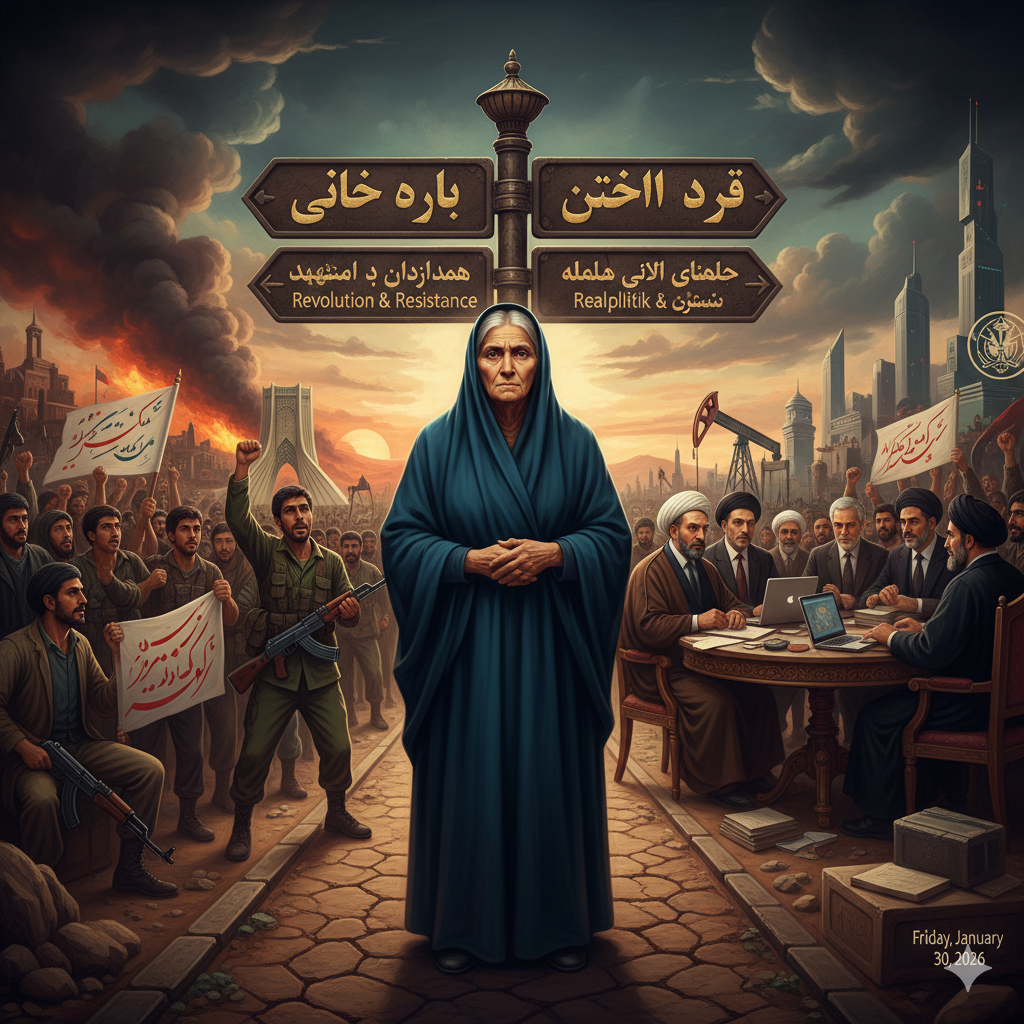
Iran today is a nation defined by profound and often painful paradoxes. It is a country of immense cultural richness, a millennia-old civilization, and a highly educated youth, yet it is ruled by a theocratic establishment entrenched in a 45-year-old revolutionary ideology. It projects power across the Middle East while its economy buckles under sanctions and mismanagement. It is a society where mandatory hijab is enforced on the streets, yet underground techno parties pulse in north Tehran basements. To understand Iran in the 2020s is to grapple with the intense and unresolved tensions between a repressive state, a resistant society, and an increasingly volatile geopolitical strategy.
The Domestic Crucible: A State vs. Its People
Inside its borders, the Islamic Republic is engaged in a relentless, low-intensity conflict with its own citizenry. The “Woman, Life, Freedom” uprising of 2022-23, ignited by the death of Mahsa Amini in morality police custody, was not just another protest cycle. It was a foundational challenge, led by women and youth, that explicitly targeted the core ideological pillars of the regime—mandatory veiling and the authority of the Supreme Leader. The state crushed it with brutal force, killing hundreds and executing protesters. However, the societal genie cannot be forced back into the bottle. The hijab, once a symbol of the revolution, has become the foremost badge of dissent. Women appear daily in public with uncovered hair, enacting a courageous, quiet civil disobedience that the state struggles to contain, oscillating between renewed crackdowns and hesitant leniency.
This social defiance unfolds against a backdrop of economic despair. Years of crippling U.S.-led sanctions, combined with epic levels of corruption and economic inefficiency, have devastated the middle class. Hyperinflation erodes savings, the currency has collapsed, and unemployment, especially among the educated youth, is endemic. The state survives by reallocating dwindling resources to its core loyalists—the Revolutionary Guards and the Basij militia—and by maintaining a vast subsidy system for basic goods, creating a dependent population even as it resents the government. This economic siege has two clear outcomes: a massive brain drain of Iran’s best and brightest, and a deep, generational alienation from the political system.
The “Axis of Resistance”: Foreign Policy as Regime Survival
Iran’s foreign policy is not merely an extension of its revolutionary ideology; it is a calculated, pragmatic tool for regime security and regional hegemony. The cornerstone is the “Axis of Resistance,” a network of militias and political movements across the Middle East that act as strategic depth and deterrence against the U.S., Israel, and rival Arab states.
- In Gaza and Lebanon: Iran’s support for Hamas and Palestinian Islamic Jihad, and its principal proxy, Hezbollah in Lebanon, places it at the epicenter of the Arab-Israeli conflict. The war in Gaza has highlighted Iran’s strategy: it maintains “strategic patience,” allowing its proxies to wage costly battles against Israel while avoiding a full-scale, direct confrontation that could threaten the regime’s survival. Hezbollah’s daily skirmishes on Israel’s northern border demonstrate this calibrated brinkmanship.
- In Yemen and Iraq: The Houthis in Yemen, with Iranian technical and military support, have become a formidable force, disrupting global shipping in the Red Sea to exert pressure in solidarity with Gaza. In Iraq, multiple Iran-backed Shia militias now wield immense political and military power, regularly targeting U.S. forces to push for an American withdrawal.
- The Nuclear Program: The Ultimate Hedge: At the heart of Iran’s security strategy is its nuclear program. The 2015 Joint Comprehensive Plan of Action (JCPOA) is effectively dead. Iran now enriches uranium up to 60% purity, a short technical step from weapons-grade levels, and has severely limited International Atomic Energy Agency (IAEA) monitoring. This advances its status as a “threshold” nuclear state, possessing the capability to build a bomb quickly if it chooses, thereby amplifying its deterrence and regional bargaining power without crossing the line that could trigger military action.
The Geopolitical Tightrope: Navigating a Shifting World
Iran’s leaders navigate a complex and shifting global order. The unipolar moment of American dominance is over, and Tehran is adept at playing in a multipolar world.
- The China-Russia Lifeline: Sanctioned and isolated from the West, Iran has pivoted decisively eastward. Its comprehensive strategic partnership with China promises long-term investment in infrastructure and energy, binding Iran to Beijing’s orbit. Its alliance with Russia has deepened dramatically since the Ukraine war, becoming a full-fledged military-technical partnership. Iran supplies Russia with deadly Shahed drones for its war effort, while receiving promises of advanced military hardware and diplomatic cover at the UN Security Council. This “alliance of the sanctioned” provides crucial economic and strategic ballast.
- Tensions and Detente in the Gulf: Relations with Saudi Arabia, long a bitter sectarian and geopolitical rival, have undergone a dramatic shift. Under a China-brokered deal in 2023, the two nations re-established diplomatic ties. This is a pragmatic move for both sides: Riyadh seeks to extricate itself from regional conflicts to focus on domestic development under Vision 2030, while Tehran aims to break its encirclement and ease pressure. However, this detente is fragile, built on elite negotiation rather than deep trust, and remains vulnerable to spoilers like further Houthi attacks or internal hardline opposition in Iran.
- The Stalemate with the West: Relations with the United States and Europe remain frozen in a cycle of maximum pressure and maximum resistance. The Biden administration’s focus is on containment and preventing nuclear escalation, not on a new deal. Europe is caught between its desire to curb Iran’s regional behavior and its need for alternative energy sources, a tension that has paralyzed a unified policy. The primary Western tools remain sanctions and rhetorical condemnation, which have so far failed to alter the regime’s core calculus.
The Looming Succession: The Shadow Over Everything
The most significant question hanging over Iran’s future is biological: Supreme Leader Ayatollah Ali Khamenei is 85 years old. His eventual passing will trigger the most consequential political transition since the 1979 revolution. The opaque, insider-dominated Assembly of Experts will choose his successor. Will it be another conservative cleric, or could the powerful Islamic Revolutionary Guard Corps (IRGC), which controls vast swathes of the economy and security apparatus, seek to formalize its power? The succession could catalyze intense factional warfare within the elite, potentially creating openings for public unrest. It is the ultimate wild card that shapes every domestic and foreign policy calculation today.
Conclusion: The Iron Fist and the Brittle Foundation
Iran today is a state of formidable resilience and profound fragility. The regime has mastered the art of survival through a combination of domestic repression, regional proxy warfare, and alliances with authoritarian partners. It has weathered mass protests, economic warfare, and international isolation. Its strategic position, backed by its nuclear hedge and militia network, ensures it cannot be ignored.
Yet, its foundations are cracking. The social contract with its people is broken. Its economy is in a permanent state of crisis. Its regional victories are costly and create perpetual flashpoints. The nation is caught between the iron dictates of a revolutionary past and the irresistible demands of its future—a future imagined by its youth who are disconnected from the state’s founding myths and yearn for normalcy, connection, and freedom.
Iran stands at a historic crossroads. The path of continued confrontation and repression leads to greater isolation and internal decay. An alternative path of diplomatic engagement and internal reform, while currently blocked by hardliners, is the only route to long-term stability. For now, the Islamic Republic chooses consolidation of power over reconciliation, betting that its security apparatus and foreign alliances can indefinitely manage the simmering discontent of a nation waiting for change. The outcome of this bet will determine not only Iran’s fate, but the stability of the entire Middle East.
