

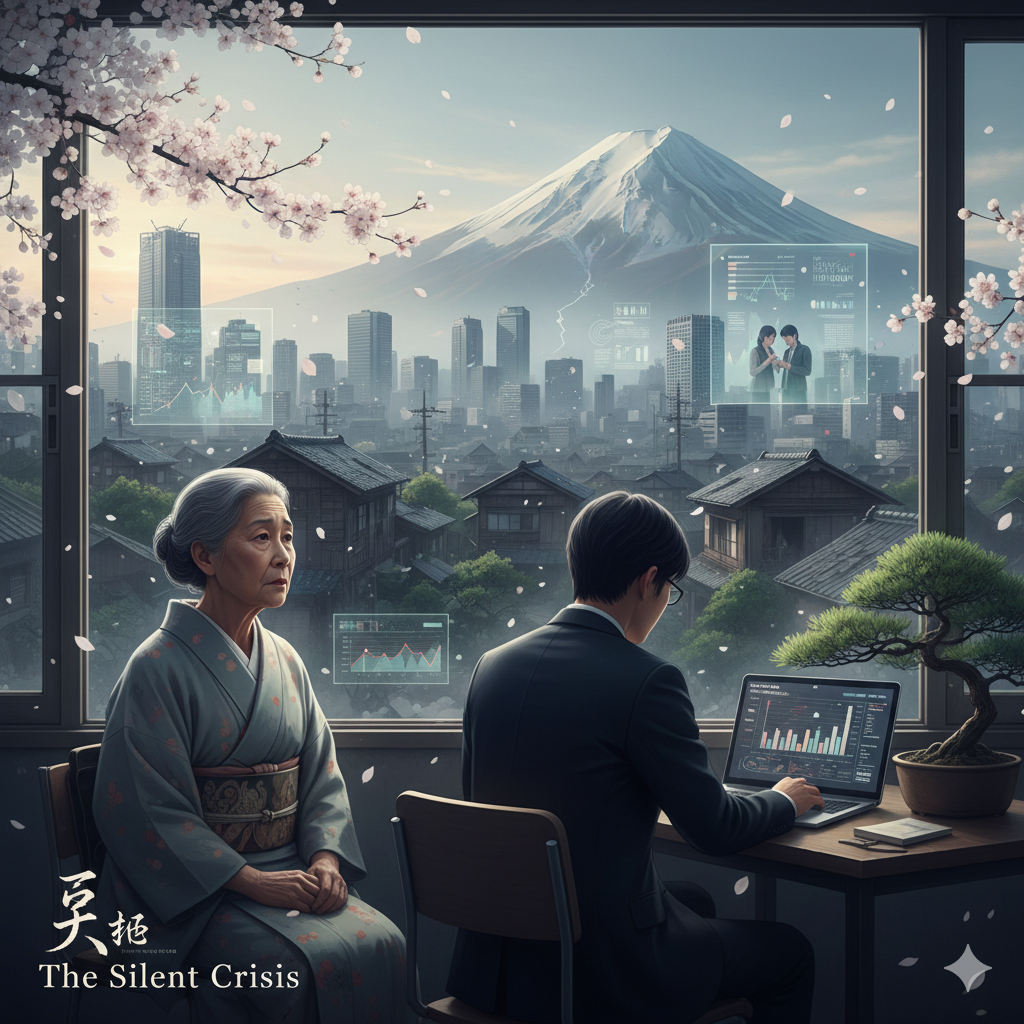
From the outside, Japan often appears as a paragon of order, tradition, and technological prowess—a nation of serene temples, bullet trains, and harmonious society. Yet, beneath this polished surface, the country grapples with a complex web of interconnected challenges that threaten its economic vitality, social cohesion, and future stability. These are not loud, sudden crises, but slow-burning, structural problems that have been deepening for decades. Understanding them is key to understanding modern Japan.
1. The Demographic Time Bomb: Super-Aging and Depopulation
At the heart of Japan’s woes lies its demographic crisis, arguably the most severe among advanced nations. Japan’s population is both shrinking and aging at an unprecedented pace. With a fertility rate hovering around 1.3, far below the replacement level of 2.1, and the world’s highest proportion of citizens over 65 (nearly 30%), the implications are staggering.
This demographic shift creates a vicious cycle. A shrinking workforce must support a growing elderly population, placing immense strain on the social security, healthcare, and pension systems. Rural towns and villages are becoming “ghost communities” as the young migrate to cities, leaving aging populations behind with dwindling services. The national economy suffers from a chronic labor shortage, suppressed domestic consumption, and a potential decline in innovation and entrepreneurship. While the government has initiated policies to promote childbirth and cautiously opened doors to foreign labor, these measures have yet to reverse the tide, facing cultural and institutional inertia.
2. Economic Stagnation and the “Lost Decades”
Japan’s economy, once an unstoppable juggernaut, has been mired in a state of low growth and deflationary pressure for over 30 years—the so-called “Lost Decades.” While not in outright recession, the economy is characterized by persistent weaknesses: stagnant wages, cautious corporate spending, and ultra-low inflation that only recently has shown signs of shifting.
A significant aspect of this is labor market duality. A core of regular, full-time employees enjoys lifetime employment and seniority-based wages, while a growing periphery of irregular, part-time, or contract workers (often women and young people) face job insecurity, lower pay, and few benefits. This not only depresses overall income and spending but also contributes to social inequality. Furthermore, corporate Japan has been criticized for risk aversion and slow digital transformation, lagging behind global counterparts in productivity and innovation despite its technological heritage.
3. The Pressure Cooker: Social Rigidity and Mental Health
Japan’s famed social cohesion comes with a cost: immense pressure to conform and succeed within rigid systems. The education system, while producing high achievers, is often criticized for its emphasis on rote memorization and high-stakes exams that determine one’s future trajectory, creating intense stress from a young age.
The workplace culture of long hours (karoshi, or death by overwork, remains a recognized phenomenon) and hierarchical structures takes a further toll. Coupled with societal expectations, this contributes to a severe mental health crisis. Japan continues to grapple with a high suicide rate, particularly among young people and middle-aged men. Social isolation—hikikomori (acute social withdrawal) affecting hundreds of thousands, and lonely deaths (kodokushi) among the elderly—highlight a profound crisis of connection in a densely populated society.
4. Gender Inequality: An Untapped Resource
Japan ranks dismally low on global gender parity indices (116th out of 146 in the 2023 World Economic Forum report), highlighting a persistent failure to integrate women fully into its economy and leadership. While educational attainment for women is high, a combination of corporate culture, tax disincentives for working spouses, and deep-seated patriarchal norms often pushes women into non-regular employment or out of the workforce after childbirth.
This “leaky pipeline” results in a dramatic underrepresentation of women in management, politics, and STEM fields. It is not merely a social justice issue but a critical economic folly; tapping into the potential of half the population is essential for addressing the labor shortage and driving growth. Despite government targets and increased female labor participation (often in part-time roles), true equality in status, pay, and opportunity remains distant.
5. Political Apathy and Bureaucratic Inertia
Japan’s political landscape, dominated by the conservative Liberal Democratic Party (LDP) for most of the post-war era, is often seen as stable but lacking in dynamism and bold reform. Voter apathy, especially among the young, is high, driven by a sense that politics is disconnected from their daily lives and that change is incremental at best.
Decision-making is often criticized for being top-down and overly reliant on powerful, conservative bureaucracies. This “kantei-led” (Prime Minister’s office) governance still struggles to overcome siloed ministries resistant to disruptive change. This inertia complicates efforts to tackle systemic issues like demographic decline, labor reform, and digitalization with the speed and scale required.
6. Natural Disasters and the Energy Conundrum
Situated on the Pacific Ring of Fire, Japan is perennially vulnerable to earthquakes, typhoons, and tsunamis. The triple disaster of 3/11 in 2011—earthquake, tsunami, and the Fukushima nuclear meltdown—left an indelible scar on the national psyche and energy policy. The subsequent shutdown of all nuclear reactors thrust the country into a reliance on expensive fossil fuel imports, undermining energy security and climate goals.
The path forward is fraught. Restarting nuclear plants faces public opposition, while the rollout of renewable energy, though progressing, has been slow. Balancing disaster preparedness, economic costs, decarbonization commitments, and public sentiment remains a herculean task.
7. An Insecure Region: Geopolitical Tensions
Japan operates in an increasingly volatile neighborhood. A rising and more assertive China, with territorial disputes in the East China Sea, and the persistent threat from North Korea’s missile and nuclear programs necessitate a delicate diplomatic and military balancing act. Japan has gradually strengthened its Self-Defense Forces and security alliance with the United States, but these tensions create an environment of uncertainty that impacts national policy and public sentiment.
Conclusion: A Crossroads of Tradition and Transformation
Japan’s problems are deeply interwoven. The demographic decline fuels economic and fiscal woes; social rigidity exacerbates the mental health crisis and gender gap; political inertia slows solutions. Yet, to view Japan solely through the lens of crisis is a mistake. The nation possesses immense strengths: a highly educated populace, cutting-edge technology, strong infrastructure, and a cohesive society.
The fundamental challenge lies in its ability to undertake bold, structural reforms—to embrace greater workforce diversity (including women and immigrants), foster a more flexible and innovative economy, and build a more inclusive social model that supports families and individuals. Japan stands at a crossroads, needing to harness its renowned resilience and capacity for meticulous planning to navigate these silent storms. The world watches, for how Japan manages its 21st-century problems will offer crucial lessons for all aging societies. The time for incremental change may be over; the moment for transformative adaptation is now.
