

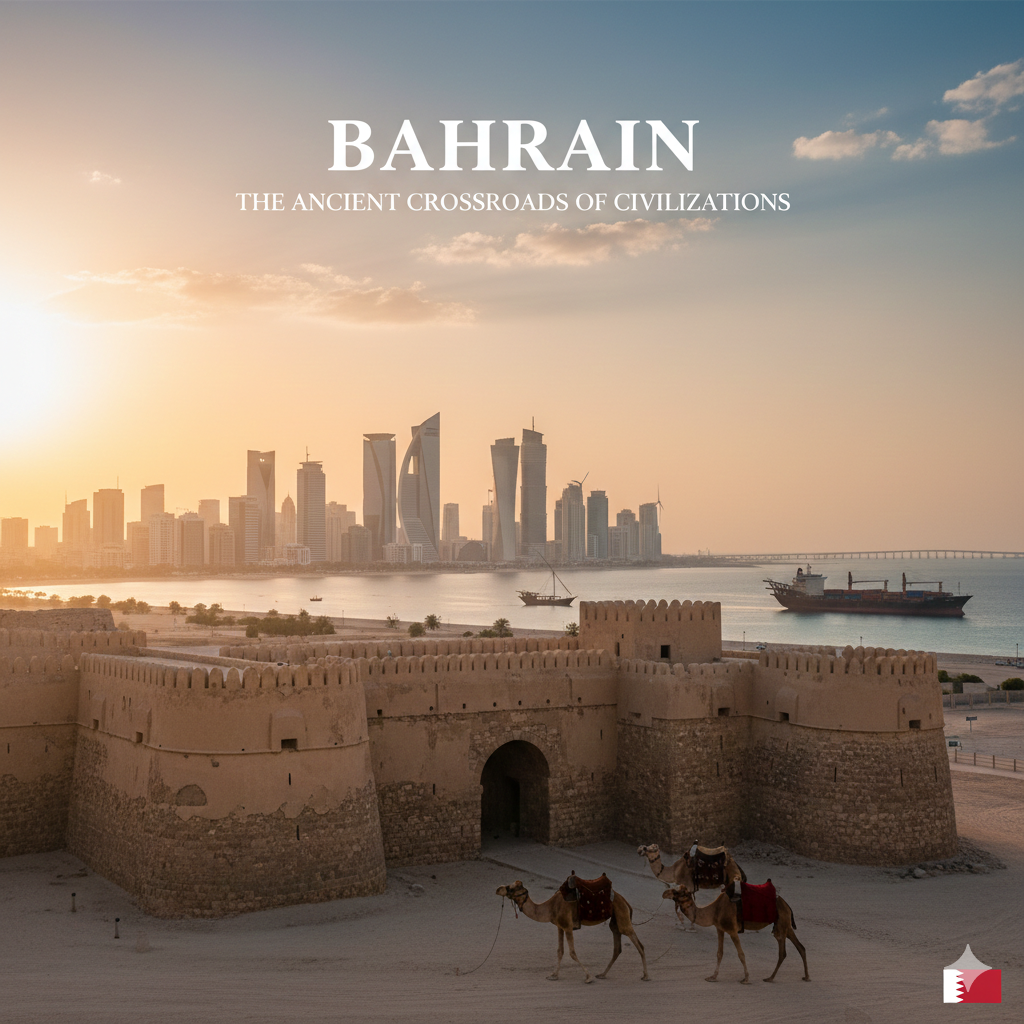
Nestled in the turquoise waters of the Persian Gulf, the island nation of Bahrain—whose name means “Two Seas” in Arabic—presents a history of astonishing depth and continuity. Far more than a modern financial hub, Bahrain is a layered archaeological and cultural archive, a microcosm of Gulf history, and a testament to the enduring human spirit in a harsh yet bountiful environment. Its story is not one of isolated splendor, but of perpetual connection, serving as a vital nexus for trade, belief, and empire for over 4,000 years.
The Dawn of Civilization: Dilmun, the Sacred Land
Bahrain’s historical significance erupts from its very soil. It is the heartland of the ancient Dilmun civilization, a Bronze Age powerhouse (circa 3000–600 BCE) celebrated in Sumerian and Akkadian cuneiform texts. To the Mesopotamians, Dilmun was a holy, pure land, a paradise where the flood hero Utnapishtim (the Mesopotamian Noah) was granted immortality. This mythical status was rooted in tangible reality: Bahrain was a crucial entrepôt, linking the advanced civilizations of Mesopotamia (modern Iraq) with the resource-rich Indus Valley (Harappan) civilization.
The lifeblood of Dilmun was trade. Its merchants transported copper from Oman, ivory and carnelian from India, timber from Dilmun’s own then-lush mangrove forests, and the most precious commodity of all: pearls. The oyster beds of the Gulf, centered around Bahrain, produced the finest pearls in the ancient world, becoming a constant thread in its economy for millennia. The archaeological evidence is breathtaking: over 170,000 burial mounds, forming one of the world’s largest prehistoric cemeteries, scatter the northern landscape. The grandeur of the “Royal Mounds” at A’ali speaks of a highly stratified society with powerful elites. The recently UNESCO-listed Qal’at al-Bahrain (Bahrain Fort) site is a “tell,” a man-made hill formed by successive layers of habitation, with Dilmun at its foundation, revealing streets, temples, and a sophisticated administrative center.
The Age of Empires: Tylos, Christianity, and Islam
Dilmun’s power eventually waned due to shifting trade routes. By the 3rd century BCE, the island, known as Tylos to the Greeks, fell under the influence of the Hellenistic Seleucid Empire and later the Parthians. Greek historical accounts praise Tylos for its cotton, date palms, and, again, its pearls. Remarkably, this era saw the arrival of Nestorian Christianity, making Bahrain one of the earliest Christian communities in the Gulf, led by a bishopric under the Persian Sassanian Empire.
The turning point that would define the region’s future came in the 7th century CE. Bahrain was an early convert to Islam, following a letter from the Prophet Muhammad in 628 AD to its ruler, Al-Mundhir ibn Sawa Al-Tamimi. The island became a pivotal center for Islamic theology, scholarship, and even sectarian diversity. For centuries, it was a bastion of the Qarmatian Ismaili movement, a radical egalitarian republic that, in a stunning act in 930 CE, sacked Mecca and carried off the Black Stone of the Kaaba, holding it in Bahrain for twenty years. This period underscored Bahrain’s capacity for independent, ideological power.
The Portuguese Interlude and the Rise of the Pearl
The early 16th century brought European imperialism to the Gulf. Seeking to control the lucrative spice and trade routes, the Portuguese invaded in 1521, building the formidable Qal’at al-Bahrain (the fort that gives the archaeological site its name). Their brutal 80-year occupation was primarily military and extractive. They were finally expelled in 1602 by a determined popular uprising, an early source of Bahraini national pride.
The ensuing centuries saw the island contested between Persian empires and emerging Arab tribes from the Arabian interior. This struggle concluded in 1783 when the Al Khalifa tribe, originating from central Arabia and part of the Utub confederation (which also settled Kuwait), successfully captured Bahrain from Persian control. The Al Khalifa dynasty has ruled ever since, establishing the framework of the modern state.
The 19th and early 20th centuries were the “Golden Age of Pearling.” As global demand soared, Bahrain’s economy became almost exclusively tied to the pearl banks. Its nukhadas (ship captains) and ghaus (divers) formed the backbone of a society that, while socially stratified, thrived on this maritime bounty. Manama grew into a cosmopolitan mercantile city, attracting traders, financiers, and laborers from across the region and Persia. This era cemented Bahrain’s identity as a mercantile, relatively open society. However, this monoculture prosperity was shattered in the 1930s with the Japanese development of the cultured pearl and the global Great Depression, plunging the island into severe economic hardship.
The Black Gold Transformation and the Road to Independence
Salvation came from beneath the waves, not from oysters, but from oil. In 1932, Bahrain struck oil, becoming the first location on the Arabian side of the Gulf to do so. This discovery transformed everything. The Bahrain Petroleum Company (BAPCO) refinery, built in 1936, became a regional fixture. Oil revenues funded modern infrastructure, education, and healthcare, creating a new middle class and drawing fresh waves of migrant workers.
Politically, Bahrain became a British protectorate in the late 19th century, ceding control of its foreign affairs and defense in exchange for security from Ottoman and Saudi threats. As the tide of Arab nationalism rose post-World War II, calls for self-determination grew. In 1971, after a United Nations survey confirmed its people’s desire for full independence, Bahrain terminated its treaty with Britain and emerged as a fully sovereign state on August 15, 1971.
Modern Bahrain: A Tapestry of Continuity and Change
Since independence, Bahrain has navigated a complex path. It pioneered the post-oil economic vision in the Gulf, diversifying aggressively into banking and financial services in the 1970s and 80s, earning the nickname “the Switzerland of the Gulf.” It invested in aluminum production (ALBA), tourism, and logistics. Socially, it made early strides in education and women’s rights, being the first Gulf state to educate girls and have women in government.
Yet, its modern history has also been marked by political tension. A brief experiment with a parliament in the 1970s was dissolved, and the 1990s saw significant unrest. The 2011 Arab Spring-inspired protests, rooted in long-standing sectarian and political grievances (the majority Shia population has often felt politically and economically marginalized by the Sunni-led government), ushered in a period of profound challenge. The state’s response and the subsequent geopolitical dynamics, including the role of neighboring Saudi Arabia, have shaped its recent decade.
Conclusion: The Living Legacy
Today, Bahrain’s history is not a relic; it is a living foundation. The ancient burial mounds stand in the shadow of soaring skyscrapers. The dhow-building yards in Muharraq, now a UNESCO World Heritage site celebrating the pearl trade, exist alongside a Formula One Grand Prix circuit. The spirit of Dilmun—the merchant, the connector, the cultural synthesizer—lives on in its modern identity as a financial and diplomatic bridge.
Bahrain’s history teaches us that the Gulf was never a backwater, but a vibrant, connected theater of human endeavor. Its story is one of resilience, adaptation, and an enduring centrality. From the sacred paradise of Dilmun to the bustling hub of modern finance, Bahrain remains, as it has for four millennia, a pivotal island between two seas.