

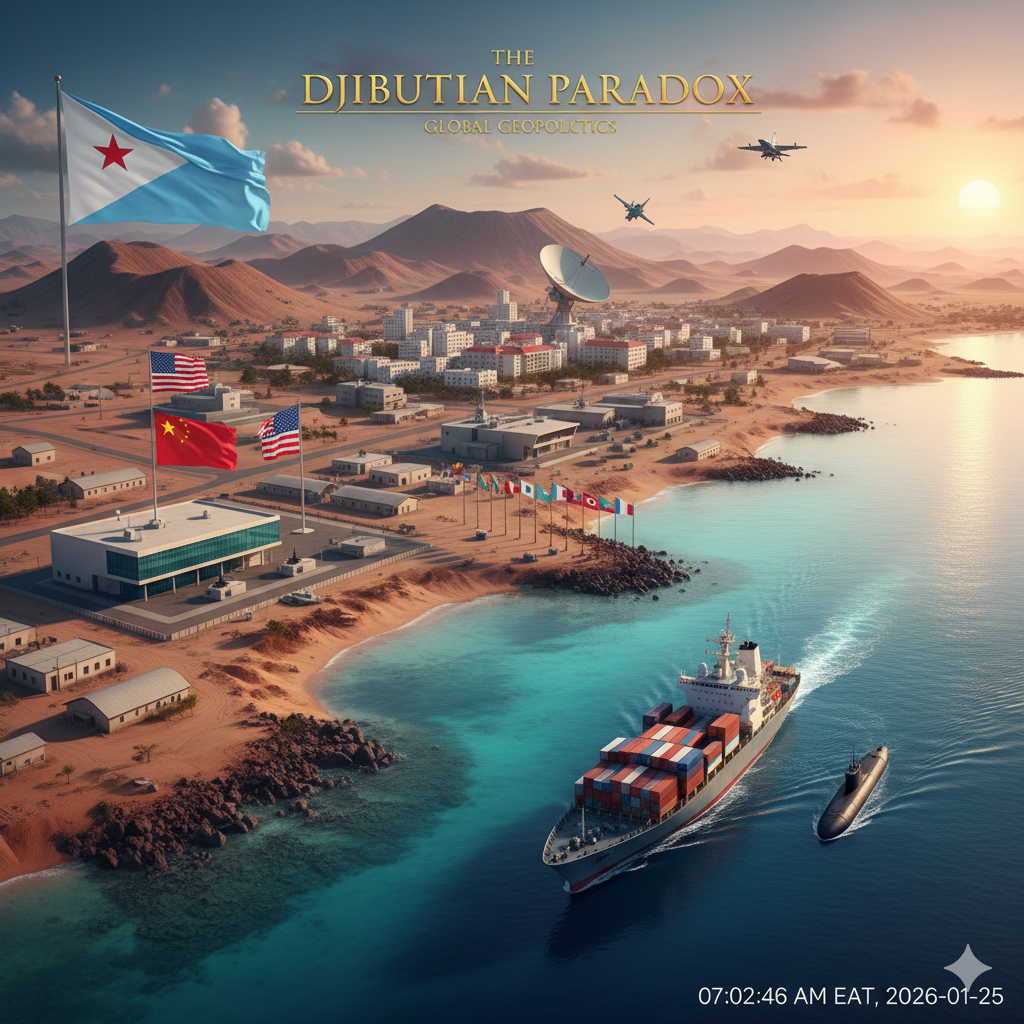
In the swirling dust of the Horn of Africa, where the sun scorches the earth and the Red Sea meets the Gulf of Aden, lies a nation so small it is often a mere footnote on world maps, yet so strategically vital it hosts more foreign military bases than almost any other country on Earth. This is the Republic of Djibouti, a land of stark, majestic beauty and profound geopolitical paradox. With a population under one million and an area smaller than New Jersey, Djibouti punches astronomically above its weight, serving as a fulcrum upon which the balance of global trade, military strategy, and great power competition precariously rests.
The Indispensable Geography
Djibouti’s unparalleled significance springs from its geography. It commands the southern approach to the Bab el-Mandeb Strait, a maritime chokepoint more critical than ever in the globalized age. This narrow sea lane, translating ominously as the “Gate of Tears,” is the conduit for roughly 30% of the world’s container shipping and a significant portion of its oil. Every ship passing through the Suez Canal must navigate this gateway, making its security synonymous with the health of the global economy. Djibouti’s deep-water ports, particularly the Doraleh Container Terminal, offer a stable, secure haven on an often-unstable coastline, making the nation the default port of entry and exit for the entire, landlocked Ethiopian market of over 120 million people. In essence, Djibouti is both a global sentinel and a regional lifeline.
A Chessboard of Great Powers
This geographical fortune has transformed Djibouti into a unique “base nation.” Walk a short stretch of its arid coastline, and you encounter a concentration of military power unmatched in the world. Here, the flags of rival global powers fly in uneasy proximity.
The United States operates Camp Lemonnier, its largest permanent base in Africa, a critical hub for counterterrorism operations in Yemen and Somalia and for ensuring freedom of navigation in the Bab el-Mandeb. Just miles away, China’s first and only overseas military base represents the cornerstone of its “String of Pearls” strategy, protecting its massive Belt and Road investments and allowing the People’s Liberation Army Navy to project power far from home. The two superpowers, locked in global competition, watch each other from adjacent deserts.
But the roster extends further. France, Djibouti’s former colonial ruler, maintains a significant legacy force. Italy, Japan, and Germany also have a presence. Even Saudi Arabia has secured a footing. This creates a surreal reality: Djibouti’s government, led by the enduring President Ismail Omar Guelleh, must perform a masterful, continuous diplomatic ballet, balancing these competing interests, leveraging rents and investments from all, while fiercely guarding its own sovereignty and avoiding being sucked into the conflicts of its patrons.
The Harsh Domestic Reality
Beneath this globalized, strategic veneer lies a domestic landscape of severe challenge. Djibouti is a country of extreme climate, with scorching heat, chronic water scarcity, and less than 10% arable land. Its economy, while growing due to port revenues and military leases, struggles with high unemployment, especially among the youth, and a stark wealth disparity. The capital, Djibouti City, with its sleek new ports and infrastructure funded by Chinese loans, contrasts sharply with the sprawling Balbala slums and the resilient but often impoverished nomadic communities in the interior.
The nation’s social fabric is a tapestry of its Somali (Issa) and Afar heritage, with a history of tension now carefully managed. President Guelleh’s government, in power for over two decades, maintains stability but faces criticism for its tight control over political life. The very foreign presence that fuels the economy also creates a sense of a nation hosting powerful guests in its own home, leading to complex feelings of both opportunity and neo-colonial anxiety. Managing the dividends from its geopolitical premium to foster inclusive, sustainable development is Djibouti’s central internal paradox.
Beyond the Military: The Digital and Green Future
Astutely, Djibouti is not content to be merely a landlord for militaries. It is leveraging its position to become a different kind of hub. The country has become the digital gateway for East Africa, with multiple submarine internet cables making landfall on its shores. This positions Djibouti as a potential future data center for the region, a vision it is pursuing with investments in fiber optics and digital infrastructure.
Furthermore, Djibouti is staring down its environmental vulnerabilities with ambitious projects. It is investing heavily in geothermal energy, tapping into the volcanic activity of the East African Rift, with the goal of becoming the first African nation to be 100% powered by renewable energy. The Lake Assal region, one of the saltiest bodies of water on Earth and the lowest point in Africa, holds potential for mineral extraction and eco-tourism. These initiatives point to a leadership aware that its geopolitical rent is a temporary advantage that must be invested in a more diversified future.
The Delicate Balance and the World’s Stake
The stability of Djibouti is not its concern alone; it is a global public good. Any severe internal instability or a tilt too far into the orbit of a single external power could destabilize the entire region and send shockwaves through global trade routes. Thus, the international community has a vested interest in Djibouti’s success as a sovereign, stable, and prosperous state. This requires partners who look beyond the immediate military calculus to support sustainable development, good governance, and climate resilience.
Djibouti stands as a powerful lesson in 21st-century geopolitics: in an interconnected world, a microstate with critical geography can become a macro-player. It is a laboratory of multi-polar competition, a test case for African agency, and a living narrative about the interplay between geography, global trade, and local destiny. As the world’s powers jostle for position on its shores, Djibouti itself is engaged in its own high-stakes navigation—charting a course between the interests of giants, the needs of its people, and the relentless pressures of a harsh and changing environment. In the silent, watchful desert, by the busy sea lanes it guards, this tiny nation continues to write a story of outsized importance for us all.
