

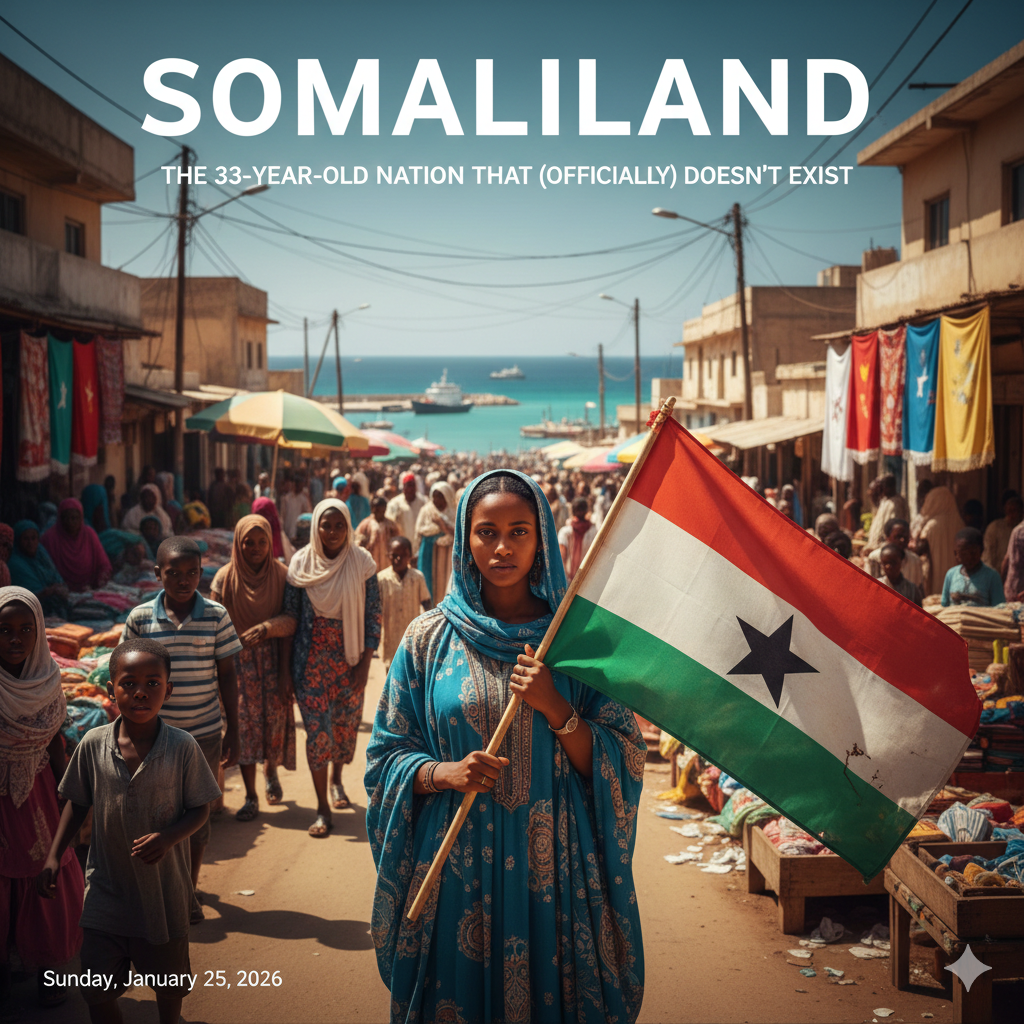
In the dusty, sun-baked Horn of Africa lies one of the world’s most compelling geopolitical anomalies. Somaliland, a self-declared republic that broke away from Somalia in 1991, has spent over three decades building what its neighbors have not: a stable, democratic, and functional state. It boasts its own government, currency, passport, military, and a record of peaceful transitions of power. Yet, on the world map, it remains a blank space, subsumed within the borders of its chaotic southern neighbor, Somalia. Somaliland today stands at a critical juncture—a testament to bottom-up state-building, yet trapped in the brutal inertia of international diplomacy and regional politics. It is a nation in all but name, caught between its undeniable successes and the world’s stubborn refusal to recognize it.
The Foundation: Forging Order from Chaos
Somaliland’s story is one of remarkable resilience. When the Somali state collapsed in 1991, the northern region, a former British protectorate, chose a different path. Led by its clans, it did not descend into warlordism but convened a series of grassroots peace conferences, most notably in Burao and Borama. Using traditional Xeer law and a consensus-based approach, the clans painstakingly negotiated a social contract. They laid the foundations for a hybrid governance system that blended modern institutions with clan representation, ultimately producing a constitution ratified by referendum in 2001. This organic, indigenous process of state formation is Somaliland’s core strength and the foundation of its unique political legitimacy among its own people.
The Pillars of a Functional State
Walking the streets of Hargeisa, the capital, reveals the tangible results of this project. Key institutions function, often in stark contrast to the rest of the region:
- Security: Somaliland maintains its own police and military forces, funded domestically. While not without challenges, it has established a credible monopoly on violence. Crime rates are low, and the territory is largely free from the al-Shabaab terrorism that plagues Somalia, a fact it highlights relentlessly to potential partners.
- Governance: The nation operates as a multi-party democracy. It has held multiple competitive presidential and parliamentary elections and local council votes, all of which international observers have generally deemed credible. In 2010, President Dahir Riyale Kahin peacefully handed power to Ahmed Mohamed Mohamoud “Silanyo” after a narrow electoral defeat—a rarity in the region. The most recent election, in November 2024, saw President Muse Bihi Abdi secure a second term, a process that, while tense, demonstrated the endurance of its electoral framework.
- Economy: Lacking access to international financial institutions, Somaliland runs on a vibrant, entrepreneurial, and largely informal economy. The Somaliland Shilling is a stable local currency. The port of Berbera, managed in partnership with DP World, is a critical economic lifeline and a source of future ambition, with major road links to Ethiopia transforming it into a vital gateway for landlocked Ethiopia. Livestock exports to the Gulf, telecommunications, and a burgeoning diaspora-driven service sector fuel growth.
The Core Contradiction: Domestic Legitimacy vs. International Limbo
This is Somaliland’s central paradox. Domestically, it possesses a high degree of internal legitimacy. Its citizens possess a strong, separate national identity, viewing themselves as Somalilanders, not Somalis. They have sacrificed and built a state that delivers a basic level of security and governance.
Internationally, however, it remains in a state of political and economic purgatory. No United Nations member state grants it formal recognition. This imposes a crushing set of constraints:
- Financial Isolation: It cannot access World Bank or IMF loans, international bond markets, or structured development aid. All investment and budget financing must come from the diaspora, local taxes, port revenues, and ad-hoc partnerships.
- Diplomatic Handcuffs: Its diplomats cannot sit at the UN. Its athletes cannot compete in the Olympics under their own flag. Its students face immense hurdles obtaining visas and having their academic credentials recognized.
- The Sovereignty Trap: The entire international order is built on the principle of respecting the territorial integrity of existing states. Recognizing Somaliland would be seen as endorsing secession, a precedent nations like Ethiopia (with its ethnic regions), Kenya, and even Spain (with Catalonia) fear. The African Union, bound by colonial-era borders, remains firmly opposed.
The Regional Chessboard: Ethiopia’s Gambit and Somalia’s Fury
Somaliland’s quest for recognition is now the centerpiece of a volatile regional power play.
The game-changer is a landmark memorandum of understanding (MoU) signed with Ethiopia in January 2024. In essence, Somaliland reportedly agreed to lease 20 km of its coastline around Berbera to Ethiopia for 50 years for naval and commercial use. In return, Ethiopia—a landlocked economic giant—would become the first major nation to grant Somaliland formal diplomatic recognition, at least in principle.
This deal has sent shockwaves through the Horn of Africa:
- For Somaliland: It is the strategic breakthrough it has sought for decades. Ethiopian recognition would shatter its isolation and likely trigger a cascade of other nations, particularly those with strategic interests in the Red Sea, to follow suit.
- For Ethiopia: It secures desperately needed sea access, a national obsession since Eritrea’s independence. It also gives Addis Ababa a powerful lever in regional politics.
- For Somalia: The reaction has been one of furious, unequivocal rejection. The Somali government in Mogadishu declared the MoU an act of “aggression” and a violation of its sovereignty. It has rallied diplomatic support across the Arab League, the EU, and the AU, all of whom have reaffirmed Somalia’s “territorial integrity.” The rhetoric from Mogadishu has grown increasingly belligerent, raising fears of a direct conflict.
Internal Fractures and The Road Ahead
Even as it navigates this high-stakes diplomacy, Somaliland faces its own internal challenges. The MoU with Ethiopia has proven controversial at home. The opposition and some clans argue the government negotiated in secret and question the terms. The eastern regions of Sool and Sanaag, claimed by both Somaliland and the neighboring Somali regional state of Puntland, remain a flashpoint, with periodic clashes underscoring unresolved territorial disputes.
The path forward is fraught with risk. If the Ethiopia deal moves toward implementation, it could lead to:
- A major diplomatic rupture and potential proxy conflict in the Horn.
- A historic breakthrough, forcing the world to finally grapple with Somaliland’s reality.
- More likely, a protracted, messy middle ground—increased Ethiopian engagement and de facto treatment as a state, without a clean wave of formal UN recognition.
Conclusion: A Test Case for a Changing World Order
Somaliland today is more than a regional curiosity. It is a profound test case. It challenges the international system’s rigid adherence to maps drawn by colonial powers over the lived reality of effective, legitimate self-determination. It proves that statehood can be built from the grassroots, without top-down international blueprints.
Yet, it also demonstrates the immense cost of existing outside that system. Its people have built a home, but the world refuses to send them a formal invitation. Whether the gamble with Ethiopia succeeds or backfires, Somaliland has already achieved something extraordinary: it has forced the world to look at it not as a problem, but as a nation. Its continued existence is a quiet, persistent revolution, and its ultimate fate will tell us much about whether the 21st-century world order can accommodate the political realities it has itself created.