

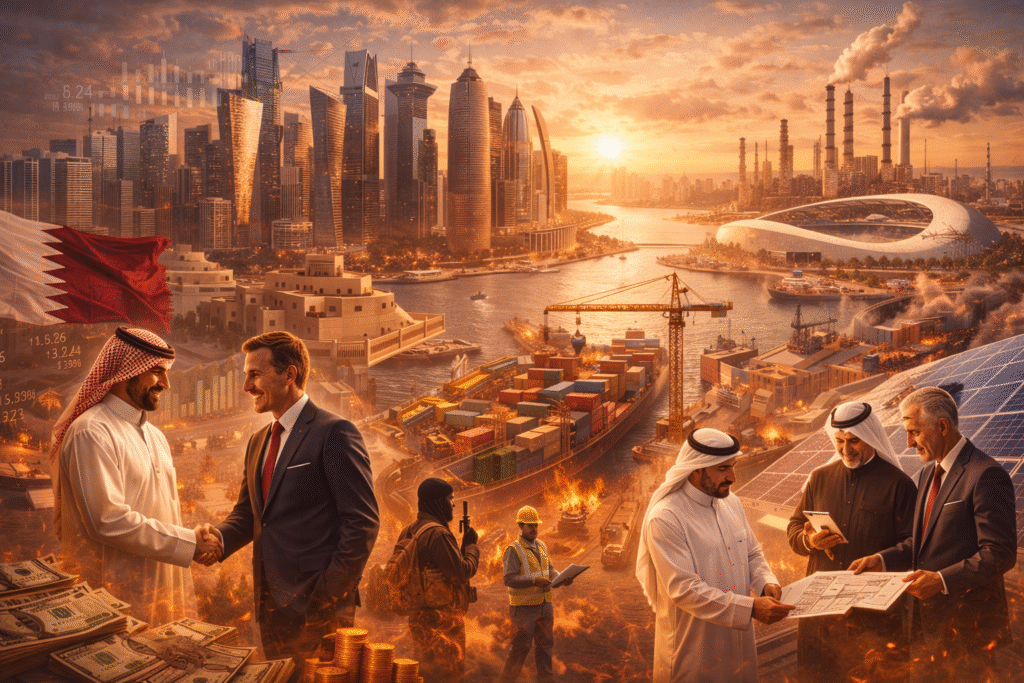
The final whistle of the 2022 FIFA World Cup did not signal an end to Qatar’s ambitions, but rather a pivotal transition. The nation, having executed one of history’s most concentrated infrastructure projects, now faces the critical business challenge of the 21st century: leveraging that investment for sustainable, diversified growth. Business in Qatar today is defined by this strategic pivot—from a World Cup host to a global business hub, powered by visionary state investment, economic diversification imperatives, and a complex geopolitical position.
The Engine of Transformation: Vision 2030 and State-Led Capital
At the core of Qatar’s business environment is the National Vision 2030, a blueprint for transforming the nation into an advanced, knowledge-based economy. Unlike organic market-driven models, Qatar’s approach is master-planned and state-financed. The sovereign wealth fund, the Qatar Investment Authority (QIA), with over $475 billion in assets, acts as the strategic conductor, directing capital both domestically and into a sprawling global portfolio. Domestically, this funds the real engine of growth: the Qatar Central Bank’s (QCB) economic stimulus packages and the relentless activity of wholly or majority state-owned enterprises like QatarEnergy and Ooredoo. This model provides immense stability and long-term vision, but private sector players must adeptly navigate a landscape where the state is both the dominant client and the primary competitor.
Hydrocarbons: The Resilient Bedrock
Despite the diversification rhetoric, liquefied natural gas (LNG) remains the unshakable foundation of Qatari prosperity. The ongoing North Field Expansion project—the largest of its kind—will increase LNG production capacity by over 60% by 2027. This colossal $30 billion-plus investment, securing long-term supply deals with European and Asian giants, guarantees revenue streams for decades. It funds the nation’s ambitions and provides a cushion of wealth that few other diversifying economies possess. For international businesses, this means sustained opportunity in the energy services, engineering, and technology sectors tied to this mega-project.
Diversification in Action: Finance, Tech, and Sports
The post-2022 agenda is accelerating diversification into clear, high-value sectors:
- Finance & Fintech: Qatar is fiercely competing to be the region’s financial centre. The Qatar Financial Centre (QFC) provides a streamlined, tax-advantaged regulatory platform attracting multinationals and financial institutions. A major push is underway in fintech, with the QCB driving a digital transformation that includes launching an instant payment platform and exploring a Central Bank Digital Currency (CBDC).
- Technology & Startup Ecosystem: While nascent compared to regional peers, Qatar is building its tech scene strategically. Focus areas include cybersecurity, edtech, and smart city solutions that leverage the nation’s new digital infrastructure. Initiatives like the “Startup Qatar” investment fund and the tech-focused Free Zones aim to cultivate homegrown innovation, though the ecosystem still struggles to attract the regional talent that flows to Dubai.
- The Sports & Events Industry: The World Cup was not an endpoint but a proof of concept. Qatar is now a year-round destination for global sports, from Formula 1 and MotoGP to world championship athletics and tennis. This creates a burgeoning business cluster around event management, sports marketing, hospitality, and broadcasting, leveraging its world-class facilities.
The Geopolitical Business Calculus
Qatar’s unique foreign policy—maintaining open channels with all sides, from the US and Iran to the Taliban and Hamas—creates a distinct business environment. It positions the country as a neutral mediator and a secure, stable hub amidst regional turbulence. This “open port” policy can facilitate trade and dialogue that is impossible elsewhere. However, it also requires businesses to be acutely aware of complex international sensitivities and sanctions regimes, making robust compliance departments essential.
Challenges on the Horizon
The path is not without obstacles. The localization imperative, embodied in the Qatarization program, creates a tight labour market for specialised expatriate talent while pressuring the private sector to develop national human capital. Bureaucratic processes, though improving, can still be slower and more hierarchical than in other Gulf commercial centres. Furthermore, the small local population (under 300,000 citizens) limits the scale of the domestic consumer market, forcing businesses to think export-oriented or B2B from day one.
The Sustainability Mandate: Green Growth as Strategy
Sustainability has evolved from a CSR talking point to a core business and national strategy. QatarEnergy has committed to an industry-leading carbon capture and storage (CCS) project linked to the North Field Expansion. The focus on green finance, sustainable urban development for the FIFA legacy, and solar power investments (like the 800MW Al-Kharsaah plant) signal that future growth must be environmentally aligned. This opens significant avenues for businesses in green technology, sustainable engineering, and ESG consulting.
Conclusion: The Maturity Phase
Business in Qatar today operates in an economy that has physically matured. The iconic stadiums, metro, and new cities are built. The question now is how to populate them with sustainable, productive, and globally competitive economic activity. The state has laid the table with immense capital and top-tier infrastructure. The opportunity for the private sector—both local and international—is to bring the innovation, operational excellence, and global connectivity to turn these assets into a thriving, diversified economy. Success requires a partner-like approach, aligning with national goals, navigating a state-centric model, and possessing the patience to play a long game underwritten by one of the world’s most formidable sovereign wealth funds. The World Cup was the opening ceremony; the main event of building a post-hydrocarbon future is now truly underway.
