

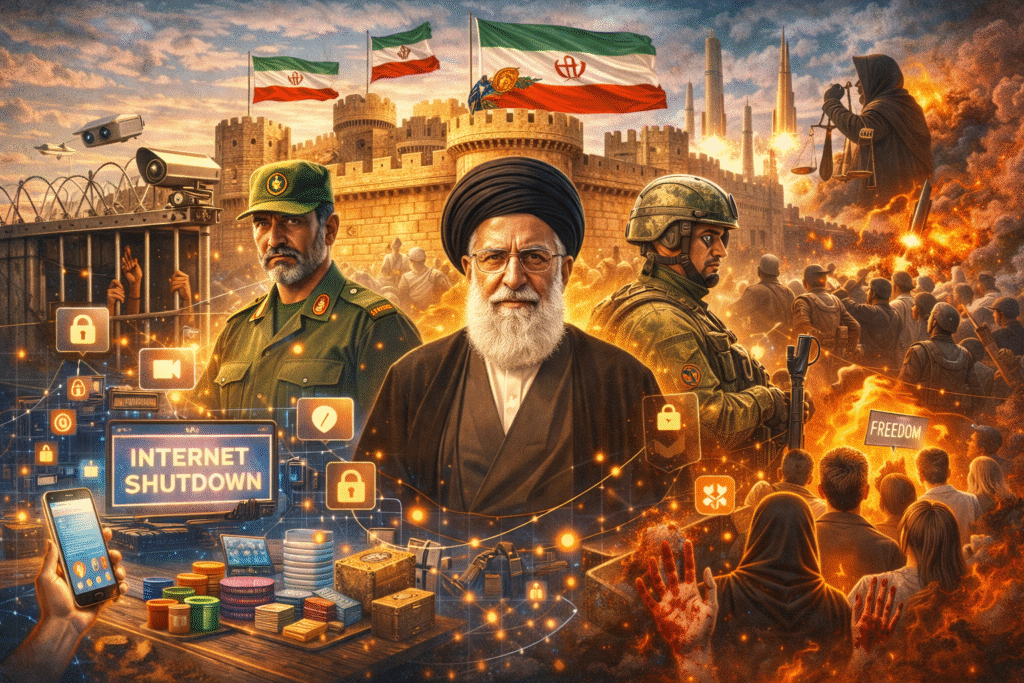
Part 1: Introduction – A System Under Strain
The political landscape of Iran today is defined by profound tension. It is a system caught between entrenched ideological power structures, a population increasingly restive and disillusioned, and the relentless pressure of geopolitical confrontation. Understanding Iranian politics requires navigating the formal institutions of the Islamic Republic, the informal networks of power, and the vibrant, often suppressed, demands of its civil society.
Part 2: The Supreme Leader: The Pivotal Center of Power
At the apex of Iran’s political system stands the Supreme Leader, Ayatollah Ali Khamenei. As Commander-in-Chief and highest-ranking political and religious authority, his office controls the military, judiciary, state media, and vast economic holdings. His health, succession, and conservative ideology remain the most significant factors shaping Iran’s domestic and foreign policy trajectory. All major state decisions flow through or are approved by this office.
Part 3: The Guardian Council & The Velvet Fist of Vetting
No institution better exemplifies the system’s control mechanisms than the 12-member Guardian Council. Appointed directly or indirectly by the Supreme Leader, it vets all candidates for the presidency, parliament, and Assembly of Experts. Its power to disqualify reformists and moderates en masse ensures the political field is heavily tilted toward conservative and hardline principles, fundamentally shaping electoral outcomes before a single vote is cast.
Part 4: The Presidency: A Manager, Not a Master
The presidency, currently held by the conservative Ebrahim Raisi, is a powerful but constrained executive office. The president manages the day-to-day governance and economy but remains subordinate to the Supreme Leader on all major strategic issues, particularly foreign and security policy. The presidency often becomes the focal point for public frustration over economic hardship, while its power to enact major change is systemically limited.
Part 5: The Parliament (Majles): A Stage for Managed Debate
The Islamic Consultative Assembly (Majles) is a forum for heated debate and political theater, but its legislative power is checked by the Guardian Council. Dominated by conservatives, it reflects the ideological preferences of the vetting bodies. It serves as a platform for factions to criticize government performance, but radical policy shifts are rare, and its role is largely to endorse and refine policies set by the core power structures.
Part 6: The Revolutionary Guards (IRGC): The Sword and the Purse
The Islamic Revolutionary Guard Corps (IRGC) is far more than a military branch. It is a parallel state—a socio-economic and ideological powerhouse with vast control over Iran’s security, intelligence, and a significant swath of its economy (from construction to telecommunications). Its Quds Force projects power across the region. The IRGC’s loyalty is to the revolutionary ideology and the Supreme Leader, making it the ultimate enforcer of the system’s stability.
Part 7: The Protest Pulse: “Woman, Life, Freedom” and Beyond
Beneath the surface of state control simmers deep societal discontent. The 2022-23 “Woman, Life, Freedom” uprising, sparked by the death of Mahsa Amini, marked a watershed. It showcased a new generation’s courage, a shift from economic grievances to demands for fundamental social and political freedoms, and the leading role of women. While violently suppressed, the movement revealed a profound legitimacy crisis for the state.
Part 8: The Sanctions Straitjacket: Politics Through an Economic Lens
The US-led “maximum pressure” sanctions regime is the dominant external factor shaping Iranian politics. It has crippled the economy, fueling inflation, unemployment, and a brain drain. The regime blames sanctions for all economic ills, using them to rally nationalist sentiment and deflect blame from domestic mismanagement. The desperate need for sanctions relief is the primary driver of Iran’s diplomatic engagements, including nuclear talks.
Part 9: The Nuclear File: The Ultimate Bargaining Chip
Iran’s nuclear program remains at the heart of its international standoff. The collapsed JCPOA (2015 nuclear deal) and Iran’s advancing enrichment capabilities to near-weapons-grade levels create a perpetual crisis. For the leadership, the program is a source of national pride, strategic leverage, and a deterrent. The political elite is divided on the cost-benefit of diplomacy versus maintaining a “threshold” nuclear capability as a permanent strategic asset.
Part 10: The “Axis of Resistance”: Foreign Policy as Ideological Export
Iran projects power not through conventional diplomacy but through its “Axis of Resistance”—a network of proxy and allied forces across the region, including Hezbollah in Lebanon, Shia militias in Iraq, the Houthis in Yemen, and support for the Syrian regime. This strategy, managed by the IRGC, is designed to keep adversaries at bay, project influence cheaply, and cement Iran’s role as a champion of anti-Western and anti-Israeli forces.
Part 11: The Succession Question: The Looming Transition
The most consequential unknown in Iranian politics is the succession of the 85-year-old Supreme Leader. The opaque Assembly of Experts will make the choice, but behind-the-scenes maneuvering among powerful factions—the IRGC, the clerical establishment, and political families—is intense. The outcome will determine whether the system shifts toward a more pragmatic, consolidationist figure or doubles down on hardline ideological purity.
Part 12: The Reformist Dilemma: Co-option and Irrelevance
The reformist movement, which once held the presidency and inspired hope for gradual change, is in disarray. Repeated disqualifications from elections, violent crackdowns on protests, and their association with failed promises of economic improvement and diplomatic openings have marginalized them. Many citizens, especially the youth, now see the entire electoral process within the system as futile, seeking change outside established channels.
Part 13: Cultural and Social Control: The Battle for Hearts and Minds
The state continues its relentless campaign for ideological conformity through strict hijab enforcement, internet censorship, and control of education and media. However, this faces massive passive resistance and the widespread use of VPNs. The gap between the state’s rigid social codes and the realities of a young, urban, globally-connected population has never been wider, representing a long-term battle the state may be losing.
Part 14: Conclusion: Stasis or Seismic Shift?
Iranian politics today is in a dangerous equilibrium. The state maintains control through coercion, patronage, and ideology, but it has lost the consent of a large portion of its people. The economy is in permanent crisis, and the region is a tinderbox. The future points toward one of two paths: a managed, hardline consolidation of power following succession, or an eventual, potentially violent, rupture caused by the unsustainable pressure between a rigid system and a changing society. For now, the system endures, but its foundations are cracking.