

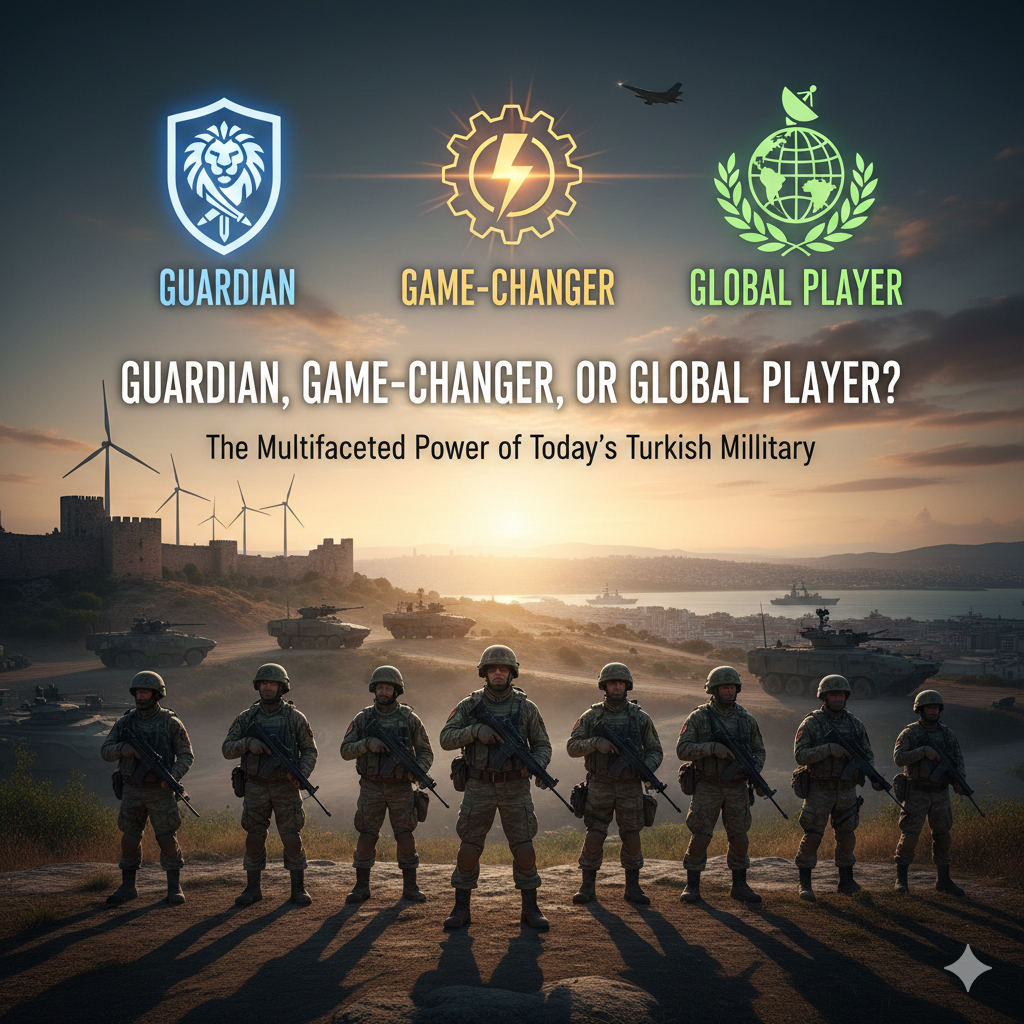
With a legacy stretching from the janissaries of the Ottoman Empire to its pivotal role in NATO’s eastern flank, the Turkish Armed Forces (TSK) stand today as one of the most significant and complex military powers on the world stage. Numbering over 425,000 active personnel, it is the second-largest standing force in the Alliance. Yet, to measure its might by size alone is to miss the profound transformation it has undergone. Today’s Turkish military is a hybrid power, navigating a dual identity as a conventional NATO army and a force increasingly defined by autonomous drone warfare, domestic industrial prowess, and ambitious cross-border operations.
For decades, the TSK’s identity was anchored in its secular, Kemalist foundations and its role as the guardian of the republic, a duty that manifested in several coups throughout the 20th century. Its strategic focus was largely defensive, oriented toward threats from Greece in the Aegean and the now-diminished risk from the Soviet Union. Its equipment was predominantly sourced from Western allies, particularly the United States and Germany. This era defined Turkey as a vital, yet sometimes difficult, NATO partner—hosting critical bases like Incirlik but often at odds with allies over regional policies.
The turning point came in the tumultuous 2010s. The failed coup attempt of July 2016 was a watershed, leading to a vast purge of the officer corps and a deep restructuring that brought the military under tighter civilian, and specifically presidential, control. Concurrently, the security landscape of Turkey’s neighborhood collapsed into chaos with the Syrian civil war, the rise and fall of the ISIS caliphate, and persistent Kurdish militancy. In response, Turkey’s military doctrine pivoted decisively from static defense to proactive, expeditionary intervention.
This new doctrine has been powered by a revolutionary asset: indigenously produced unmanned aerial vehicles (UAVs). The now-famous Bayraktar TB2 drone became the symbol of this new era. These relatively low-cost, high-impact platforms proved devastatingly effective in conflicts from Syria and Libya to Nagorno-Karabakh, where they decimated traditional armor and air defense systems, reshaping modern warfare doctrines globally. Turkey is now not just a drone user but a leading exporter, with the TB2 and the more advanced Akıncı finding customers across continents. This success is the crown jewel of a sprawling domestic defense industry that now meets over 80% of the military’s needs, from Altay tanks and MILGEM corvettes to the aspiring TF-X Kaan national fighter jet—a program symbolizing Turkey’s ambition for full strategic autonomy.
Operationally, the TSK is persistently engaged. It maintains a significant presence in northern Syria through several major operations (Euphrates Shield, Olive Branch, Peace Spring), aiming to create a buffer zone against Kurdish groups it designates as terrorist. In Iraq, it conducts frequent cross-border strikes against PKK bases. In the Eastern Mediterranean, its naval presence asserts claims to hydrocarbon resources, leading to tense standoffs with Greece and Cyprus. Perhaps most consequentially, through controversial yet strategic diplomacy, it has positioned itself as a key power broker in conflicts in Libya, the South Caucasus, and between Russia and Ukraine—even supplying Kyiv with Bayraktars while maintaining a working relationship with Moscow.
This very autonomy defines Turkey’s most critical challenge: its strained relationship with NATO. The purchase of the Russian S-400 air defense system triggered a crisis, resulting in Turkey’s removal from the F-35 program. While it supports NATO enlargement (as with Sweden and Finland) and provides a crucial bulwark on the Black Sea, its actions often create profound unease in Brussels and Washington. The military must therefore balance its deep institutional ties to the Alliance with a foreign policy that increasingly charts an independent, and at times adversarial, course.
Internally, the military’s traditional, apolitical stature has been recalibrated. It remains a respected institution, but its once-untouchable general staff now operates firmly under the presidential executive. Its primary internal security role has shifted from guarding secularism to counter-terrorism, predominantly against the PKK and affiliated groups.
The Turkish military of today is thus a force of stark contrasts: a NATO army employing game-changing drones, a regional intervener with global export ambitions, and a institution reconciling its historic legacy with a transformed domestic and geopolitical role. It is no longer just a guardian of the republic’s borders but an active instrument of its assertive foreign policy. As Turkey navigates a precarious economic landscape and an increasingly multipolar world, the readiness, capability, and deployment of its military will remain the foremost tool in its quest to be recognized not merely as a regional power, but as a sovereign and indispensable global player. Its evolution from a steadfast sentinel to a proactive and technologically advanced power projector is the definitive story of Turkish defense in the 21st century.