

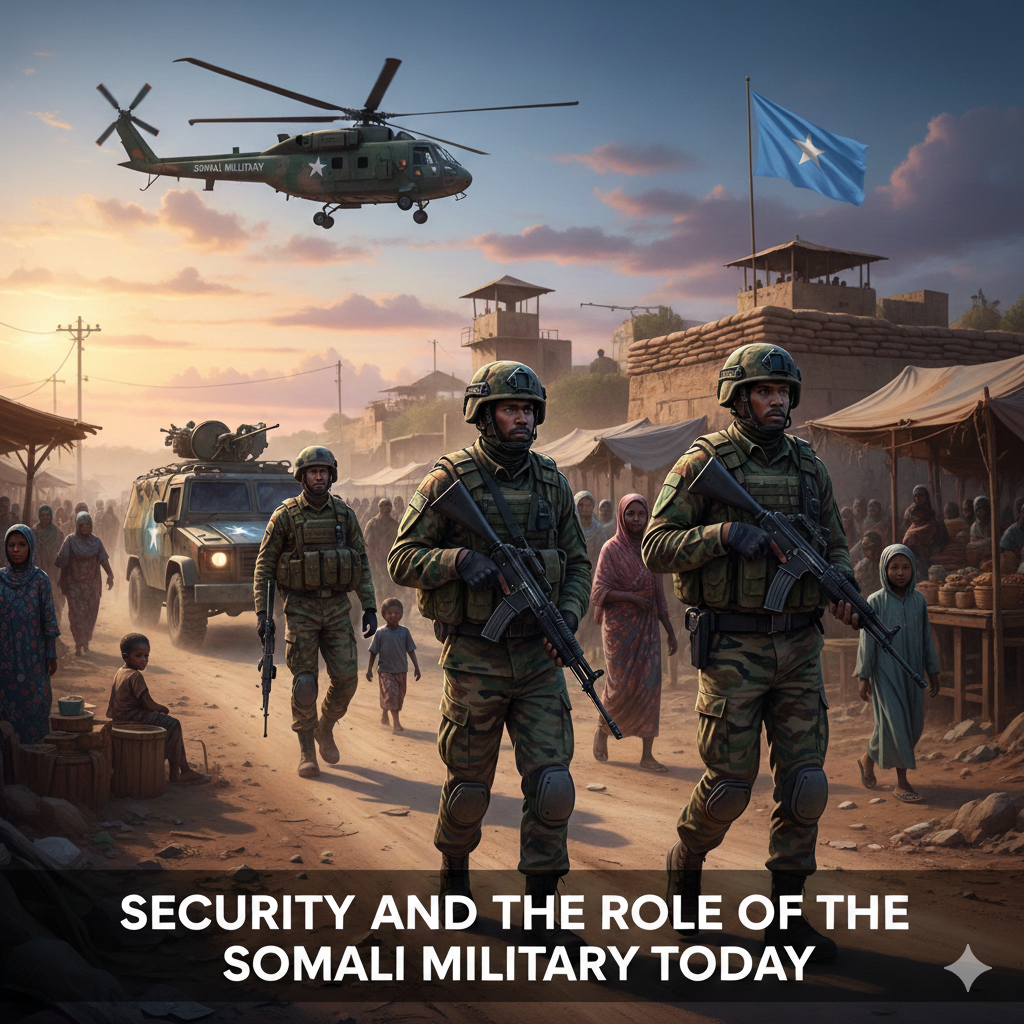
Somalia’s military today stands at a critical point in the country’s long journey toward stability, sovereignty, and peace. Decades of civil conflict weakened state institutions, including the armed forces. In recent years, however, renewed efforts by the Somali government, supported by regional and international partners, have focused on rebuilding a national military capable of securing the country and protecting its people. While progress has been made, Somalia’s military continues to face complex challenges related to security threats, resources, training, and political coordination.
Historical Background
Somalia once had one of the strongest militaries in the Horn of Africa, particularly during the 1960s and 1970s. That strength collapsed after the fall of the central government in 1991, leading to fragmentation, the rise of militias, and prolonged instability. For many years, Somalia lacked a unified national army, relying instead on clan-based forces and international peacekeepers to provide security.
Structure of the Somali National Army (SNA)
Today, the Somali National Army (SNA) is the main component of Somalia’s military forces. It operates under the Federal Government of Somalia and is organized into regional commands and specialized units. The SNA works alongside federal member state forces and security agencies, including the police and intelligence services. Efforts are ongoing to improve command structures, integrate regional forces, and establish a clear national chain of command.
Role in Counterinsurgency Operations
One of the primary responsibilities of Somalia’s military today is combating the militant group Al-Shabaab. The SNA conducts operations to reclaim territory, protect civilians, and secure major roads and urban centers. These operations are often carried out with support from international partners, including air support, intelligence sharing, and training assistance. Recent offensives have resulted in reclaimed areas, particularly in central and southern Somalia, though security gains remain fragile.
Partnership with International Forces
International support plays a crucial role in Somalia’s military capacity. The African Union Transition Mission in Somalia (ATMIS), along with support from the United Nations and individual partner countries, has assisted Somali forces in training, logistics, and joint operations. A key goal today is the gradual transfer of security responsibility from international forces to Somali-led institutions, known as the “Somali Transition Plan.”
Training and Capacity Building
Training and professionalization are central to rebuilding the Somali military. Somali soldiers receive training both domestically and abroad, focusing on basic soldiering skills, leadership, human rights, and civilian protection. Training programs aim to create a disciplined, accountable force that operates according to national and international standards. However, challenges such as inconsistent funding, limited equipment, and uneven quality of training persist.
Equipment, Logistics, and Funding
The effectiveness of Somalia’s military is affected by limited resources. Shortages of equipment, vehicles, communication tools, and reliable logistics constrain operational capacity. Soldiers’ salaries and welfare have improved in recent years, but delays in payment can affect morale. Sustainable financing of the military remains a major issue, as Somalia continues to depend on international assistance for security spending.
Federalism and Security Coordination
Somalia’s federal system adds complexity to military organization. Federal member states maintain their own security forces, and coordination with the national army is sometimes challenging. Integrating regional forces into a unified national military remains an ongoing process. Effective cooperation between federal and regional authorities is essential for long-term security and state-building.
Civil-Military Relations and Human Rights
Strengthening civil-military relations is an important focus for Somalia today. Efforts are being made to ensure that the military respects human rights, protects civilians, and operates under civilian oversight. International partners emphasize accountability, rule of law, and proper conduct during operations. Building public trust in the military is essential for national unity and stability.
Women in the Somali Military
Women are increasingly involved in Somalia’s security sector, including the military. Although they remain underrepresented, women serve in various roles such as administration, medical services, and peacebuilding initiatives. Expanding women’s participation is seen as important for inclusivity, professionalism, and broader security sector reform.
Challenges Facing the Military
Somalia’s military faces numerous challenges, including ongoing security threats, political tensions, limited resources, corruption risks, and dependence on external support. Climate-related disasters and humanitarian crises also stretch military and security capacities. Overcoming these challenges requires sustained political commitment, institutional reform, and national reconciliation.
Future Outlook and Conclusion
Somalia’s military today reflects both progress and persistent difficulties. Rebuilding a capable and self-sustaining national army is essential for peace, development, and sovereignty. Continued reforms, improved coordination, and gradual assumption of security responsibilities from international partners will shape the future of Somalia’s armed forces. While the road ahead is long, strengthening the military remains a central pillar in Somalia’s effort to achieve lasting stability and security.
