

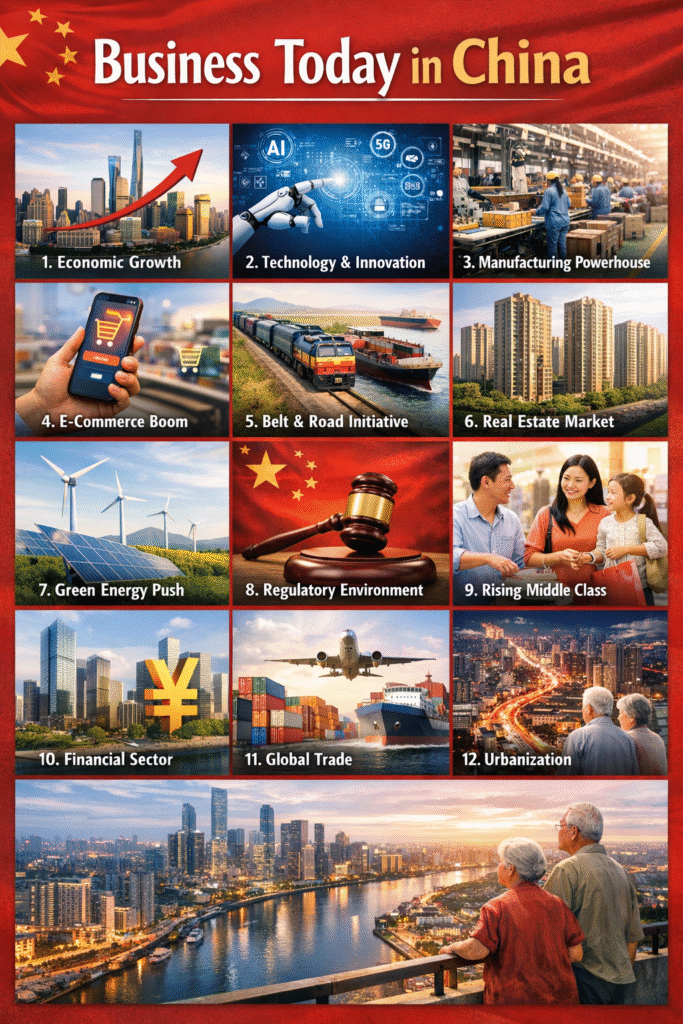
1. Introduction: A Dynamic Economic Landscape
China remains one of the most influential economies in the world. With a vast domestic market, strong manufacturing base, and growing technological capabilities, business activity in China continues to shape global trade, investment, and innovation.
2. Macroeconomic Overview
China’s economy is transitioning from high-speed growth to high-quality development. Government policy emphasizes stability, domestic consumption, and sustainable growth while managing challenges such as debt, demographic shifts, and global economic uncertainty.
3. Government Policy and Regulation
The Chinese government plays a central role in business through industrial policy, regulation, and long-term planning. Policies such as five-year plans, support for strategic industries, and regulatory reforms strongly influence corporate strategy and investment decisions.
4. Manufacturing and Industrial Strength
China remains the world’s largest manufacturing hub. From electronics and machinery to textiles and automobiles, Chinese factories combine scale, efficiency, and improving quality, while increasingly adopting automation and smart manufacturing technologies.
5. Technology and Innovation
Technology is a key driver of business today in China. Sectors such as artificial intelligence, semiconductors, e-commerce, fintech, and biotechnology receive strong investment. Innovation is supported by large talent pools, research institutions, and digital infrastructure.
6. Digital Economy and E-commerce
China’s digital economy is among the most advanced globally. E-commerce platforms, mobile payments, livestream shopping, and digital services are deeply embedded in everyday life, creating new business models and opportunities for both domestic and foreign firms.
7. Small and Medium-Sized Enterprises (SMEs)
SMEs are vital to employment and innovation in China. While they face challenges such as financing constraints and regulatory pressure, digital platforms, local government support, and supply chain integration help many SMEs remain competitive.
8. Foreign Investment and Global Business
China continues to attract foreign investment, especially in high-tech manufacturing, green energy, and services. At the same time, regulatory complexity and geopolitical tensions require foreign companies to carefully manage risk and compliance.
9. State-Owned Enterprises (SOEs)
State-owned enterprises remain important players in key sectors such as energy, telecommunications, transportation, and finance. Reforms aim to improve efficiency, corporate governance, and competitiveness while maintaining state control in strategic industries.
10. Green Economy and Sustainability
Sustainability is increasingly central to business in China. Investments in renewable energy, electric vehicles, and environmental technology are growing rapidly as China pursues carbon reduction goals and greener industrial practices.
11. Labor Market and Talent Development
China’s labor market is evolving with rising wages, an aging population, and demand for high-skilled talent. Companies invest more in training, automation, and talent retention to remain productive and innovative.
12. Challenges and Risks
Businesses in China face challenges including regulatory changes, market competition, supply chain disruptions, and global trade tensions. Managing compliance, costs, and strategic flexibility is essential for long-term success.
13. Future Outlook
The future of business in China will be shaped by innovation, domestic consumption, sustainability, and deeper integration of digital technologies. While challenges remain, China is likely to continue as a major engine of global economic activity.
