

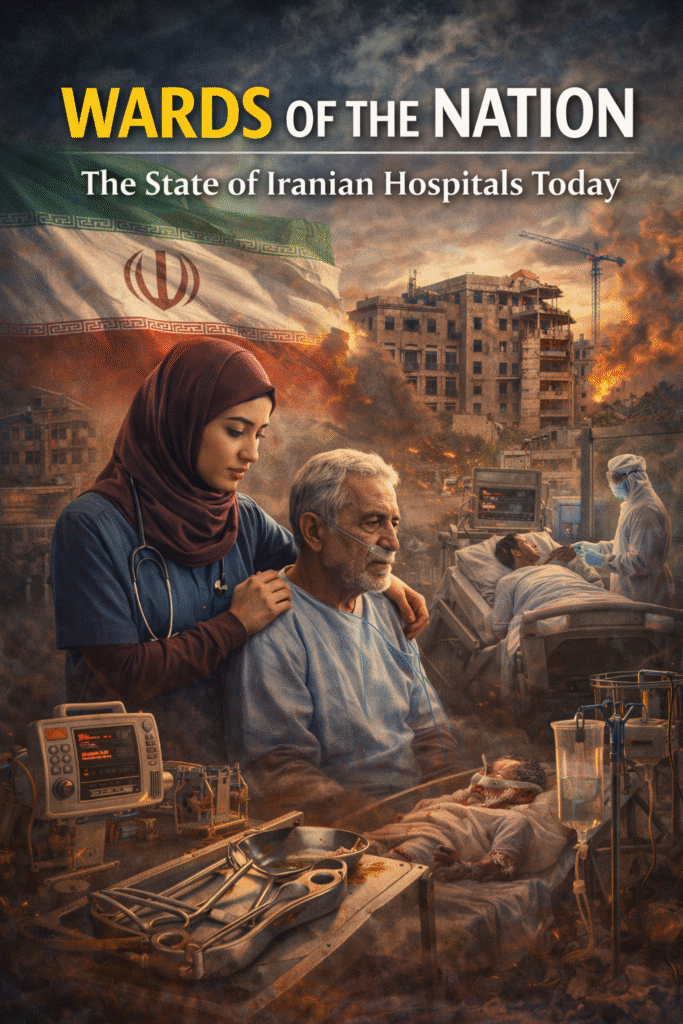
As February 2026 draws to a close, the hospitals of Iran stand at a unique and precarious intersection. They are simultaneously showcases of advanced medical innovation, critical nodes in a national crisis-preparedness network, and institutions still recovering from the trauma of serving on the frontlines of recent civil unrest. The Islamic Republic’s healthcare system is a study in contrasts: world-class specialized care exists alongside overwhelmed emergency rooms, and ambitious public health expansions proceed under the shadow of potential military confrontation.
This is the state of Iranian hospitals today: a system stretched thin, preparing for the worst, yet continuing to push the boundaries of medical science.
A System on Standby: Preparing for the Unthinkable
The most immediate reality facing Iranian hospitals in late February 2026 is the specter of war. As diplomatic tensions between Tehran and Washington reach their highest point in decades, with American carrier groups positioned in the Arabian Sea and a reported 10-to-15-day deadline for nuclear negotiations hanging in the air, Iran’s medical leadership has moved to a wartime footing .
On February 22, the Iranian Medical Organization held a press conference to announce that the country’s healthcare system is fully prepared for any contingency. Dr. Mohammad Raiszadeh, head of the organization, emphasized that no extraordinary measures are required because the system’s human resources are perpetually on standby. Rapid reaction teams and rescue units have been organized and can be deployed immediately to any region requiring reinforcement .
The briefing revealed the scale of the system’s recent experience. During the January unrest—the wave of protests that swept the country following economic grievances—between 2,000 and 7,000 people sought medical care daily over a two-week period. Approximately 1,300 individuals required surgical intervention. In response, an estimated 6,000 physicians and more than 60,000 nurses and rescue personnel were mobilized .
This experience has informed current preparations. Raiszadeh specifically addressed concerns about potential attacks on medical facilities, warning that online narratives portraying hospitals as gathering places for high-ranking military and political officials could be a pretext for targeting healthcare infrastructure. He called on the international community to prevent such attacks before they occur, emphasizing that any strike on medical facilities would cripple the nation’s救治 capacity .
The message from Iran’s medical establishment is clear: the system will operate in a state of perpetual readiness, ensuring that regardless of the emergency, hospitals can continue to admit patients, perform surgeries, and coordinate evacuations .
Innovation in the Wards: The Cold Plasma Revolution
Amid the preparations for potential conflict, Iranian hospitals are simultaneously rolling out some of the most advanced medical technologies in the region. Leading this charge is the Atomic Energy Organization of Iran (AEOI), which has made medical applications a priority.
In recent weeks, the AEOI has overseen the inauguration of multiple cold plasma-based wound treatment clinics across the country. On February 16, the 16th such clinic opened at Hazrat-e Qaem Hospital in Firuzabad, Fars Province, in the presence of AEOI chief Mohammad Eslami . Days earlier, clinics had become operational in Bushehr and Bandar Ganaveh .
Cold plasma technology represents a significant advance in wound care, particularly for chronic conditions. The devices used in these clinics feature the latest global technologies and are being deployed to treat diabetic foot ulcers—a debilitating and common complication of diabetes that affects millions of Iranians. Early results have been described as “effective and promising” .
AEOI chief Eslami outlined a two-pronged strategy for the technology. First, cancer treatment applications are currently undergoing clinical trials and, pending successful results, will be expanded nationwide in collaboration with the Ministry of Health. Second, chronic wound treatment is being rolled out aggressively, with authorities aiming to transform these clinics into regional specialized hubs serving broader populations .
The nuclear agency’s involvement in medicine extends beyond plasma technology. Eslami noted that approximately 1.5 million Iranians currently benefit from radiopharmaceutical services—a field he described as “among novel treatment methods in the world” where advanced countries have made extensive investments .
Earlier in January, Eslami had announced the launch of nine specialized plasma-based wound treatment clinics, including five in Tehran and one in Sabzevar . The rapid expansion reflects a deliberate policy: “Given the positive outcomes, we will expand the use of this technology in healthcare to ensure that all patients can benefit from cold plasma therapy,” Eslami stated .
Primary Care Transformation: The Family Physician Program
Beyond the high-technology headlines, a quieter but equally significant transformation is underway in Iranian healthcare. The Family Physician Program—a flagship initiative launched in 2005 to improve health sector efficiency—is set for major expansion .
Deputy Health Minister Sajjad Razavi announced in late January that 59 additional cities will join the program in the next Iranian year, beginning March 21, 2026. This expansion will bring services to approximately 10 million people .
The program’s philosophy is rooted in comprehensive, continuous care. Unlike episodic treatment, family physicians provide periodic examinations, round-the-clock access to basic services, and frequent visits to monitor patients’ health status. Services encompass medical care, dentistry, mental health, midwifery, nutrition, laboratory testing, pharmaceuticals, and medical imaging .
In rural areas, the program operates on specific staffing ratios: one physician per 3,300 villagers, and one midwife per 5,200 people. This structured approach ensures that even remote populations have access to primary care .
Health Minister Mohammad-Reza Zafarqandi has characterized the program as a large-scale initiative based on social behavior change, requiring careful coordination between the ministry, provincial governors, and other institutions. He has advocated for a national headquarters chaired by the president to oversee implementation .
President Masoud Pezeshkian, in January 2025 remarks, called Iran’s health system “a role model in the region and even the world,” citing substantial progress in vaccination coverage, prenatal care, infectious disease control, and health education. He specifically praised the family physician program for making “comprehensive and continuous healthcare accessible to millions” .
Universal Coverage: Women in Medicine
A remarkable dimension of Iran’s healthcare system is the role of women within it. According to data released by the Iranian Embassy in Prague, health insurance now covers 100 percent of urban dwellers and 99 percent of rural residents—near-universal coverage by any standard .
Equally striking is the composition of the physician workforce. Women constitute 30 percent of all subspecialty physicians and 40 percent of all specialist physicians in Iran . These figures reflect both the educational achievements of Iranian women and the healthcare system’s capacity to attract and retain female talent at the highest levels of medical practice.
Medical Tourism: A Growing Sector
Iran’s advanced medical capabilities have also given rise to a thriving health tourism industry. The Ministry of Foreign Affairs maintains a publicly available list of licensed hospitals authorized to admit international patients, promoting Iranian healthcare as a destination for patients from neighboring countries and beyond .
The official description highlights that Iranian hospitals are “equipped with paramount technologies in providing diagnostic and treatment services, including outpatient and inpatient services, apace with other advanced countries.” The range of services available is comprehensive: facial and body aesthetics, cosmetic and therapeutic dentistry, infertility treatment, weight loss surgery, orthopedics, cardiology, ophthalmology, cancer diagnosis and treatment, tissue and organ transplantation, and neurosurgery .
For international patients, the government offers a complete support package: visa processing within the shortest possible time, airport transfers, accommodation coordination, 24-hour interpreter support, and follow-up care even after the patient returns home . This infrastructure positions healthcare as both a humanitarian service and an economic sector.
The January Crisis: Hospitals Under Siege
The technological achievements and policy expansions, however, cannot erase the trauma of recent months. In January 2026, as anti-government protests swept across more than 100 cities, Iranian hospitals found themselves on the frontlines of a different kind of conflict .
Medical staff described scenes of overwhelming strain. A doctor at Farabi Hospital, Tehran’s main eye specialist center, told the BBC that the facility had gone into crisis mode, with emergency services overwhelmed, non-urgent admissions suspended, and all staff called in to deal with emergency cases . In Shiraz, a medic reported that large numbers of injured people were being brought in and the hospital lacked sufficient surgeons to cope .
The injuries were severe. Medical workers reported a high incidence of gunshot wounds to the head and eyes, suggesting the use of live fire by security forces . One Tehran hospital staff member described a night when there was “no time for resuscitation,” with dozens of wounded and dead arriving simultaneously. “The hospital stopped functioning and turned into a death scene,” she said .
In Rasht, a hospital’s morgue reportedly reached capacity, forcing staff to move bodies outside. Families seeking to retrieve their dead were allegedly told to pay billions of Iranian rials .
The international community took notice. WHO Director-General Tedros Adhanom Ghebreyesus expressed deep concern over “multiple reports of health personnel and medical facilities in Iran being impacted by the recent insecurity.” He specifically cited reports of “health workers assaulted, and at least five doctors detained, while treating injured patients” and called for their release .
Iranian authorities have disputed these characterizations. The Medical Organization’s Raiszadeh, in his February 22 briefing, specifically denied claims that医护人员 were arrested for treating protesters, asserting that such reports are false .
Nuclear Medicine: Preparing for the Worst
In a development that speaks to both Iran’s technological ambitions and its security concerns, the AEOI has announced plans to establish a specialized hospital for treating victims of potential nuclear incidents .
The facility, announced in late January, will be equipped with radiotherapy capabilities and centrifuges—the latter presumably for producing medical isotopes rather than enrichment. AEOI chief Ali Akbar Salehi acknowledged that equipping such a hospital would be extremely costly, with Bank Pasargad likely to provide 50 percent financing .
While the announcement was framed in terms of nuclear emergency preparedness, it also underscores Iran’s confidence in its nuclear and medical technologies. As former nuclear negotiator Saeed Jalili noted, despite international pressures and sanctions, Iran now stands “among the 10 most advanced countries in the nuclear technology” .
The Strain Beneath the Surface
For all the official pronouncements of readiness and progress, the healthcare system bears deep scars. The January protests exposed vulnerabilities that cannot be quickly repaired: hospitals overwhelmed by mass casualty events, medical staff caught between their Hippocratic oath and security forces, and morgues unable to accommodate the dead .
Economic pressures compound these challenges. Inflation, currency devaluation, and international sanctions have made importing medical equipment and pharmaceuticals difficult. While domestic production has expanded—including in areas like radiopharmaceuticals and plasma technology—the system operates under constant resource constraints.
The human cost is borne by patients and providers alike. Elective procedures were canceled during the January crisis; routine care was disrupted; medical staff worked under impossible conditions . The resilience of Iranian healthcare is undeniable, but so is the toll that repeated crises exact.
Looking Ahead
As the calendar turns toward March 2026, Iranian hospitals face an uncertain future. The nuclear negotiations with the United States could lead to sanctions relief and economic recovery—or to military confrontation and a new wave of casualties. The family physician program could bring comprehensive primary care to millions—or struggle under funding constraints. The cold plasma clinics could expand into regional hubs—or remain limited by international isolation.
What is certain is that Iranian healthcare operates at multiple levels simultaneously. It is a system of advanced technology and primary care, of wartime readiness and peaceable healing, of international aspiration and domestic struggle. The hospitals of Iran today are not merely medical facilities; they are mirrors reflecting the nation’s complexities, contradictions, and resilience.
For the physicians working through the night, the nurses treating wounds both physical and psychological, and the patients seeking care amid uncertainty, the coming weeks will determine which version of Iran’s healthcare future prevails. The system is ready, they say. The question is what it must be ready for.
