

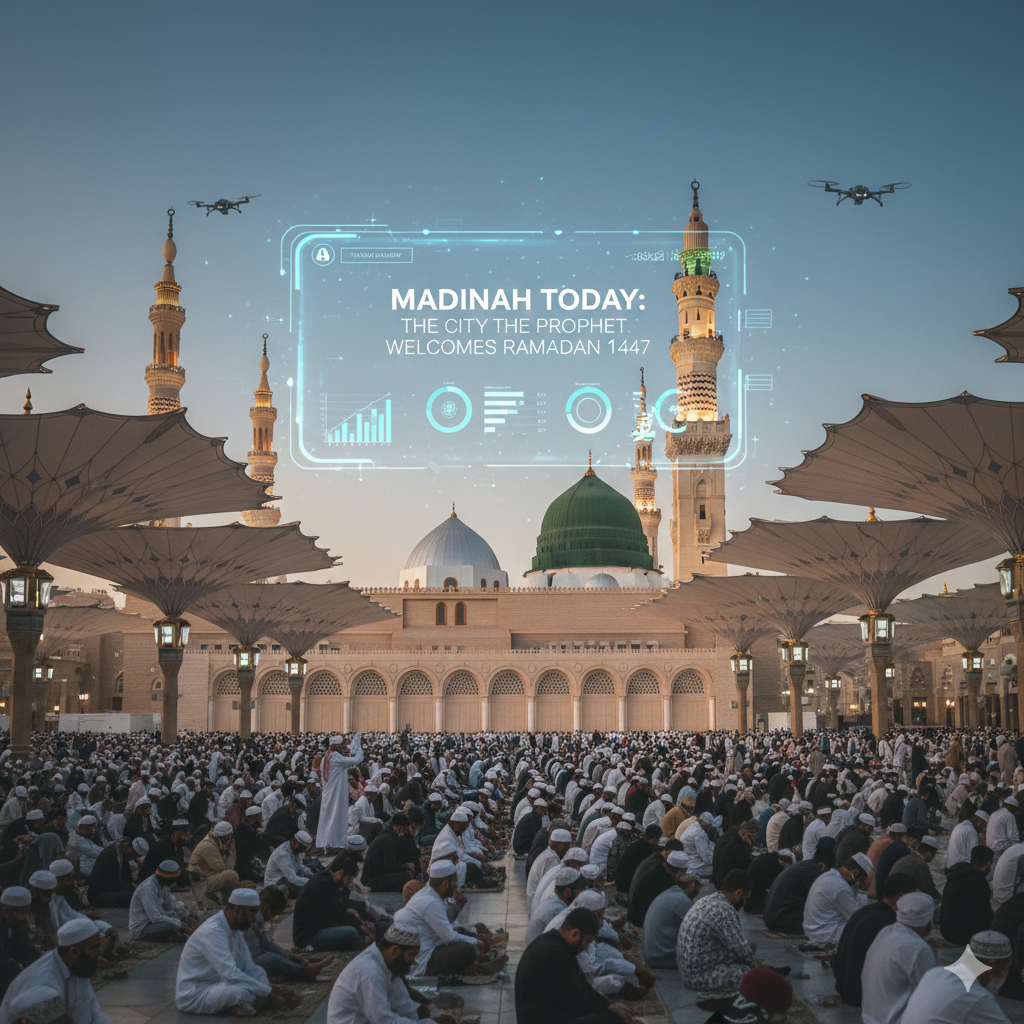
Madinah Today: The City of the Prophet Welcomes Ramadan 1447
As the first fast of Ramadan 1447 draws to a close on Wednesday evening, the Prophet’s Mosque in Madinah stands at the heart of a city transformed. While its sister city Makkah witnesses the largest congregational prayers on earth, Madinah offers something distinct—a quieter, deeply personal spirituality rooted in the presence of the Prophet Muhammad (peace be upon him). Here, in the City of Light, millions of visitors have arrived not only to pray but to connect with the very origins of Islam.
This is Madinah today on the second day of Ramadan 1447 (2026): a city where meticulous planning meets profound devotion, where modern technology facilitates ancient rituals, and where every street, bus route, and service point has been optimized for the guests of God.
The Spiritual Epicenter: The Prophet’s Mosque
At the heart of Madinah’s Ramadan transformation is the Prophet’s Mosque itself. The General Authority for the Care of the Affairs of the Grand Mosque and the Prophet’s Mosque has implemented comprehensive operational plans to accommodate the millions expected throughout the month .
For those fortunate enough to pray here during Ramadan, the experience is defined by the voices that lead them. The schedule of imams for Taraweeh and Tahajjud prayers at the Prophet’s Mosque has been officially announced, featuring some of the most revered reciters in the Islamic world. Worshippers will be led by Sheikh Salah Al-Budair, Sheikh Abdullah Al-Qarafi, Sheikh Khalid Al-Hana, Sheikh Muhammad Barhaji, Sheikh Abdul Mohsen Al-Qasim, and several other distinguished sheikhs . Their voices, carried through the mosque’s advanced sound system, create an atmosphere of profound spirituality that envelops the vast courtyards and expansion areas.
The General Presidency’s operational plan for Ramadan rests on seven strategic goals: enhancing and enriching the visitor experience; teaching the Holy Qur’an and the Prophet’s Sunnah; consolidating the Kingdom’s religious leadership in serving the Two Holy Mosques; advancing translation and linguistic services; developing human competencies; harnessing modern technologies; and enhancing communications with Muslims worldwide . In Madinah, these goals translate into tangible services that touch every visitor.
Accessing the Sacred: Al-Rawdah Al-Sharifah Schedule
For millions of Muslims, the pinnacle of a visit to Madinah is praying in Al-Rawdah Al-Sharifah—the sacred area between the home of the Prophet (now his noble chamber) and his pulpit. This space, described in prophetic tradition as “a garden from the gardens of Paradise,” measures approximately 330 square meters but holds spiritual significance that transcends its physical dimensions .
The General Authority has announced the Ramadan visiting schedule for Al-Rawdah Al-Sharifah, with different timings for the first 20 days and the final 10 days of the month .
For the first 20 days of Ramadan:
- Men may visit from 11:20 a.m. to 8:00 p.m. and from 2:00 a.m. to 5:00 a.m.
- Women’s visiting hours are from 11:00 p.m. to 1:40 a.m. and from 6:00 a.m. to 11:00 a.m.
During the final 10 days—when worship intensifies in seeking Laylat al-Qadr (the Night of Power)—the schedule adjusts:
- Men have three periods: 11:20 a.m. to 8:00 p.m., 11:00 p.m. to 12:00 a.m., and 2:00 a.m. to 5:00 a.m.
- Women retain a morning slot from 6:00 a.m. to 11:00 a.m.
Crucially, authorities emphasize that all visits must be booked in advance through the Nusuk app, ensuring a smooth, organized, and tranquil experience for worshippers . This digital reservation system, now well-established, prevents the overwhelming crowding that once characterized peak periods.
Supporting the Worshippers: Services and Accessibility
The scale of service provision at the Prophet’s Mosque during Ramadan is staggering. During a recent field inspection, Minister of Hajj and Umrah Dr. Tawfiq Al-Rabiah reviewed on-ground preparations, crowd management plans, and coordination mechanisms among all entities within the “Guest of God service ecosystem” .
Key service highlights include:
- More than 10,000 manual wheelchairs and over 400 electric carts for the elderly and people with disabilities
- 12 carts designated for assisting pilgrims with exiting the state of Ihram
- 31 guest care centers offering 13 services, including assistance for lost persons, support for the elderly, people with disabilities and children, spatial guidance, and identification bracelets
- 30 mobile guidance points providing services in 20 key languages
- Four free luggage storage centers operating around the clock
- Three child hospitality centers to care for young visitors while parents pray
- An interactive digital map to facilitate movement and a “Worshipper’s Guide” available in seven international languages
Field guidance has been reinforced through walking teams and multilingual color-coded wayfinding systems. Reception and guidance services at all entry points are provided by 595 staff members, supported by more than 500 volunteers through the Nusuk Care centers .
The Minister noted that these preparations reflect the Kingdom’s continued commitment to caring for the Two Holy Mosques and their visitors, in line with the objectives of the Pilgrim Experience Program .
Moving the Masses: The Madinah Bus Project
Getting to the Prophet’s Mosque is half the challenge during Ramadan, and the Madinah Region Development Authority (MRDA) has risen to meet it. The Madinah Bus project has activated its shuttle service specifically for the holy month, operating from three main stations to serve nearby neighborhoods and facilitate the movement of residents and visitors .
The service operates from:
- Sports City station, serving Ad Difa, Taybah, Urwah, Al-Nakhil, Al-Aziziyah, Abu Buraikah, Dhu Al Hulayah, Al-Wabra, Al-Jamiah, Al-Duaithah, Al-Salam, Al-Jamawat, and Jama Um Khaled
- Shatha station, covering Shatha, Al-Nuzhah, Al-Dar, Al-Matar, King Fahd, Al-Shafiyah, Al-Aridh, Al-Mabuth, Al Duwaykhilah, Jashm, and Wairah
- Al-Hadiqa station, serving Al-Ahn, Al-Khatim, Al-Usbah, Al-Qaswa, Al-Jabirah, Shuran, Al-Rawabi, Wadi Mahzur, Wadi Mudhainib, Al-Hadiqah, Al Ranuna, and Al-Sadd
This strategic initiative aims to ease the movement of worshippers and visitors to and from the Prophet’s Mosque and Quba Mosque, reduce congestion around the holy sites during peak times, and provide organized transport that ensures comfort and safety for all .
Health and Safety: Protecting the Millions
With millions of visitors comes the critical task of maintaining public health. The Ministry of Municipalities and Housing, represented by the Madinah Regional Municipality, has intensified its field and operational preparations to raise service readiness and ensure continuity of services .
The scale of the effort is remarkable:
- More than 13,000 inspection tours targeting health-related activities
- Nearly 4,000 inspection tours covering commercial activities
- 8,000 food and water samples being collected to verify compliance with approved health standards
- More than 5,700 personnel participating in the operational plan
- Over 1,230 pieces of equipment and machinery deployed
- 12 alternative emergency plans to ensure rapid response
The ministry is focusing on intensifying health and commercial inspection tours, raising compliance levels with regulatory requirements, and boosting oversight of activities related to public health and food safety to ensure a safe and healthy environment for all .
The City’s Embrace: Aesthetic Transformations
Beyond the mosque and its immediate services, the entire city of Madinah has transformed to welcome Ramadan. Markets and streets have undergone comprehensive organizational and aesthetic improvements, creating a shopping environment that reflects the spirituality of the holy month .
Preparations include enhanced readiness in markets and roadways, improved lighting, and the beautification of the urban landscape with lanterns and welcoming phrases. These additions create a distinctive atmosphere for shoppers and visitors alike .
Markets are experiencing increased activity and demand for Ramadan essentials, supported by ongoing regulatory monitoring to ensure service quality. This economic vibrancy aligns with the city’s religious and touristic significance during the season .
Leadership Commitment: Oversight at the Highest Level
The seamless experience for visitors is no accident. In the days leading up to Ramadan, Madinah’s leadership conducted intensive field inspections to verify readiness.
Madinah Governor Prince Salman bin Sultan bin Abdulaziz emphasized the importance of strengthening security management and coordination among government and service agencies to ensure the safety and comfort of residents and visitors to the Prophet’s Mosque. He directed that all resources be mobilized to serve the pilgrims .
This commitment from the highest levels of leadership cascades through every level of service provision, ensuring that the Guest of God service ecosystem functions as an integrated whole.
A Personal Reflection: The Spirituality of Madinah in Ramadan
For the millions who have traveled to Madinah this Ramadan, the experience is profoundly personal. Unlike the frenetic energy of Makkah’s circumambulation, Madinah offers space for quiet reflection. The green dome of the Prophet’s Mosque, the rawdah where prayers are answered, the cemetery of Al-Baqi where so many companions rest—these places invite contemplation.
The extended prayers of Taraweeh, recited by voices that have memorized the entire Qur’an, create a nightly spiritual journey through revelation. In the final ten days, when the mosque remains alive throughout the night, the search for Laylat al-Qadr intensifies. And throughout, the knowledge that one is praying in the city that welcomed the Prophet and his companions adds layers of meaning to every prostration.
Conclusion
Madinah today, on the second day of Ramadan 1447, is a city operating at the intersection of profound faith and extraordinary organization. From the imams leading Taraweeh to the bus drivers shuttling worshippers, from the health inspectors monitoring food safety to the volunteers guiding lost visitors—all are part of a single purpose: to serve the guests of God.
The Prophet’s Mosque stands at the center, its lights illuminating the night, its courtyards filled with worshippers from every corner of the earth. Around it, a modern city hums with activity, its systems optimized for the millions who have come to pray.
For those fortunate enough to be here, the experience is transformative. For those who cannot come this year, the knowledge that prayers are rising from the City of the Prophet offers its own comfort. In Madinah, as the second fast draws to a close, the spirit of Ramadan fills every street, every mosque, and every heart.
